The Importance of Content Continuity

October 8, 2012

If good content marketing equates to telling a good story, then content continuity is getting that story to become memorable. Let me explain.

When you create a piece of content, why stop at the first distribution channel? Sure you can re-purpose the content so that it will be used at another channel but content continuity means more than simply taking the content and fitting it in another medium. It involves using that content and expanding it, working different angles, but keeping the core message intact. It’s not that difficult, but it requires some planning.

A good example might be that presentation one of your executives delivered at the trade show. The PowerPoint slides can be uploaded to SlideShare where people who didn’t attend the session can now access it (this is re-purposing the content). But if you take the presentation, and add a few more slides to it in order to emphasize a key message, or if you take that message and link it to a video or an eBook that reinforces the story, then you are creating continuity.

Why is this distinction important? First, because if you simply take the exact same message and just change the publishing format (from PowerPoint to video, for example) it may attract different readers but it doesn’t help promote or further expand the message, it’s just a rehash of what has already been said in another format. Second, if you simply repurpose content you already created then you may lose the opportunity to create important links between the multiple stories your products or services support.

So instead of creating pieces of content that stand alone, create a “content network” (for lack of a better term) in which each node reinforces another, where a story you started telling is continued and extended with the next piece of content.

Next time you create some content (eBook, whitepaper, blog article, video, etc.), don’t just publish and forget; think of it as part of a broader theme or story. Good stories don’t have to end and neither does your content (think of it as “Your Content – Part II”, like in Hollywood).


How to Maintain Great Content Curation

June 19, 2012

A guest post by Lior Levin.

Content CurationOn the surface, content curation sounds like a great way to generate content with little to no time or effort. After all, you don’t actually have to write much new content, just find interesting items on the Web and point others to them, becoming a hub for all that’s relevant to your field.

However, doing content curation well means a lot more than just plastering your site with a bunch of synopses and links. Doing content curation right takes a lot of time and requires almost as much investment as creating original content.

Doing content curation poorly, though easy and quick, is often seen as spam and is likely to raise copyright and plagiarism issues for you. On the other hand, proper content curation can be a powerful tool for both building your site and driving traffic to it. In fact, in the best possible cases, it can make you an indispensable part of your niche’s ecosystem.

So how do you curate content in a way that both attracts visitors and makes you a hero to your peers? Here are a few tips to help you get started.

1. Participate in Your Community

If you want respect from your community, you need to do more than simply share their links. You need to create at least some original content and, equally importantly, connect with and interact with those around you.

Instead of just linking to a post, take the time to comment on it as well. Interact with other webmasters on social media and encourage them to send you interesting links. The more you contribute and interact with the community, the more they will respect and embrace you. That embracing not only makes the environment less hostile, but it also opens up new opportunities for cooperation that can make your offerings truly unique.

2. Be Careful How You Aggregate

Be careful about what you use and how you use it. Remember that the works you’re referencing are copyrighted and other webmasters, if they feel they are being infringed, may come after you.

Use only what you need, short snippets of text (usually under 50 words), headlines and links should be more than enough. If you find yourself writing a 400-word summary of a 500-word article, you likely need to rethink your approach.

Also, always attribute everything you use. Not only is it the right thing to do ethically, but it keeps you from making enemies needlessly.

3. Don’t Automate

When you have a site or service that seems perfectly relevant to your topic, it might be tempting to grab everything that it posts by RSS or another automated tool.

Don’t do it.

The benefit a curator brings to a niche is human involvement. If you’re not selecting the best posts to share, you miss out on adding value to your readers or community. Anyone can subscribe to a site via RSS, and no site is going to be 100% relevant.

In short, automatically shooting out everything that a site or a group of sites puts out is not only very spammy, but it is of no benefit to the reader or the community.

4. Be Where the Audience Is

While this is great advice for any site, it is even more true for curated content as curation is about convenience. You don’t want to make your readers work for your content so it’s important to be where they are.

Have an audience that spends a lot of time on Reddit? Be on Reddit. Are they active on Facebook? Be on Facebook.

Don’t be afraid of multiple platforms as the time needed to add a Tumblr or a Twitter is fairly minor. On the other hand, don’t be afraid to ditch services that aren’t working out for you.

5. Create Expectations and Meet Them

Very quickly, answer these questions for your readers:

  1. What are you going to post?
  2. How much are you going to post?
  3. And When are you going to post it?

Readers need this information so they know what to expect from your curation and know if they want to subscribe. Create a plan and stick to it.

Whether you want to curate ten links weekly about whales or five articles a day about modern medicine, tell your readers what to expect and deliver reliably.

In the end, great curation is a lot of work, but it’s that work that adds value to the reader and the community. Bad curation is, at best, mere spam and at worst copyright infringing.

As a curator, you can’t afford to be a parasite as you need a healthy, welcoming community for your efforts to thrive.

So don’t look for shortcuts with your curation efforts and, instead, focus on providing the best value you can, especially over the long haul. Your community, your readers and even the people you link to will all thank you and reward you for it.

This guest post is written by Lior Levin, a marketing consultant for a neon sign store that offers a variety of custom neon signs for businesses and individuals, and who also consults for a company that specializes in a to do list app.


What My Paper Route Taught Me about Content Marketing

May 3, 2012

Note: This is a guest post by Brad Shorr. See his bio at the end.

My career in content marketing started at age 12. Every day I’d load up my red Schwinn Varsity bicycle with The Aurora Beacon News and head out to make deliveries, learning valuable lessons about digital content marketing that just starting to sink in lately. Here are a few of these lessons, which I’m sure you will pick up a lot faster than I did!

Old man using a laptop with his grand son reading a newspaper1.     Content Marketing Is Hard Work

Delivering content may not be as physically demanding as it once was, but today it is a combination of strategic planning, thorough execution, meticulous review and continual improvement. There are no shortcuts, either. Back in the day, if I cut across a neighbor’s yard to get to the next house … I’d get yelled at. Today, if you try to skip steps or gloss over them, you’ll similarly be punished. Shortcuts to avoid include things such as –

  • Trying to pass off lame, rehashed content as something new and relevant
  • Relying on automated feeds to push content rather than building genuine social media connections
  • Putting content marketing processes on autopilot in order to shift attention to shiny new marketing toys

2.     Reader Convenience Is Everything

In the print era, there was nothing more convenient than having the latest news delivered literally to your doorstep. Newspapers thrived in part because of their efficient and ultra-convenient delivery system. The principle still applies in the age of digital content. Making content easy for the reader to obtain and consume makes all the difference:

  • Site loading speed. A big consideration, one that is so important that Google now uses loading speed as a ranking factor. If I showed up at a subscriber’s house an hour late … I’d get yelled at. Today, if readers have to wait five seconds for a page to load, they will click off.
  • On-page usability factors. Facilitating easy content consumption means adhering to best practices for typography, navigation, page layout and design. Tripping up in any one of these areas invites readers to make a hasty exit and leave with a bad taste in their mouths.
  •  Multiple search options.It should be as easy as possible for readers to find relevant content on a business site or blog. Among the techniques to accomplish this:
    • Internal search engines
    • “Most Popular” blog posts listed on the sidebar
    • “Most Commented” blog posts listed on the sidebar
    • “Recent” blog posts listed on the sidebar
    • User-friendly archiving
    • Meaningful blog categories
  • Multiple delivery options.  In the past, there weren’t many ways to deliver news. Today, content marketers must support readers who find content via RSS, email subscriptions, bookmarking sites, social media, and organic search. This necessitates optimizing content for search and social sharing, and engaging with multiple communities on multiple social networks.

3.     Consistent Delivery Matters

My paper route taught me how much we humans are creatures of habit. If I showed up 15 minutes behind schedule … I’d get yelled at. Some people would even freak out if I showed up early. Well, even though content marketing technology has changed enormously, human nature remains the same. This means content marketers must bring a certain degree of consistency to their execution, including –

  • Theming. Is the big-picture, underlying message consistent, or does it change from one day to the next? Inconsistencies dilute brand identity and put obstacles in front of prospects that are trying to figure out what a company does and why they should care.
  • Publishing. Are blog posts and e-newsletters delivered on a consistent, predictable schedule, or haphazardly? Digital marketers can learn a LOT from the newspaper industry on this score: when people know when to expect information, they have a greater appetite for it.
  • Social Sharing. Because people are habitual, they hang out on Facebook, Twitter and other networks at fairly regular times throughout the day. By testing and analyzing re-shares and mentions, content marketers can develop intelligent timetables for both scheduled posting and active engagement.

About the Author

Brad Shorr is Director of Content & Social Media for Straight North, a search engine marketing firm in Chicago. They work with middle market B2Bs in industries as diverse as restaurant merchant processing and bulk gloves. Brad is an experienced content strategist, SEO copywriter and blogger. He still rides a bicycle. 


Ten Tips On How To Promote Your Website Through Content

May 1, 2012

Note: This is a guest post by David Tully. See his bio at the end.

Image by mdurwin2 via Flickr

The emphasis on creating quality content has increased markedly since Google put the hammer down on many old tried and tested SEO tactics. Below I have listed 10 tips on how you can promote your website through content.

1. Offer How to Guides/Whitepapers/Analysis – Good first hand analysis or guides in relation to the niche you are in can really help boost visitor numbers to your website. You are giving valuable, relevant information which they will appreciate.

2. Utilizing personas – Always write content from the perspective of the intended reader. Questions that a reader may have such as “why is this information useful?” and “what benefits are there to me?” should be in your mind when writing content so as to hook the reader in.

3. Understand what works and what doesn’t – Get a form of site analytics set up on your site to assess what type of content works. You may find that a particular type of blog post does a lot better than others.  Optimizing content in this way can help rank better as more of your content is shared and read by web users.

4. Incorporate user feedback – The more interactivity you have with readers the better. If someone asks you a question of Facebook, Twitter or in blog comments, it is a good idea to create some content about it as it is more likely than that others within your niche market have the same question.

5. Regular posting – Many websites fall down on this last point. People will come to your site often for fresh content, if you don’t provide it, your audience will cease visiting. Google will also see the lack of fresh content and rank your far lower.

6. Repurpose content into different forms – If you have had a very popular blog post, there is every possibility that the content will do well if you repurpose it as a video, podcast or infographic. Each form may reach a slightly different audience helping to boost your website.

7. Social media promotion – The most important aspect for promoting your site through content. Google ranks websites depending on indicators from social media. In addition, the more something is shared on Facebook or retweeted on Twitter, the more site visitors you will have. Creating content which is more likely to be shared is therefore crucial.

8. Share your content on PDF sharing websites – PDF sharing websites such as DocStoc and SlideShare always rank highly in Google. If you have a great piece of content and want it spread as widely as possible, create a PDF file and share it on these websites.

9. Content Curation – Curating content is becoming ever more popular in marketing online. Basically, you are sharing quality content and adding your own take on stories or issues within your market. As long as you link back to your original source, this is an excellent way of using content to help improve site numbers.

10. Use of video – Some niches are not very interesting and when marketing your website, getting the message across in an inventive video can really make a difference. It has a greater possibility of going viral and helping your site.


About the Author:

David Tully has written many articles on content marketing and is currently a regular contributor to content marketing strategy website Bright Authority.


Why Seeding Your Content is Key to Making it Viral

April 26, 2012

First Seeds Planted by Pictoscribe - Home again @FlickrIs great to see scientific research being done on social media, viral videos, and marketing in general (see previous post on the New Science of Viral Ads). Problem is, many research papers contradict each other. A recent study published on Marketing Journal titled “Seeding Strategies for Viral Marketing: An Empirical Comparison” (requires registration), by Oliver Hinz, Bernd Skiera, Christian Barrot, & Jan U. Becker, tries to get some of the contradictions resolved when it comes to what makes something “go viral“.

4 Critical Factors for Viral Success

According to the authors, there are four critical factors for viral marketing success:

1: Content, or the attractiveness of a message makes it memorable

2: The structure of the social network 

3: The behavioral characteristics of the recipients and their incentives for sharing the message

4: The seeding strategy, which determines the initial set of targeted consumers chosen by the initiator of the viral marketing campaign

The authors attribute the fourth component, Seeding Strategy, the higher weight. It’s all about who you are sending your video to, they say.

“Seeding the “right” consumers yields up to eight times more referrals than seeding the “wrong” ones” – Hinz, Skiera, Barrot, Becker

So how do you go about “seeding” it right? Here’s where many researchers disagree. There are typically three types of people you can target:

  • Hubs:  well-connected people with a high number of connections to others
  • Fringes: poorly connected people
  • Bridges: those who can connect two otherwise unconnected parts of the network

Network

Hubs tend to be better informed because of their social links and they can also influence their networks (hey, if I got this from Bob it must be good!). However, Hubs may not be optimal channels because if the person that acts as a hub doesn’t like or doesn’t agree with the content, they will not pass it on to their network. As big targets for new content, hubs are constantly bombarded with information and therefore may ignore or not see your new content which will prevent it from being spread.

Adoption of a new idea can then start at the “fringes” and make its way through the network. It has also been argued that fringes are more easily influenced than hubs and therefore may be good targets for spreading content. Bridges, for their ability to connect different areas of a network have also been targets because they can influence a portion of the network otherwise immune to the ‘viral’ content you have created.

The Optimal Seeding Strategy

In their research, the authors encountered four studies that recommend seeding hubs, three recommend fringes, and one recommends bridges. No wonder there is so much confusion when it comes to social media and viral videos! They then conducted experiments to prove those theories to the test to see which one would emerge as the winning seeding strategy.

The result was that “Marketers can achieve the highest number of referrals, across various settings, if they seed the message to hubs or bridges“. They also go on to say that “companies should use social network information about mutual relationships to determine their viral marketing strategy”.

Check out a summary of the study and results published by the authors on SlideShare (link below):

The Social Network

Understanding the social structure of potential networks is an important part when planning your social strategy. It pays off then for companies to mine the data they already have about their customers in order to determine the best people to seed your campaign. If high-connected people are picked to seed the campaign, the probability that it will spread is greatly increased.

Finally, it remains to be seen whether Facebook and other social networks will start playing a very active role in providing companies with detailed network information in order to help with their seeding efforts. Companies already have access to demographics, is just a matter of expanding the data set and, of course, avoiding potential privacy concerns.


A Content Rules Cheat Sheet

March 15, 2012

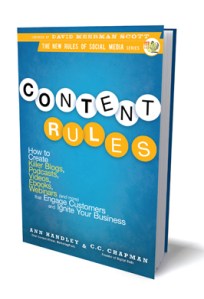
Content Rules Book

Edit: The PDF is now back online, link at the end of the post.

Edit: The authors of the book asked me to make a slight change to the PDF byline. Will be uploading the updated version of the Cheat Sheet shortly.

Edited: In my haste, I neglected to ask permission from the authors to put this cheat sheet together. As per their request I am taking the link down.

I’ve got to admit, I am a big fan of the “Content Rules” book, by Ann Handley and C.C. Chapman. No, is not groundbreaking or earth-shattering content. Actually, a lot of the stuff you probably are already doing and it kinda seems natural once you read it. But boy, is it actionable. It consolidates a lot of what is out there about content marketing and delivers it in an easy to read format with no gobbledigook or too much fanfare. Yes, I think I like it more than a few other books out there because of the straight-forwardness (is this a word?) of the language the authors use.

While a longer book review is in order, I just wanted to share something I’ve created with you. The book is based on 11 content rules:

  1. Embrace being a publisher
  2. Insight inspires originality
  3. Build momentum
  4. Speak human
  5. Reimagine, don’t recycle
  6. Share or solve, don’t shill
  7. Show, don’t just tell
  8. Do something unexpected
  9. Stoke the campfire
  10. Create wings and roots
  11. Play to your strengths

As you might imagine, each rule alone is not much and anyone can do it. Heck you are probably already doing a handful even without knowing. But, like a good superhero story, when put together they unleash the power of great content creation.

For those of us who read the book and keep coming back to it for additional insights, I have created a “Content Rules Cheat Sheet“. Is basically the list of rules put together nicely in a PDF that you can download, print, and peg to your wall/board/monitor/etc. Use it as a reminder and as a checklist. Give to the new intern to make a few copies and spread around the office and present your team members with a copy printed in nice paper. Click below to view and download it.


How to Build a Content Development Plan for Your Site

March 13, 2012

Note: this is another great guest post by Brad Shorr. See his bio at the end.

Have you ever visited a website that looked like a teenager’s bedroom – content strewn about everywhere, overflowing with information yet impossible to find what you’re looking for? This often happens when a firm fails to make a long-term content development plan a component of its new site launch.

The consequences of haphazard content development are quite serious:

  • Interested prospects can’t find what they are looking for, so they click off the site.
  • Prospects who are ready to buy get confused, frustrated, or lost on the site – and fail to convert.
  • All visitors leave with an impression that the firm is as disorganized as its site.

Here are ways to prevent these things from happening.

1. Long-term Focus

Most Web development projects are obsessed with the immediate future: We have to get the site launched on time; we have to get it done within budget.

In terms of content, avoid the very strong temptation to cram everything you want to say into the initial launch. You won’t have enough time, and you won’t have enough money. Instead, identify the content you must have for launch, and then schedule the content you want to have for future phases of the project.

2. Go from General to Specific over Time

The most important content to present on the initial launch of a business site is the overview. Give prospects and customers the big picture: what you do, what problems you solve, what benefits you offer, and why people should buy from you.

If you do nothing more than get those simple points across, you’ll have a manageable number of pages to produce for the launch, and you won’t obscure the message with distracting details. And as a consequence of that, you’ll have a site with content that effectively supports lead generation.

3. Logically Layer On the Details

Develop a more detailed picture of your firm over time by adding new layers of content. For instance, consider a restaurant supply business. A simple, long-term content plan for its products could look something like this:

  1. Launch Phase: One Products Overview page with a brief summary of all product groups.
  2. Second Phase: Build out Product Group pages with more detail on Furniture, Bar Supplies, Kitchen Supplies, etc.
  3. Third Phase: Build out detailed Item pages for the 10 most popular items in each Product Group.
  4. Fourth Phase: Build out detailed Item pages for the next 25 most popular items in each Product Group.

4. Content Categories and Subcategories

The above tip refers to content depth, but let’s take a minute to consider content breadth. For a launch phase, these content categories are generally indispensible:

  • Products
  • Services
  • About
  • Contact

From here, much can be added in future project phases. Here are a few ideas to get you thinking about the possibilities.

  • Category: Testimonials
  • Category: Case Studies
  • Category: Careers
  • Subcategory of Products: FAQs
  • Subcategory of Services: Important Resources
  • Subcategory of About: Charitable Giving

Creating these additional content sections requires a lot of time and creativity. If information is thrown together at the launch phase to meet a tight deadline or budget, entire sections may well come off looking extremely lame. Again, it’s preferable to think long-term and patiently roll out new content based on a plan.

Key Takeaways

By mapping all this out in advance, not only will content be delivered to visitors in logically organized and digestible chunks, designers and programmers will be able to build proper layouts and navigation into the site from the beginning.  Over the long-term, your site will be as clean as the bedroom you see to the right.

This point cannot be overemphasized. Content should drive any web development project! If designers and programmers don’t know where the content is heading, they can only guess at how much room to allocate for future navigational links, where those links should go, and what they should look like.

Quite often, this is why a mature site has navigation that appears haphazard and cramped, that has crucial call to action blocks hidden in obscure corners of the page. The firm boxed itself into a corner as it added content and did not have the resources to rebuild the site from the ground up. Not a good situation to be in, but one that is all too common.

About the Author

Brad Shorr is Director of Content & Social Media for Straight North, a Chicago Internet marketing firm. They specialize in niche, middle market B2B industries such as video broadcast equipment and gloves for electrical work. Brad is an experienced content strategist, SEO copywriter and blogger.

(Image Credits: Image 1, © Iriana Shiyan #39382212; Image 2, © Joseph Helfenberger #1106456 – Fotolia.)


When Inbound Marketing Goes Wrong

February 9, 2012

The fact that Inbound Marketing is taking over traditional marketing methods is not news. It seems that every eBook, blog post, and webinar is now touting content marketing and inbound marketing as the go-to strategies for the new marketers. Marketing is evolving, there is no denying that.

But for those out there in the trenches, trying to follow all the advice and get their marketing engines running it is not that simple. Sometimes, despite your best efforts you can’t seem to move the marketing needle enough.

Why Your Inbound Program Isn’t Working

Marketo‘s new whitepaper, “Amplify Your Impact: How to Multiply the Effects of Your Inbound Marketing Program“, takes a different route from others out there. I was pleasantly surprised when they decided to attack the core of the problem by saying “It can be common for organizations that implement an inbound marketing strategy to see an early lift. However, while early results are strong, the leads can dwindle to a trickle“. That’s not your typical Inbound Marketing whitepaper!

The reasons, according to Marketo, are many:

  1. Your aim is too wide
  2. Some prospects may find you, but many don’t know you exist
  3. Others may know your exist, but don’t understand what you do
  4. You aren’t reaching the decision makers
  5. Sometimes you can’t break through the noise
  6. Sometimes there isn’t any noise
  7. Inbound marketing has a diminishing return

Content developed for inbound marketing should be more focused on your prospects’ problems and concerns than on your product or solution – Marketo

For each problem listed above, you can find good examples that might reflect exactly what you are facing at your company. In some cases, a few tweaks may get you back on track but in other cases you should re-evaluate your strategy. They also list a few things other companies are doing that you should think about, such as:

  • Have a staff dedicated to inbound programs
  • Combine inbound AND outbound programs
  • Ensure you have nurturing programs too

The Right Marketing Program Mix

“Increased output is not directly linked to a greater number of leads or customers or higher profit. You need to strategically determine where to spend your time – especially if you have a limited amount of resources”

The quote above, from Marketo, is the key for your inbound marketing troubles. The combination of the right programs based on their effectiveness for your particular situation is what will generate the best results. And, according to Marketo, outbound programs have their place in your marketing arsenal. They explain that while inbound marketing supports your newly created content by sharing it on social channels, making it faster and easier for your content to be found, outbound marketing (paid sponsorships, banner ads, etc.)can help you further spread the word about the content and multiply the number of new views you generate (and thus the number of shares, likes, etc.).

The mixing of both Inbound and Outbound Marketing programs helps with:

  • Brand recognition
  • Making prospects speak your language
  • Capture your target

The last part of the paper touts the benefits of marketing automation (expected, since Marketo is one of the players in this space) to help with your nurturing campaigns. As Marketo puts it:

“The leads you’ve generated via inbound marketing are often still conducting research and evaluating their solution options. That’s where lead nurturing comes in — you need to invest in the process of building relationships with qualified prospects, with the goal of earning their business when they are ready to buy. Marketing automation helps you deliver relevant information over time to keep leads interested, engaged, and educated until they’ve made that decision”

Besides, marketing automation also helps to:

  • Raise open and click rates
  • Enables A/B testing beyond landing pages
  • Creates new landing pages easily
  • Shorten sales cycle
  • Lets sale show when their prospects are engaging online
  • Automates repetitive tasks
  • Delivers sophisticated reporting and analytics

The free whitepaper is worth a read. The part where they talk about inbound marketing campaigns gone wrong can give you some interesting food for thought and help you rethink how your own campaigns are being setup.


Your Content Marketing Mandate: Just Do It!

January 24, 2012

I’ve heard a few times now from companies that want to get their content marketing engine cranking but haven’t put anything out there yet because of one of the following reasons:

  1. We don’t have a marketing person or department
  2. We don’t have enough time to create content
  3. Our website sucks, we want to fix it first
  4. We are still researching topics for our blog posts
  5. We don’t know where to start

Any other typical reasons I missed? You have probably heard (or thought yourself) a few more, I bet.

A Simple Content Marketing Strategy

Yes, creating content is difficult. Creating blog posts, writing articles, shooting videos take time and effort. BUT (a big but for sure) you’ve gotta start somewhere!

So here’s my suggestion for those still on the fence or trying to climb what seems like a very tall content-marketing-fence: Just Do It! (sorry Nike!, don’t sue me for copyright infringement please)

That’s right, just type something and let it fly. Don’t waste time reviewing 5 times before hitting “publish”. Don’t wait three days for your team to give their feedback. Stop having second thoughts of whether anyone will like it.

You know why? Because if you are not producing any content now, anything (yes, anything!) you produce will be better than what you have today.

Yes, it’s that simple

Sure, you don’t want to publish crappy stuff. But you know what? If you add too much stress, too much “process” and too much thinking behind content creation you will set yourself for failure. Small companies or small marketing departments can’t afford to spend too much time on content marketing, I know that for a fact. There are lead generation programs, the new email marketing system being implemented, and something the sales department asked you to do (don’t they always?) a few times already.

So make your life easy and just start writing (or recording, if you will) and publishing. With time, you will be able to put more processes in place, get a good review and approval workflow, whatever you think is necessary to create quality content at your company. But, start simple. Unless you start creating something NOW you will regret not having done it sooner.