Selecting the Right Email Marketing Provider

April 6, 2011

You either have or will have to evaluate and select an email marketing software provider at some point in your marketing career. And there’s a good reason most people dread this project, after all with so many ESP (email service providers) out there, is really a daunting task.

That’s why I wrote a comprehensive guide to help you in your email selection process. Published in a 3-part series by Email Vendor Selection website, it shows a proven approach to quantitatively help you narrow down your choices and select the solution that will be the best fit for your organization.

Check out part 1 of the “Taking control of the email vendor selection process” article and let me know what you think!


Marketing Automation Catching On Fire

February 16, 2011

According to the recent report by Marketing Sherpa, “CMO Perspectives on B2B Marketing Automation” (offered for FREE by Marketo until March 1st), “the majority of CMOs have either implemented, are in the process of implementation, or are at least considering implementation of marketing automation software“.

34%: Our marketing automation software is partially implemented

19%: Our marketing automation software is fully implemented

17%: We have not began implementation but plan to

30%: We have not began implementation and don’t plan to

This is probably good news for the vendors, which are competing in an increasingly crowded market. Some have even suggested that marketing automation market is floundering, but it is such a new market and offering that is innevitable to have doubts, especially with these many vendors in the space. With time, a shake out is likely (in fact, the recent acquisition of Unica and Aprimo may point to consolidation) and the evolution of solutions will ensure marketing automation has a place in most marketing organizations, much like CRM is now standard for sales departments.

A Marketing Automation Timeline

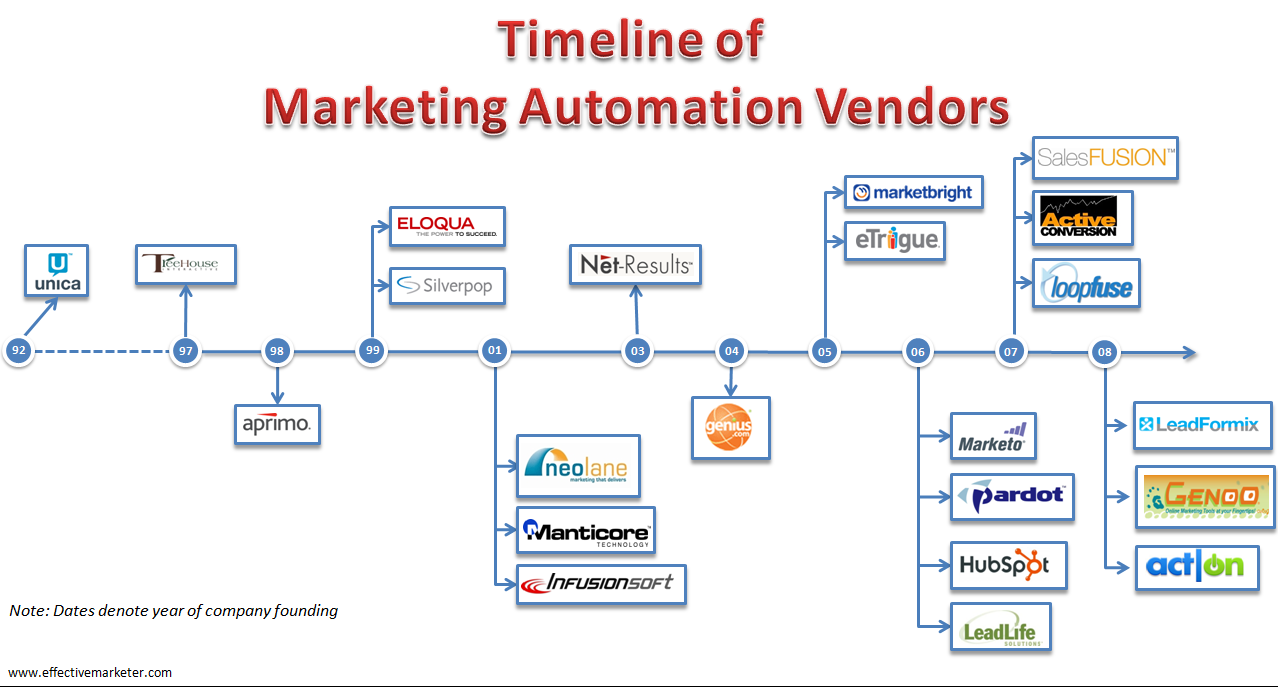
So let’s take a look at the marketing automation companies in play today (mostly US based in this case) and when they were founded. Interesting to note that the majority of the players only came to existence not even 5 years ago. This nascent industry still has lots of growth to do.

Timeline of Marketing Automation Vendors

You may spot some companies that were not considered to be “marketing automation” players just a year or so ago. That points to the evolving nature of the market, and the key functions of lead nurturing, scoring, and automated triggers becoming part of email marketing and other marketing solutions. Marketing Automation Software Guide published a B2B Marketing Automation market map that shows a few other players I ignored for the timeline above, like SAP and Oracle because although they do have marketing automation capabilities it is not their core business (and I don’t agree with tagging Salesforce.com as a marketing automation solution).

Investment in Marketing Automation

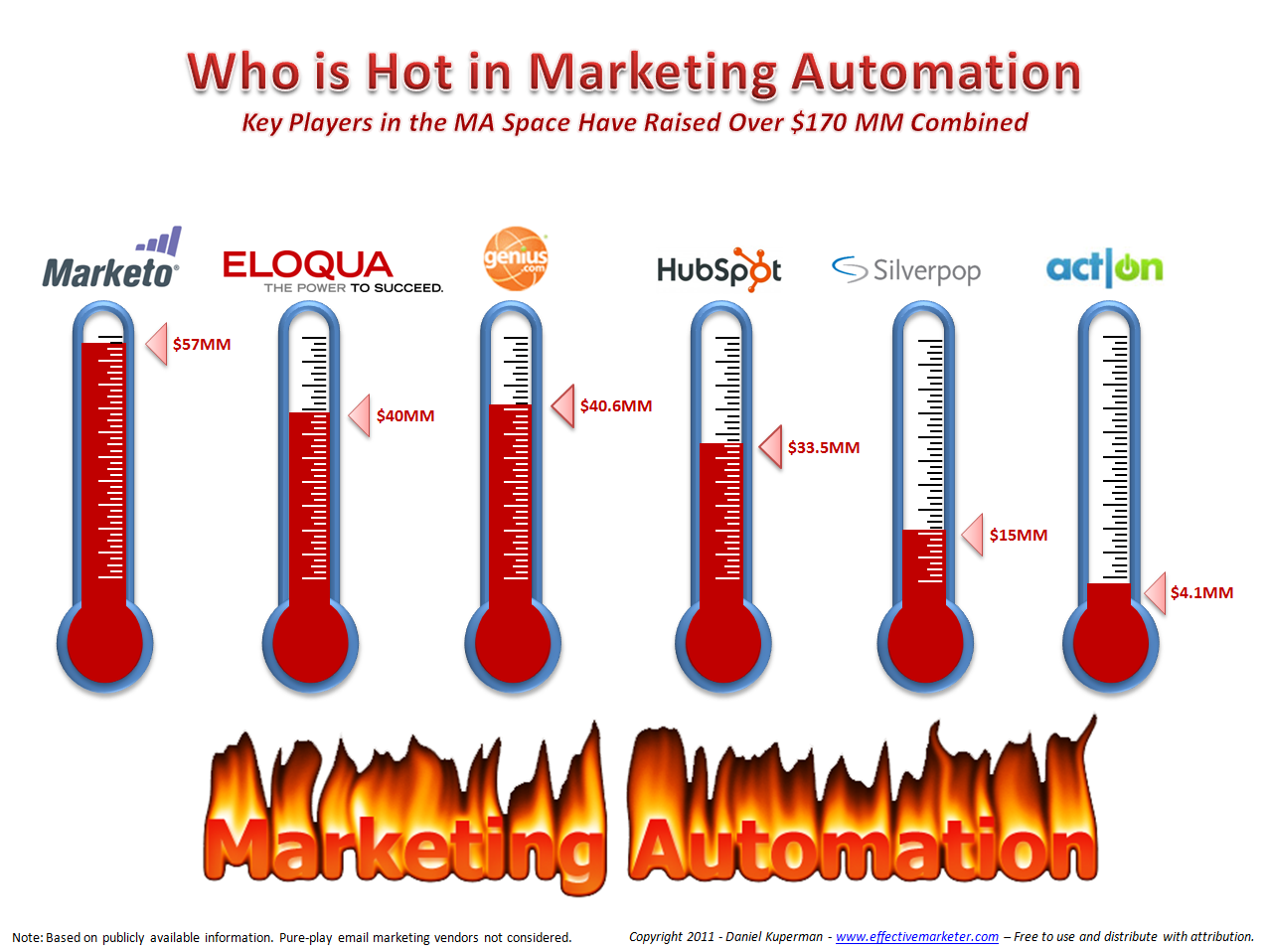
Another interesting factor to consider in the marketing automation industry and why it seems to be catching on fire is the money that is flowing towards some of the key players. Just a few marketing automation companies have already raised over $170 million dollars combined. Whether they will all be around a couple years from now is still to be seen, but it does make for a highly competitive environment. With cash to burn, these companies are focusing on growing the customer base first, with hopes that revenue will follow.

Total invested in Marketing Automation vendors

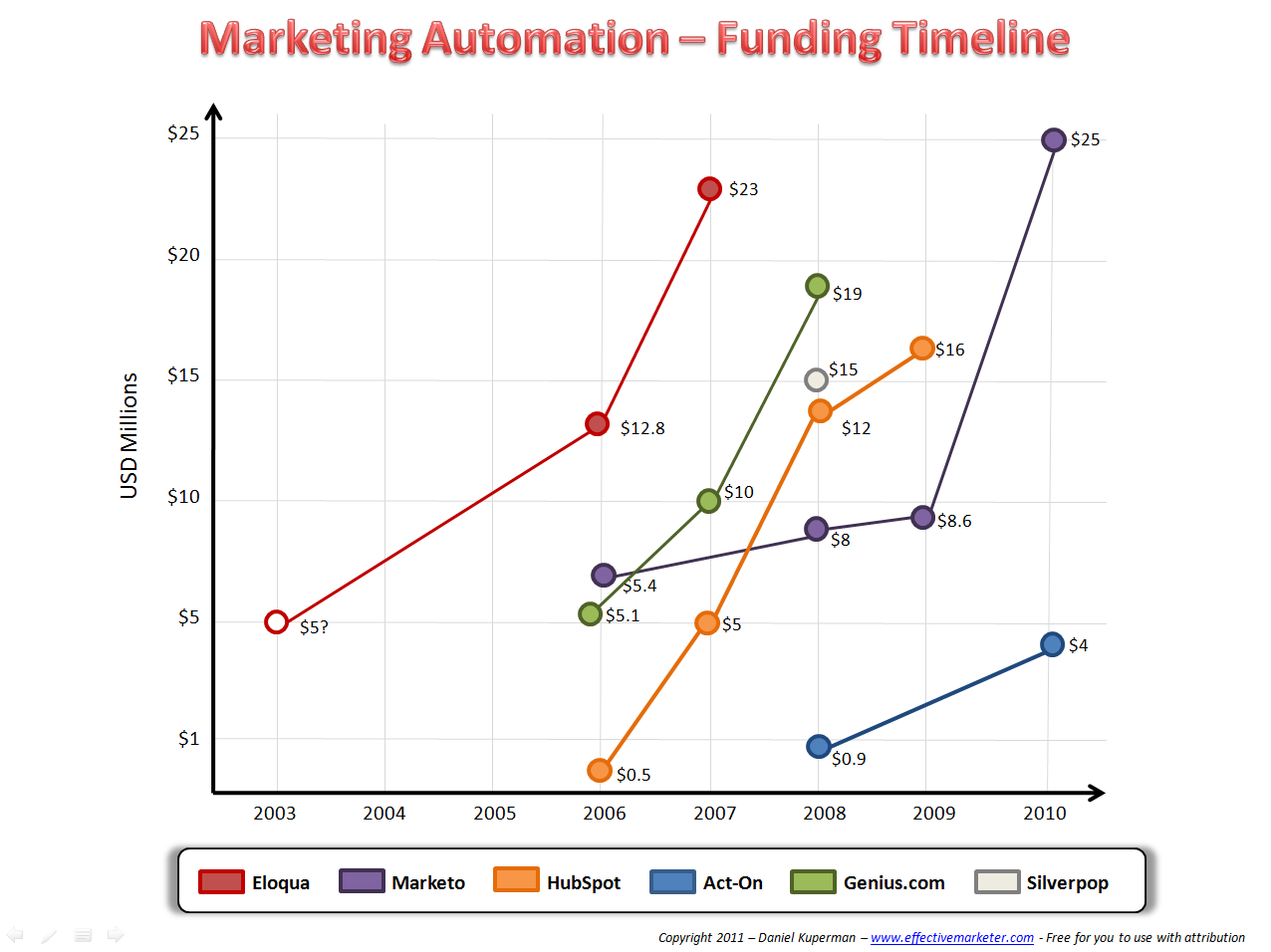
The marketing automation infographic above (click to enlarge) shows the top players in the MA space that have raised over $1 million dollars. Also interesting to note that if you break down the fundraising of each of the above vendors into a timeline (like I did below), most of the investment has been made in the past couple years.

Marketing automation funding timeline

You may have to click to enlarge the funding timeline infographic above.

Note: I used publicly available data and wasn’t able to find Eloqua’s Series A, so I deducted based on valuation of their second round.

The Marketing Automation Market

The Marketing Automation market is at an interesting stage. Companies are fighting for customers, trying to educate the market, and we may be seeing the beginnings of consolidation. Based on the investment figures above it seems is catching on fire, but at the same time there’s fierce rivalry and still a lot of room to improve… what will happen? I don’t know but it promises to be really interesting!

What do you think ?

P.S. Let me know if I missed any MA company in the graphics above or if I got incorrect data. I’d be happy to fix the infographics for benefit of everyone.


The Science of Email Marketing

February 10, 2011

I just attended “The Science of Email Marketing” online webinar, hosted by HubSpot and presented by social media scientist Dan Zarrella.

Slides should be available for download soon here.

Key takeaways:

  1. Businesses are consumers (the boundaries between B2C and B2B are blurred when it comes to reading email)
  2. Try sending emails on weekends
  3. Send very early in the morning
  4. Optimize for mobile
  5. Use lots of links
  6. Include reference information in your emails
  7. Serialize and label your emails
  8. Give your subscribers special access
  9. Send email from someone they’ve heard of
  10. Don’t be afraid to send too much email
  11. Your newest subscribers are your best
  12. Make them want to get your emails
  13. Ask people to follow you

The presentation was based on data collected via focus groups and from MailChimp’s email database of over 9.5 billion emails sent.

I like Dan’s presentation for its brevity and focus on key action items based on solid data. What I wish he had shared is how the data from focus groups and MailChimp is broken down. How many B2B vs. B2C companies, industries, and even job titles. It’s easy to say that B2B and B2C email patterns are similar, but without seeing the data underlying that assumption I’m very skeptic. Also, MailChimp is now known to be used by large corporations (they focus on SMB market) therefore the data may not take into account larger organizations.

As with all analysis and reports out there, you have to take all of the recommendations with a grain of salt. Test them, see if they work, then be the judge. No one knows your industry and customers better than you.


Upcoming Marketing Conferences

February 3, 2011

It’s February already and you keep thinking “what the heck happened to January”? You’re note alone. A few good events have come and gone, like the Digital Marketing Forum, MarketingSherpa’s Email Marketing Summit, and the Email Evolution Conference and I completely missed them.

Sure, budget is short and you can’t attend every single event, but is good to know what’s coming up so that you can prepare yourself and pick the ones you should go. Also, the earlier you register usually the better deal you can get. So here you go, this is the list of marketing events and marketing conferences coming up (US only) for the first half of 2011. Check them out, pick a couple and start planning!

Upcoming marketing conferences

==February==

Online Marketing Summit
February 7-11
San Diego, CA
Link: http://www.onlinemarketingsummit.com/

Social Media Strategies Summit
February 8-10San Francisco, CA
Link: http://socialmediastrategiessummit.com/

Frost & Sullivan Marketing World
February 8-11
New Orleans, LA
Link: http://www.frost.com/prod/servlet/summits-details.pag?eventid=200426011

Social Media Camp
February 9New York, NY
Link: http://socialmediacampny.com/

Social Media Masters
February 11San Diego, CA
Link: http://socialmediamasters.com/

Content Marketing Strategies Conference
February 16-17
Berkeley, CA
Link: http://contentmarketingstrategies-mashable.eventbrite.com/

Social Fresh Tampa
February 21-22
Tampa, FL
Link: http://socialfresh.com/tampa/

DMA Mobile Marketing Day
February 22
New York, NY
Link: http://www.the-dma.org/councilevents/mobileday/

==March==

Marketing Research Executive Forum
March 6-8
Atlanta, GA
Link: http://www.marketingpower.com/Calendar/Pages/default.aspx

Search Marketing Expo
March 8-10
San Jose, CA
Link: http://searchmarketingexpo.com/

Conversion Conference
March 14-15
San Francisco, CA
Link: http://conversionconference.com/west/home.html

Search Engine Strategies
March 21-15
New York, NY
Link: http://www.searchenginestrategies.com/newyork/

==April==

Forrester Marketing Forum
April 5-6
San Francisco, CA
Link: http://www.forrester.com/events/eventdetail/0,9179,2511,00.html

AdTech
April 11-13
San Francisco, CA
Link: http://www.ad-tech.com/sf/adtech_san_francisco.aspx

The Power of eMarketing Conference
April 19-20
San Francisco, CA
Link: http://www.emarketingassociation.com/2011/SF/index.html

Mobile Marketing Strategies Summit
April 26-28San Francisco, CA
Link: http://mobilemarketingstrategiessummit.com/

==May==

Marketing Innovation Summit
May 2-5
Boston, MA
Link: http://www.mis2011.com/Boston/Home

Sirius Decisions Summit
May 4-6
Scottsdale, AZ
Link: http://www.siriusdecisions.com/live/home/document.php?dA=ConfAnnSummit2011

Event Marketing Summit
May 16-18
Chicago, IL
Link: http://emsummit.eventmarketer.com/

==June==

International BMA Conference
June 1-3
Chicago, IL
Link: http://www.marketing.org/i4a/pages/index.cfm?pageid=5288

MarketingProfs B2B Forum
June 13-15
Boston, MA
Link: TBD

==

And the following are some of the marketing conferences I’ll keep watch and decide as we get closer.

MarketingSherpa B2B Marketing Summit Boston
09/26-27
Boston, MA

MarketingSherpa B2B Marketing Summit SF
10/24-25
San Francisco, CA

Dreamforce 2011
August 30-Sept 2
San Francisco, CA

BlogWorld Expo
October 14-16
Las Vegas, NV

Conferences abound, but they are a great way to learn new things, network, and more importantly get out of the office and focus for a couple days.

P.S.: I’ll be presenting at the upcoming The Power of eMarketing Conference, so if you plan on going to that one let me know so we can meetup.

Did I forget a conference? Let me know and I’ll update the list.


Aberdeen Shows How to Do Email Marketing Right

January 13, 2011

The new research report from Aberdeen Group “Email Marketing: Customers Take it Personallyhas some very interesting insights. They talk about how the increase in the number of available marketing channels coupled with the resource constraints of most marketing organizations is the toughest challenge for marketers to overcome. If you have just started your 2011 campaigns after battling the budget process, I bet you can definitely see some relation to your own company.

So with all these new channels available, why does email marketing continue to be a top choice for marketers everywhere? According to the research “email marketing’s ability to provide a high quantity of leads combined with direct revenue gains” is what makes it still an attractive channel. Even when compared with social media, the research states:

“83% of all companies surveyed indicate they will leverage email as a core tool in the marketing mix and at a rate 54% more than social media despite that channel’s growth and popularity”

This is definitely contrary to a lot of the predictions of email marketing’s death and the rise of social media as the main communications channel for marketing that we heard throughout 2010.

In their research they also classify companies according to their results in email marketing usage. The leaders of the pack, called Best-in-Class companies, follow some best practices you can also adopt at your own organization:

  • Remove opt-out members from database
  • Remove hard and soft bounce recipients from the database through email authentication
  • Deliver special offers to high value customers
  • Integrate nurturing of existing leads with campaign results
  • Have an organization structure that supports data capture and sharing
  • Measure the impact of email marketing optimization practices and changes
  • Share the activity history of an existing or net-new lead with sales team

And, they add that the real key critical factor is the personalization of content in your emails. They say that “companies that marry high value customers with personalized, specialized offers in their email campaigns produce far greater results on every tangible measure of effectiveness”. Content personalization is not an easy task but according to the research it will likely give you a 38% better open rate and 86% greater click-through rate than non-personalized email messages.

The lesson? Work your way through the list above and start playing with content personalization, even if only for a small segment of your database. It will likely pay off handsomely.

The report has more interesting stuff and  I suggest you spend a few minutes reading it. You can get it for free for a limited time here:

http://bit.ly/fxiUoz


The Online Guide for Email Marketing Resources

April 26, 2010
I am often looking for best practices, reports and other resources on email marketing and end up exchanging what I have written down on pieces of paper with other marketers at conferences or online, so I’ve decided to publish here my entire list of resources I found on the web for all things “email marketing”.

This is a good list but not meant to be all inclusive, I am definitely missing a few good sites. Please let me know which ones you think should be included and I’ll update this resource page.

Articles, Best Practices, Links About Email Marketing
Email Benchmarks and Industry Statistics (mostly free)
Notable Email Marketing Blogs
Blogs worth checking out, both from vendors and independent sources (in no particular order):
Email Marketing Training
The following are some training programs on email marketing. Note that some are paid. Email marketing vendors and ESP (Email Service Providers) sometimes have good free online training on their sites that although usually slanted towards their offerings can give newbies a good overview of the basics.
Conferences and Events
Although there are many marketing conferences out there, very few focus almost exclusively on email marketing. Below are the few that stand out.
Email Marketing Vendors
Below are the most well known email marketing vendors listed in alphabetical order.

Did I miss any good resource you’d recommend? Let me know!


B2B Email Design – Gallery 2

March 17, 2010

Last week I started an email design gallery containing a series of HTML emails I received. This post is another installment of the “gallery” concept so that you have more designs to review and use in your own creative process. Is good to see what’s out there, what is working and what is not. The emails in these galleries are mostly B2B marketing in nature, but the design principles can be applied to B2C as well.

Note: The emails are in no particular order and the senders were selected at random from a variety of emails I get. Click on the images for larger version.

Design #11

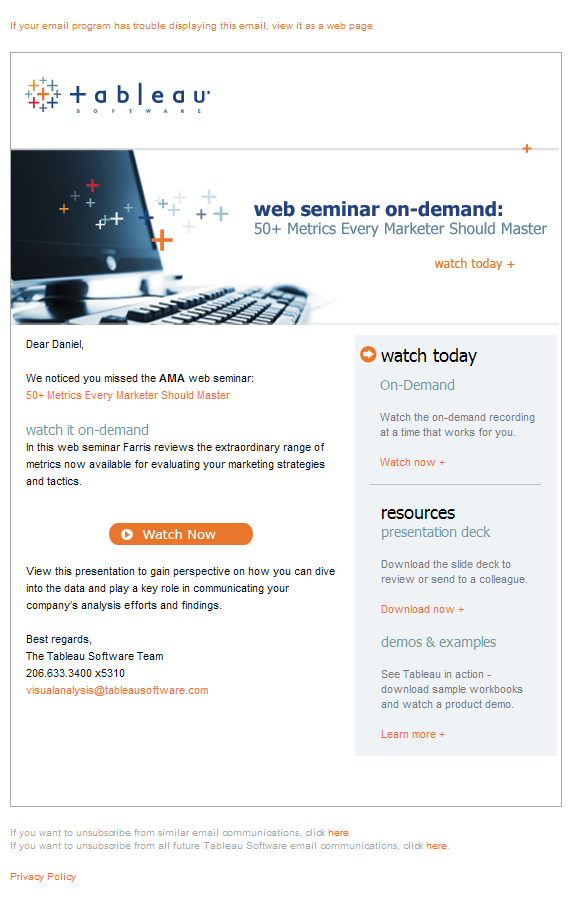
  • Email Sender: Tableau Software
  • Email Title: 50 Metrics Every Marketer Should Master

  • What I Like: Small but visible logo on top left identifies the company immediately. Clean header graphic with big and concise title. Short copy. Right side bar with useful links related to the webinar.
  • What I Don’t Like: Copy is a bit too short… I did register for the webinar and missed it but it could have a bit more copy enticing me to go on and watch it on demand.

Design #12

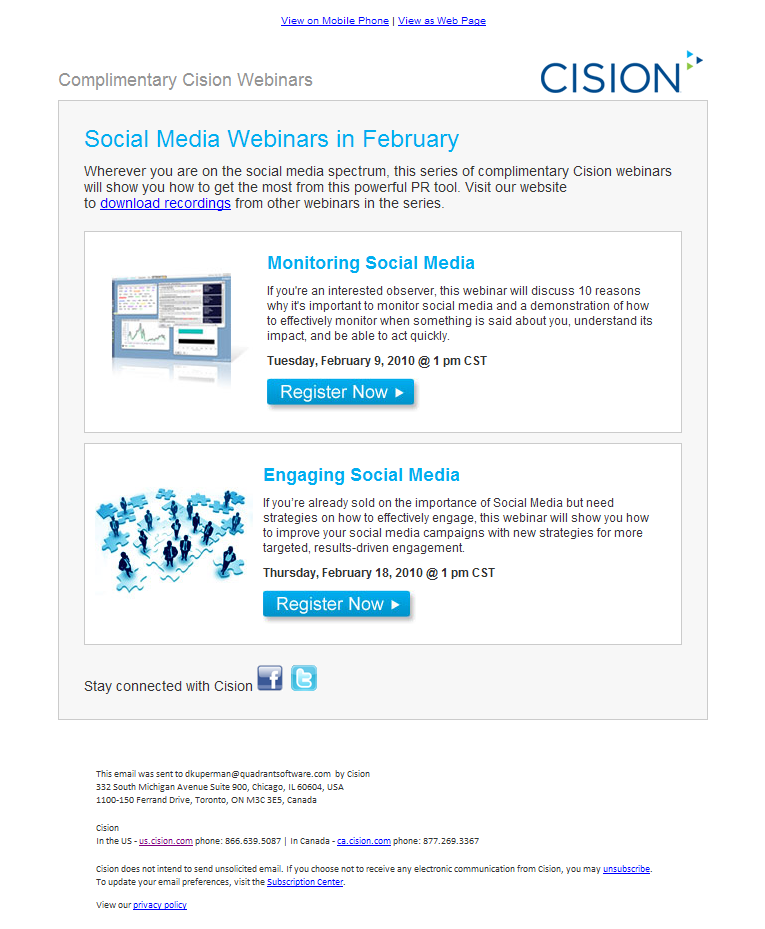
  • Email Sender: Cision
  • Email Title: Discover the secret weapon

  • What I Like: Header graphic ties into the title of the webinar. Big blue lead in. Good use of bullets and of bolding of words within the bullets, drawing reader’s attention to them.
  • What I Don’t Like: Three different font sizes in the header graphic. The “sign up today” hyperlinked text at the bottom looks out of place, not sure if because of font size but doesn’t seem to fit within the design.

Design #13

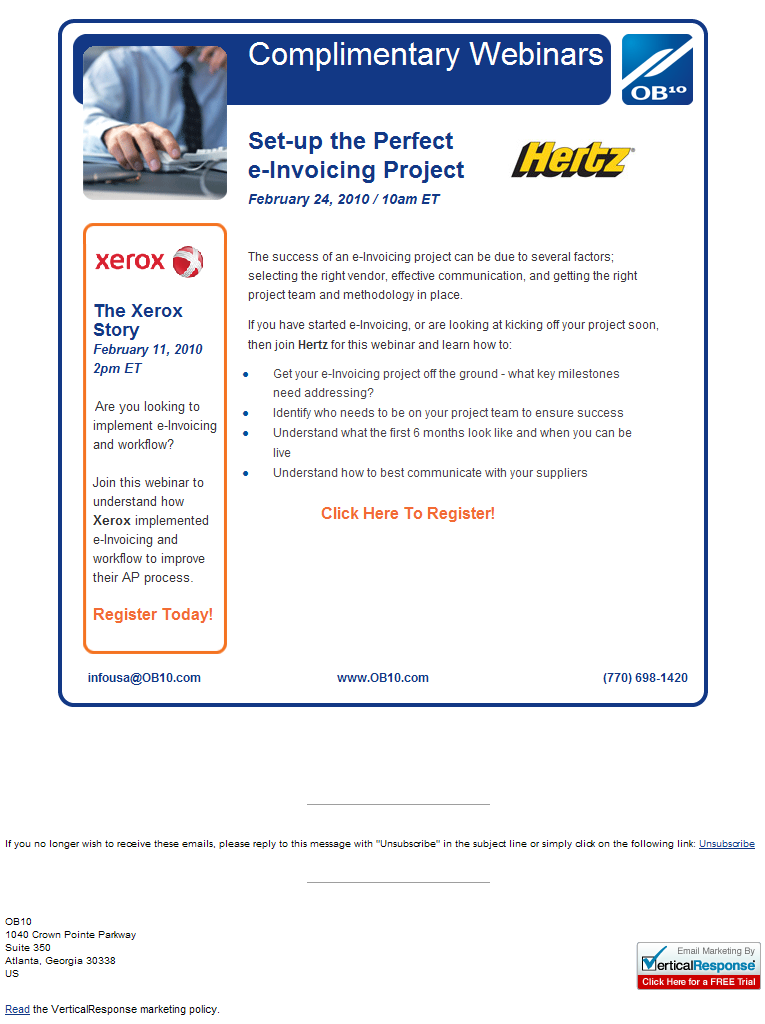
  • Email Sender: OB10
  • Email Title: Setup the Perfect e-Invoicing Project

  • What I Like: Logos for Hertz and Xerox calls attention. Clear and concise title tells you right away what the subject of the webinar is about.
  • What I Don’t Like: Image used at the header (top left) is one of those generic stock photos that don’t add much to the message. Copy has nothing to do with the Hertz logo. I look at the logo and think it will be something about how Hertz did their e-Invoicing project but the copy doesn’t address that. Left side bar with Xerox logo talks about another webinar, which could be confusing. What do you want people to do after all, register for this one or for the other one?

Design #14

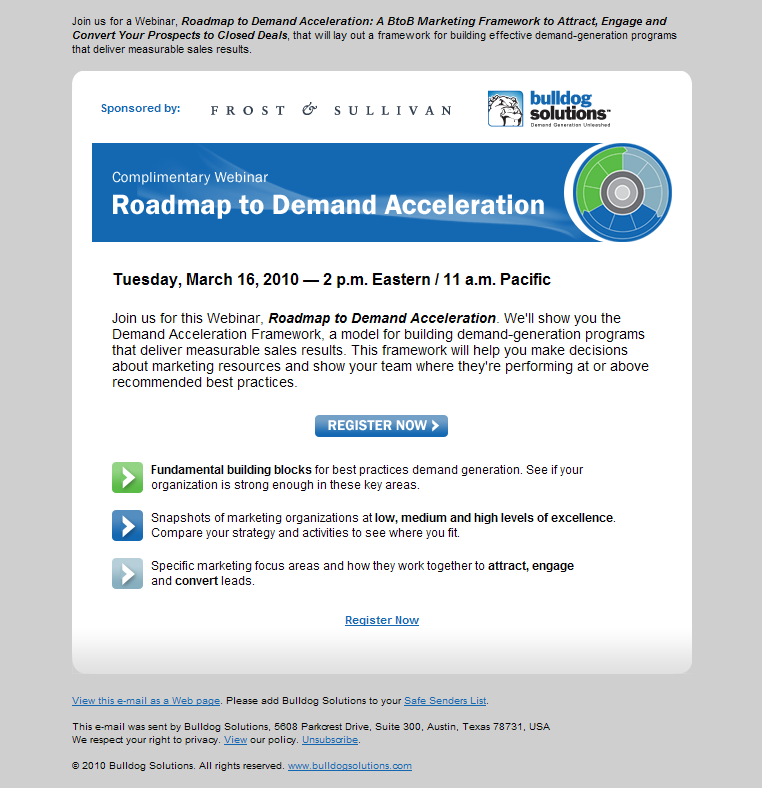
  • Email Sender: Bulldog Solutions
  • Email Title: Roadmap to Demand Acceleration

  • What I Like: This email was optimized for Outlook as you can see by the very top of it containing plain text. Sure, it may not look that good when you open it but if you’re using MS Outlook with “preview” or with images off, then you can clearly identify what the email is about. Simple but strong header graphic with webinar topic. Good balance between copy and design elements.
  • What I Don’t Like: The words they use in bold at the bottom are completely opposite to what I would have bolded.

Design #15

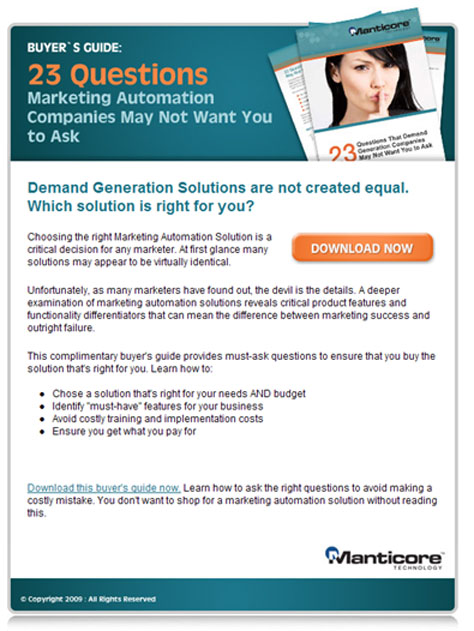
  • Email Sender: Manticore
  • Email Title: 23 Questions Marketing Automation Vendors Don’t Want You to Ask

  • What I Like: Big attractive header graphic with compelling title and nice “hero shot” of the buyer’s guide being offered. Compelling lead in. Concise bullet points.
  • What I Don’t Like: Seems to have too much copy, I get discouraged from reading it just by opening the email. Copy takes too long to get to the point of what the buyer’s guide is about. There seems to be a weird white space between the last bullet and the final paragraph.

Next I’m thinking about reviewing some email subject lines, because your email design won’t matter if the recipient doesn’t even get to open it!


The Danger of Email Marketing Benchmarks

February 15, 2010

A recent article from BtoB Online about email deliverability reminded me of how dangerous this whole thing of email marketing deliverability numbers can be. Studies from multiple email marketing service providers show different numbers when it comes to delivery rates, bounce rates, open rates, clickthrough rates, and more.

I work for a B2B software company and we do regular email blasts. Our open rates average 30%. Is this good? If I were to look at benchmark data from MailChimp we are doing way better than their published rate of 18% for companies in the software industry.  If I decided to spend the money for MarketingSherpa’s Email Marketing Benchmark Guide their benchmark open rate would probably be different.

Comparing Apples and Airplanes

You know that comparing different industries is irrelevant and that emailing B2C is nothing like B2B, but when you see reports that paint a good or bad picture about how email is doing in your industry, you tend to look at it carefully. Just beware of that inevitable question “why are we not getting the same results?” from your boss. Reading these isolated numbers and trying to use them as your overall goal will only lead to frustration. Yes, looking at different email marketing metrics is good to give you and your team an overall sense of how others are doing and also to spot trends but you should set your goals based on your overall objectives and historical performance.

Instead of asking how to match the industry averages, ask instead:

  1. How can we improve deliverability?
  2. How can we improve open rates?
  3. What can we do to improve clickthrough rates and, more importantly, to get people to buy/download/register?
  4. What are the most important metrics we should track?

The last question is probably the most important. The more you try to track, the less you will be able to do. Focus on the 3 to 5 key metrics for your email marketing program and the rest will follow. Evaluate how you are doing on a monthly and quarterly basis and try to improve every time. Analyze the results you get by segment (geography, products purchased, industry targeted, job titles, etc.) and start fine tuning the message, email design, subject line, date and time sent, and other relevant variables to each segment and you will start creating your own baseline.

OK, if you insist, here are some links to benchmarks I found online. A good starting point is the major email service providers (ExactTarget, Silverpop, Lyris, Eloqua, ConstantContact, Emma, etc.).

As I said, look at them but don’t bet on them or try to set your goals based on what others are supposedly doing. Industry benchmarks are only useful for bathroom reading.


Choosing an Email Marketing Software

January 11, 2010

Who’s the best email marketing company/software?

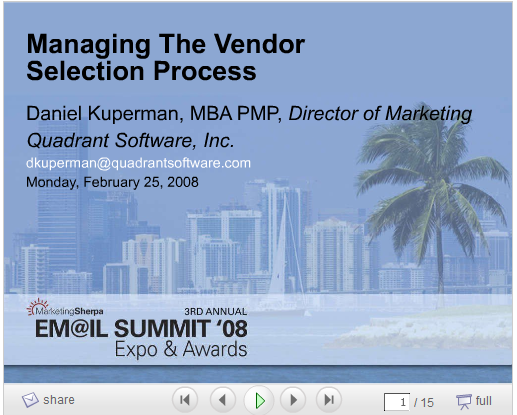
This question on a recent LinkedIn discussion thread for the Technology Marketing Community reminded me of when, a couple years ago, I delivered a presentation at the 2008 MarketingSherpa Email Marketing Summit. Titled “Managing the Vendor Selection Process”, it talked about my experience in selecting a new email marketing software for my company. Slides can be seen below.

Slideshare link: www.slideshare.net/dkuperman/managing-the-email-marketing-vendor-selection-process

The Selection Process

As the Director of Marketing, I had been pressing the company to replace our internal, archaic email system with something that was web-based (an “ESP”, or Email Service Provider, as the industry calls it) and that would reduce the time it took us to prepare, send, and evaluate email campaigns. The process we went through is not necessarily the best or the only way to do it, but it certainly helped put some metrics in place that we could use to evaluate each vendor. With so many options out there, having some kind of analytical basis to back your final choice can help get approval for the new system.

The Vendor Selection Matrix

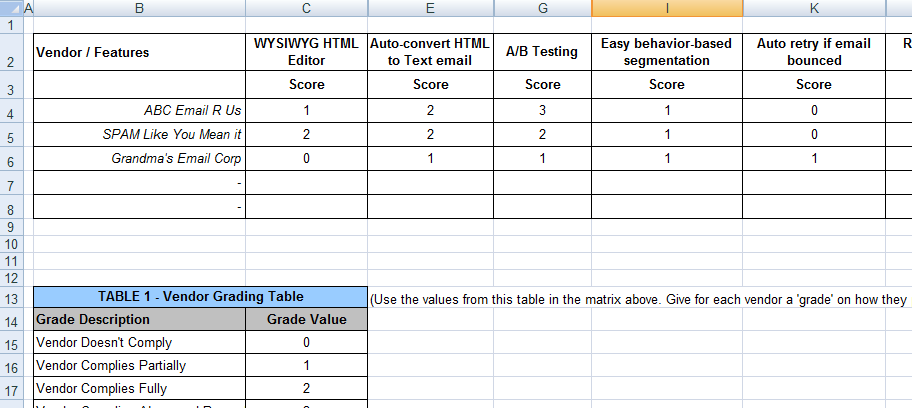
I created an Excel file to consolidate all info from the vendors we selected so that we could do an analytical evaluation. The matrix helped us focus on how vendors compared on each feature and also gave us the ability to rank vendors based on weighted scoring. Why? Well, because there were some features we considered more important than others and so should you. Just because a vendor has a great way to create dynamic content for newsletters, it won’t matter if you don’t usually send out newsletters. You get the point.

Excel Template for vendor comparison: you can download and use my template as a starting point.

Note: if the download link doesn’t work for you, contact me and I’ll email the file to you.

How to score vendors using the comparison matrix spreadsheet:

  1. List features
  2. List vendor names
  3. Decide on a numbering system for each feature evaluation (if you have multiple people helping you select and evaluation vendors, make sure everyone agrees on what constitutes a “meets feature fully” versus “meets feature partially”). This is to help you differentiate between vendors that offer a similar way to accomplish something but one is clearly better (because it’s easier, or gives more options, etc.)
  4. Decide which features are more important (here’s where the weighted score comes in… give higher numbers for features that are more important)
  5. Score vendors

The best email marketing vendor?

Ha! Good question! This is a question that only you can answer:

  1. Decide what is your goal with the email marketing software
  2. Define key features you really need
  3. Score vendors
  4. Chose the one that most closely matches your needs

How about “soft” qualities?

Yes, the excel matrix may help compare features vs. features, but falls short on so-called “soft” features like technical support, quality of service, and the all too common “gut feeling”. Make sure you take those into consideration, especially on tie breakers. Vendors that score very closely may have some clear differentiators that are not easily measurable. The important thing is to lead with the analytics side before throwing the qualitative evaluation into the mix.

Good luck in your email marketing selection process!