The State of Demand Generation

March 22, 2012

If you missed the DemandCon Conference hosted earlier this month in San Francisco, the online recording of the sessions is worth checking out. BrightTalk did an excellent job with the recordings and is making all of them available for free on their website.

There are over 20 presentations available, ranging from Social CRM and Lead Generation, to Case Studies and Sales Enablement. A must-watch presentation, though, is the keynote address “The State of Demand Creation“, by Tony Jaros, SVP Research for SiriusDecisions. Here are some of my notes.

SiriusDecisions State of Demand Gen 2012

The State of Demand Generation 2012

Why is demand generation so important? According to Tony Jaros, marketers will typically spend 60% of their budget on demand generation programs. The problem is, there are 4 key battles playing out in organizations:

  1. Task ownership (who does what in demand gen process)
  2. Buying cycle control (you need to facilitate the buying process and understand what is required of you as a result)
  3. Create sufficient content (how can we possibly keep up with demand for content?)
  4. Create demand while we sleep (build a “perpetual demand engine”)

Tony says that SiriusDecisions is in the process of revising their demand generation waterfall framework (Inquiries > Marketing Qualified Leads > Sales Accepted Leads > Sales Qualified Leads > Deal Closed), but shared some interesting facts about typical conversion rates and contrasted those with what they consider “best-in-class” companies:

Typical Rates for the Average B2B Company:

  • Inquiries to MQL: 4.4%
  • MQL to SAL: 66%
  • SAL to SQL: 49%
  • SQL to Close: 20%

The numbers above mean that out of 1,000 inquiries, the typical organization will close 2.9 deals.

Best Practice B2B Company Rates:

  • Inquiries to MQL: 9.3%
  • MQL to SAL: 85%
  • SAL to SQL: 62%
  • SQL to Close: 29%

Best practice companies, on the other hand, will typically close 14 deals out of 1,000 inquiries.

The 5 Critical Tasks

How do you get to be a “best practice” company and increase your efficiency? SiriusDecisions says that to drive best-in-class performance, sales and marketing must align around five waterfall-based jobs:

  • Seed (use of traditional and social media to set the stage for demand creation)
  • Create (generation of “original” demand, focusing on quality, i.e. generating a better lead for sales)
  • Nurture (care and feeding of prospects that aren’t ready for sales or that have fallen out of the waterfall)
  • Enable (help reps increase productivity, both for sales and marketing-sourced demand)
  • Accelerate (help sales move deals more quickly through the pipeline)

This all leads to a few things. For one, the rise of the “Demand Center” taking away tasks that were typically the domain of Field Marketing. But, more importantly, demand creation has become more complex, requiring increasingly specialized skills. And so, there are new roles coming down the pike based on each of the critical tasks mentioned before:

Seed:

  • Content strategist
  • Inbound marketer

Create:

  • Automation expert
  • Web anthropologist

Nurture:

  • Nurturing specialist

Accelerate:

  • Acceleration specialist

The Customer Buying Cycle Framework

According to SiriusDecisions, buyers go through three stages and six steps during their buying process.

Stage 1: Education
– Loosening the status quo
– Committing to change

Stage 2: Solution
– Exploring possible solutions
– Commiting to a solution

Stage 3: Vendor Selection
– Justifying the decision
– Making the selection

Buyers move in and out of each stage. You have to be prepared to engage them throughout the cycle. The problem, though, is that marketers have to face the realities of the B2B Buying Cycle:

  • You control less
  • You see less
  • Your sales resources will often be in reactive mode

Organizations have to become better at determining what need and what questions buyers have when they decide to engage in the sales process. Understanding the buying cycle and the key needs buyers have at each point can help marketers and sales reps. Create a knowledge base with relevant content that your sales team can leverage during the sales cycle.

Content Creation Challenges

The biggest complaint from marketers is that they can’t keep up with content creation needs (multi-touch programs, social media, nurturing programs, thought leadership, etc.).

Why companies can’t keep up? Usually because marketers suffer from:

  • No accountability (is everybody’s job and nobody’s job, there is a void in planning and strategy related to content creation)
  • Lack of targeting (too broad a vision/strategy which is never revised)
  • Rampart waste (content created has no memory, not related to previous content, not connected to other content, and has no story; and limited ability to find what’s needed)
  • Burned cycles (lack of buyer knowledge, and lack of specificity)

Centralized responsibility for content strategy is becoming a requirement for highly effecitve b2b marketing. AKA the rise of the “Content Strategist“, which is someone that has:

  • Accountability
  • Authority
  • Responsibility
  • Organization
  • Measurement

Another issue when it comes to content creation is that most organizations engagage in “absolute targetting“, they think about everyone that could potentially buy what they are selling, and create content accordingly which means response rates are low, and quality of leads is also low.

Marketers should instead engage in “relative targeting“. You want to take your industry and segment it into sub-verticals and rank them in terms of external factors (trends, category spend, product use and importance, competitive presence). Then, use internal factors (solutions delta, domain knowledge, messaging, sales readiness, and database) to select the best segment for you to go after.

Content Audit

Best in class companies are auditing their assets. There are two steps for that:

  1. Classify by content type (white papers, brochures, testimonials, videos, case studies, etc.)
  2. Evaluate each piece of content (quality, relevance, value, influence on buyer perception)

The Complete B2B Persona

Buyer personas are all the hype again, and for good reason. They are the first step in your content planning process. SiriusDecisions has a B2B Persona template they use which you should consider for your next content creation project. Here are the key things they look at when creating the persona:

  • Job role
  • Demographics
  • Buying Center (the department that makes the buying decision)
  • Common titles
  • Position in the org chart
  • Challenges (what are the challenges this person faces?)
  • Initiatives (what initiatives in this person involved with?)
  • Buyer role type (influencer, decision maker, etc.)
  • Interaction preferences (how do they prefer to communicate)
  • Watering Holes (where do they go to get info they want)

The Perpetual Demand Creation

The presentation ends with the idea of the PDC (Perpetual Demand Creation). Building the perpetual demand creation involves a set of strategies to create efficiencies and improve performance over time:

  • Inbound Marketing
  • Website Conversion Optimization
  • Lead Nurturing
  • Sales Programs

As I said, there is a lot of good information presented and is definitely worth watching the BrighTalk recording in full.


A Content Rules Cheat Sheet

March 15, 2012

Content Rules Book

Edit: The PDF is now back online, link at the end of the post.

Edit: The authors of the book asked me to make a slight change to the PDF byline. Will be uploading the updated version of the Cheat Sheet shortly.

Edited: In my haste, I neglected to ask permission from the authors to put this cheat sheet together. As per their request I am taking the link down.

I’ve got to admit, I am a big fan of the “Content Rules” book, by Ann Handley and C.C. Chapman. No, is not groundbreaking or earth-shattering content. Actually, a lot of the stuff you probably are already doing and it kinda seems natural once you read it. But boy, is it actionable. It consolidates a lot of what is out there about content marketing and delivers it in an easy to read format with no gobbledigook or too much fanfare. Yes, I think I like it more than a few other books out there because of the straight-forwardness (is this a word?) of the language the authors use.

While a longer book review is in order, I just wanted to share something I’ve created with you. The book is based on 11 content rules:

  1. Embrace being a publisher
  2. Insight inspires originality
  3. Build momentum
  4. Speak human
  5. Reimagine, don’t recycle
  6. Share or solve, don’t shill
  7. Show, don’t just tell
  8. Do something unexpected
  9. Stoke the campfire
  10. Create wings and roots
  11. Play to your strengths

As you might imagine, each rule alone is not much and anyone can do it. Heck you are probably already doing a handful even without knowing. But, like a good superhero story, when put together they unleash the power of great content creation.

For those of us who read the book and keep coming back to it for additional insights, I have created a “Content Rules Cheat Sheet“. Is basically the list of rules put together nicely in a PDF that you can download, print, and peg to your wall/board/monitor/etc. Use it as a reminder and as a checklist. Give to the new intern to make a few copies and spread around the office and present your team members with a copy printed in nice paper. Click below to view and download it.


How to Build a Content Development Plan for Your Site

March 13, 2012

Note: this is another great guest post by Brad Shorr. See his bio at the end.

Have you ever visited a website that looked like a teenager’s bedroom – content strewn about everywhere, overflowing with information yet impossible to find what you’re looking for? This often happens when a firm fails to make a long-term content development plan a component of its new site launch.

The consequences of haphazard content development are quite serious:

  • Interested prospects can’t find what they are looking for, so they click off the site.
  • Prospects who are ready to buy get confused, frustrated, or lost on the site – and fail to convert.
  • All visitors leave with an impression that the firm is as disorganized as its site.

Here are ways to prevent these things from happening.

1. Long-term Focus

Most Web development projects are obsessed with the immediate future: We have to get the site launched on time; we have to get it done within budget.

In terms of content, avoid the very strong temptation to cram everything you want to say into the initial launch. You won’t have enough time, and you won’t have enough money. Instead, identify the content you must have for launch, and then schedule the content you want to have for future phases of the project.

2. Go from General to Specific over Time

The most important content to present on the initial launch of a business site is the overview. Give prospects and customers the big picture: what you do, what problems you solve, what benefits you offer, and why people should buy from you.

If you do nothing more than get those simple points across, you’ll have a manageable number of pages to produce for the launch, and you won’t obscure the message with distracting details. And as a consequence of that, you’ll have a site with content that effectively supports lead generation.

3. Logically Layer On the Details

Develop a more detailed picture of your firm over time by adding new layers of content. For instance, consider a restaurant supply business. A simple, long-term content plan for its products could look something like this:

  1. Launch Phase: One Products Overview page with a brief summary of all product groups.
  2. Second Phase: Build out Product Group pages with more detail on Furniture, Bar Supplies, Kitchen Supplies, etc.
  3. Third Phase: Build out detailed Item pages for the 10 most popular items in each Product Group.
  4. Fourth Phase: Build out detailed Item pages for the next 25 most popular items in each Product Group.

4. Content Categories and Subcategories

The above tip refers to content depth, but let’s take a minute to consider content breadth. For a launch phase, these content categories are generally indispensible:

  • Products
  • Services
  • About
  • Contact

From here, much can be added in future project phases. Here are a few ideas to get you thinking about the possibilities.

  • Category: Testimonials
  • Category: Case Studies
  • Category: Careers
  • Subcategory of Products: FAQs
  • Subcategory of Services: Important Resources
  • Subcategory of About: Charitable Giving

Creating these additional content sections requires a lot of time and creativity. If information is thrown together at the launch phase to meet a tight deadline or budget, entire sections may well come off looking extremely lame. Again, it’s preferable to think long-term and patiently roll out new content based on a plan.

Key Takeaways

By mapping all this out in advance, not only will content be delivered to visitors in logically organized and digestible chunks, designers and programmers will be able to build proper layouts and navigation into the site from the beginning.  Over the long-term, your site will be as clean as the bedroom you see to the right.
This point cannot be overemphasized. Content should drive any web development project! If designers and programmers don’t know where the content is heading, they can only guess at how much room to allocate for future navigational links, where those links should go, and what they should look like.

Quite often, this is why a mature site has navigation that appears haphazard and cramped, that has crucial call to action blocks hidden in obscure corners of the page. The firm boxed itself into a corner as it added content and did not have the resources to rebuild the site from the ground up. Not a good situation to be in, but one that is all too common.

About the Author

Brad Shorr is Director of Content & Social Media for Straight North, a Chicago Internet marketing firm. They specialize in niche, middle market B2B industries such as video broadcast equipment and gloves for electrical work. Brad is an experienced content strategist, SEO copywriter and blogger.

(Image Credits: Image 1, © Iriana Shiyan #39382212; Image 2, © Joseph Helfenberger #1106456 – Fotolia.)


Guidelines for a Content Marketing Audit

February 29, 2012

If you are already a content marketing convert and understand the importance of embracing content publishing as a core component of your marketing strategy, you may be wondering how well you are doing in comparison to other companies. The Altimeter Group has a report that can help you with that. Their recently released “Content: The New Marketing Equation” report puts together a “Content Marketing Maturity” framework to help you assess your content marketing efforts.

The Content Marketing Maturity Model

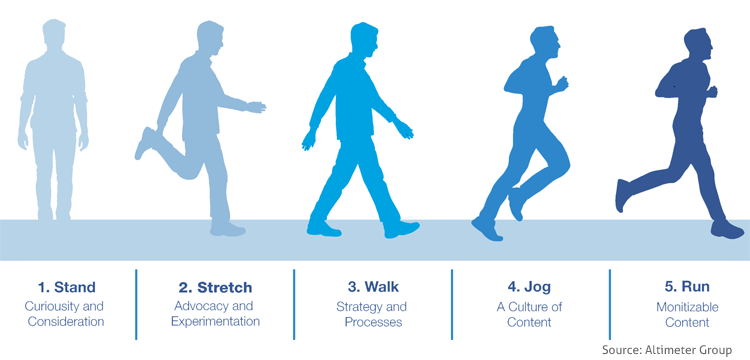
Based on their analysis, the Altimeter Group devised a content marketing maturity model comprised of the following stages:

  • Stand: you haven’t yet realized the value of content marketing as a key component of your marketing strategy.
  • Stretch: you understand the benefits of content marketing and have started to create content.
  • Walk: now with a solid foundation organizationally that supports content creation, your content strategy is more fully refined and tweaked. There is also a concerted effort to connect content development with all parts of the organization’s communication teams.
  • Jog: your company is seriously committed to content marketing and has a clear strategy.
  • Run: companies at this stage have production and creative as full, standalone business unit, and your company is creating content that is sold and licensed based on its standalone merit.


Content Marketing Maturity Model - Altimeter Group

The report details each stage with an accompanying case study and suggestions for moving onto the next stage. It also shows how you can perform a content marketing self-audit and score your organization based on the different elements that define content marketing maturity, namely:

  • Organizational Structure
  • Internal Resources
  • External Resources
  • Measurement
  • Education

Whether you decide to really audit your content creation efforts or not, just going through the criteria and the different case studies can give you additional insights you can use to better fine tune your own content marketing processes.

Key Content Creation Recommendations

The report ends with some final recommendations for anyone that wishes to improve their content marketing creation efforts:

  1. Build Content Around the Brand/Product/Service, Not About It
  2. Drive Organizational Change and Transformation
  3. Educate and Train
  4. Design Recombinant Content

One thing is clear, in order to achieve the higher stages of content marketing maturity, the whole organization must recognize its importance and support for content creation must come from the executive levels.

The free report is available to download directly from the Altimeter Group’s website (or click the image below).

Altimeter Group Report The Content Marketing Equation


When Inbound Marketing Goes Wrong

February 9, 2012

The fact that Inbound Marketing is taking over traditional marketing methods is not news. It seems that every eBook, blog post, and webinar is now touting content marketing and inbound marketing as the go-to strategies for the new marketers. Marketing is evolving, there is no denying that.

But for those out there in the trenches, trying to follow all the advice and get their marketing engines running it is not that simple. Sometimes, despite your best efforts you can’t seem to move the marketing needle enough.

Why Your Inbound Program Isn’t Working

Marketo‘s new whitepaper, “Amplify Your Impact: How to Multiply the Effects of Your Inbound Marketing Program“, takes a different route from others out there. I was pleasantly surprised when they decided to attack the core of the problem by saying “It can be common for organizations that implement an inbound marketing strategy to see an early lift. However, while early results are strong, the leads can dwindle to a trickle“. That’s not your typical Inbound Marketing whitepaper!

The reasons, according to Marketo, are many:

  1. Your aim is too wide
  2. Some prospects may find you, but many don’t know you exist
  3. Others may know your exist, but don’t understand what you do
  4. You aren’t reaching the decision makers
  5. Sometimes you can’t break through the noise
  6. Sometimes there isn’t any noise
  7. Inbound marketing has a diminishing return

Content developed for inbound marketing should be more focused on your prospects’ problems and concerns than on your product or solution – Marketo

For each problem listed above, you can find good examples that might reflect exactly what you are facing at your company. In some cases, a few tweaks may get you back on track but in other cases you should re-evaluate your strategy. They also list a few things other companies are doing that you should think about, such as:

  • Have a staff dedicated to inbound programs
  • Combine inbound AND outbound programs
  • Ensure you have nurturing programs too

The Right Marketing Program Mix

“Increased output is not directly linked to a greater number of leads or customers or higher profit. You need to strategically determine where to spend your time – especially if you have a limited amount of resources”

The quote above, from Marketo, is the key for your inbound marketing troubles. The combination of the right programs based on their effectiveness for your particular situation is what will generate the best results. And, according to Marketo, outbound programs have their place in your marketing arsenal. They explain that while inbound marketing supports your newly created content by sharing it on social channels, making it faster and easier for your content to be found, outbound marketing (paid sponsorships, banner ads, etc.)can help you further spread the word about the content and multiply the number of new views you generate (and thus the number of shares, likes, etc.).

The mixing of both Inbound and Outbound Marketing programs helps with:

  • Brand recognition
  • Making prospects speak your language
  • Capture your target

The last part of the paper touts the benefits of marketing automation (expected, since Marketo is one of the players in this space) to help with your nurturing campaigns. As Marketo puts it:

“The leads you’ve generated via inbound marketing are often still conducting research and evaluating their solution options. That’s where lead nurturing comes in — you need to invest in the process of building relationships with qualified prospects, with the goal of earning their business when they are ready to buy. Marketing automation helps you deliver relevant information over time to keep leads interested, engaged, and educated until they’ve made that decision”

Besides, marketing automation also helps to:

  • Raise open and click rates
  • Enables A/B testing beyond landing pages
  • Creates new landing pages easily
  • Shorten sales cycle
  • Lets sale show when their prospects are engaging online
  • Automates repetitive tasks
  • Delivers sophisticated reporting and analytics

The free whitepaper is worth a read. The part where they talk about inbound marketing campaigns gone wrong can give you some interesting food for thought and help you rethink how your own campaigns are being setup.


6 Ways to Spice Up Boring Email Marketing Campaigns

February 7, 2012

Spice Up Your Email CampaignNote: This is a guest post by Lior Levin. See Lior’s bio at the end of the article.

For a marketer, email is possibly the most powerful medium ever created. In addition to be instantaneous and simple, it’s a personal medium that can be tailored to every person, it’s opt-in, meaning that you’re reaching an already-engaged audience and, best of all, the cost of sending each email is effectively zero.

However, the problem with email marketing is that it’s very much like a relationship, difficult to keep the excitement and enthusiasm up for a long period of time. This is true for both the marketer and the recipient.

So how can you help keep that spark alive when sending email after email? A lot of it comes down to simple creativity. However, there are several things you can do to revitalize a dull campaign and re-engage both yourself and your audience with your email marketing.

Here are just a few that you can consider:

1. Take a Survey

If an email campaign is a relationship, then every great relationship starts with communication. You need to take a moment and listen to your subscribers.

Take time out from your regular email campaign to have your readers fill out a short survey and learn what they want out of your emails. You might learn that there are whole directions you haven’t explored or that there are topics of interest you haven’t talked about yet.

Aside from that, getting your readers engaged and making them feel as they have a voice in the newsletter makes them more likely to stay and more likely to pay attention to what you send out.

2. Hold a Contest

People love contests and they get excited about the prospect of winning something. Whether it’s a contest for a large prize, a coupon to a certain percentage of subscribers or something else altogether, contests are a great way to generate buzz and interest in your email campaign.

Contests work especially well if you couple them with promotion elsewhere, offline and on, and can be even more effective if you reward your readers for attracting new subscribers.

But even if you can’t do anything grandiose, a simple contest is a great way to renew subscriber interest and improve your metrics. Just be careful to follow all relevant laws.

3. Reward Your Subscribers

Sometimes reviving a dull relationship is as simple as saying “Thank you”.

Offer a special deal to your readers just for being on your list. Give them something that makes them feel important and like they are your most valuable customers just because they are on the list.

This reward doesn’t have to be something large, just something unique that is only available to subscribers. Whether it’s a small percentage off, early access to new merchandise or a free download, anything that makes your subscribers feel as if you’re catering to just them will help keep their interest and their loyalty.

4. Segment Your Audience

Ideally, the more information you have about your audience the better. In addition to their name, email and other contact info, you ideally should know at least some about their interests, especially if you’re in a business that has a variety of products catering to many different types of customers.

However, even if you don’t have that information, you can still target your subscribers by publishing themed emails aimed at one or two specific segments. The idea is to talk directly to a part of your audience and engage them deeply. Though your other subscribers will likely ignore the email, you will come back and reach out to them another day.

All in all, segmenting your audience and reaching out to them is a great way to make your emails more relevant, interesting and useful.

5. Revamp Your Template

Revamping your site’s template is a long, difficult process that involves changing out multiple parts and, possibly, confusing a much larger audience. With your mailing list, you can make changes a great deal easier and, with the smaller audience and lack of search engine visibility, the risks are less.

So, if your campaign seems stale, it may be time to revamp your email template. Not only is this a chance to add new visual appeal, but you can also add new features such as a fast fact, a relevant quote or a promotion.

In short, if you’ve been using your old email template for a while and would like the chance to bring in some new content, a new template might be just what you need.

6. Test, Test and Re-Test

Of course, if you’re going to do any of the above changes, you want to test them as thoroughly as possible.

Most email service providers offer an easy way to split A/B testing where you send out slightly different emails to various groups and see which are the most effective. This allows you test one variable at a time, such as a new subject line or a tweak in the template.

However, even if you can’t do A/B testing, you can achieve the same result by changing the emails you send out between mailings. Basically, by making small changes every mailing and closely tracking results, you can hone in on things that improve your response.

In the end, the only thing that is required to keep the interest and spark in your email campaigns is a willingness to try new things and to engage with your audience. If you can do those two things, there likely won’t be a single boring week for your newsletter.

It does mean, however, that you have to be vigilant with your campaign and, even if things seem to be going well, you have to be willing to take a risk.

With email, if your campaign isn’t moving forward, it’s stagnating and a stagnating campaign is a dying one.

About the Author:

This guest post is written by Lior Levin, a marketing consultant for a company that offers a to do list application for businesses and individuals, and who also consults for a company that convert psd to html format.


The Danger of Automatic Feeds in Social Media

January 31, 2012

Note: This is a guest post by Brad Shorr is Director of Content & Social Media for Straight North. See Brad’s bio at the end of the article.

Participating in social media is time consuming, so it’s only natural that people look for shortcuts. However, some shortcuts become disastrous detours, and this is often what happens when a company relies on automation for significant portions of its social updating.

Automatic feeds come in two flavors. Fully automatic feeds publish to a social media platform without any human intervention. An example of this is setting up your Twitter updates to automatically feed into your Facebook company page.  Semi-automatic feeds require intervention. For example, my HootSuite social media interface allows me to publish the same message simultaneously on Twitter, Facebook, LinkedIn, Foursquare, and soon, Google+.

Why to Avoid Automatic Feeds

The catch is, while automation is tempting for publishers, it is often annoying to readers. The following three consequences of overfeeding are why you should avoid automation, or at the very least use it judiciously.

1. Stream clogging. Automation encourages publishers to over communicate. If you overload any given platform with updates, your connections will either mentally tune you out, or physically tune you out by removing you from their stream (think Facebook) or disconnecting from you altogether (think Twitter). Most social platforms enable users to finely tune and personalize their incoming content, dooming any type of mass merchandising effort. And even though you can’t stop your mail to prevent junk mail, social media users can and do stop messaging they regard as spam.

2.Redundancy. Publishers sometimes lose sight of how many of their connections frequent multiple platforms. When I see the same update on three platforms, I remember it, but not in a good way. My assumption is the sender either doesn’t understand me or doesn’t mind bombarding me. Either way, the sender is not inspiring me to interact or do business.

3. Inappropriate style. The composition of a tweet, which is limited to 140 characters, does not lend itself to doubling as an effective Facebook post. Conversely, updates from other networks feeding into Twitter may be severely truncated, rendering them cryptic or entirely incomprehensible. Each platform has its own stylistic conventions that encourage conversation and action. Ignoring them only renders your social media activity less effective.

How to Avoid Automatic Feeds

Why do companies use this sort of indiscriminate messaging? Besides the convenience factor, I believe many companies simply don’t have a clear and distinct communication strategy for each social platforms on which they engage.

For example, a B2C firm might use …

  • Twitter to announce daily Twitter-only promotions
  • Facebook as a place for customers to upload photos of themselves using the product
  • LinkedIn for business updates relevant to employees and stakeholders

A B2B firm might use …

  • Twitter to distribute industry news and analysis highly relevant to its customer base
  • Facebook to provide in-depth information on its products and solicit feedback
  • LinkedIn as a recruiting channel

You’ll notice that each example necessitates targeting a particular audience segment and then theming the message to appeal to that segment.

Putting a purpose behind social communication not only eliminates the temptation to use automatic feeds, it allows companies to give audience segments a clear and persuasive reason to connect and much more important, stay connected and engaged. A constant barrage of thematically unconnected updates might accomplish the former, but never the latter.

Any business in social media for the long haul needs a strategy that employs something other than convenience as the linchpin.


About the author:

 Brad Shorr is Director of Content & Social Media for Straight North, an Internet marketing, Chicago-based agency. They specialize in niche, middle market B2B industries such as flame resistant apparel and thermoplastic injection molding. Follow @bradshorr on Twitter for non-automated discussion of all things marketing.

Proven Tactics to Increase Blog Traffic

January 26, 2012

Thanks to Christopher S. Penn and his newsletter I read this amazing post by SEOmoz on “21 Tactics to Increase Blog Traffic“. It not only validates some of my personal beliefs but also gave me additional tactics to apply to my own blog as well as companies I work with.

The tactics discussed in the article are:

  1. Target Your Content to an Audience Likely to Share
  2. Participate in the Communities Where Your Audience Already Gathers
  3. Make Your Blog’s Content SEO-Friendly
  4. Use Twitter, Facebook and Google+ to Share Your Posts & Find New Connections
  5. Install Analytics and Pay Attention to the Results
  6. Add Graphics, Photos and Illustrations (with link-back licensing)
  7. Conduct Keyword Research While Writing Your Posts
  8. Frequently Reference Your Own Posts and Those of Others
  9. Participate in Social Sharing Communities Like Reddit + StumbleUpon
  10. Guest Blog (and Accept the Guest Posts of Others)
  11. Incorporate Great Design Into Your Site
  12. Interact on Other Blogs’ Comments
  13. Participate in Q+A Sites
  14. Enable Subscriptions via Feed + Email (and track them!)
  15. Attend and Host Events
  16. Use Your Email Connections (and Signature) to Promote Your Blog
  17. Survey Your Readers
  18. Add Value to a Popular Conversation
  19. Aggregate the Best of Your Niche
  20. Connect Your Web Profiles and Content to Your Blog
  21. Uncover the Links of Your Fellow Bloggers (and Nab ’em!)
  22. (Bonus) Be Consistent and Don’t Give Up

While I was indeed doing most of what they suggest, there were a couple of good tactics I had either neglected completely or kept postponing (yeah, I procrastinate sometimes… ask my wife!).

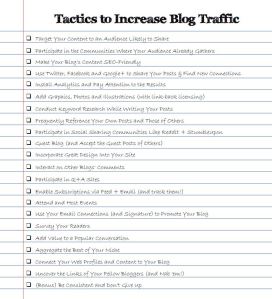
Your Checklist for Increasing Blog Traffic

Take the list above, make it into a checklist format, print it and place it somewhere next to you (like, on the wall right in front of you!). Then, make a point of every week to review it and plan your tactic for the coming week. It’s a lot to do but if you break it down into weekly tactics, dedicating 1 hour or so for a handful of them, you will see great improvement in your blog traffic.

You know what? Let me help you out. Here’s the list in a PDF format ready for you to print and use. It includes a few extra blank lines for you to add your own tactics based on your company’s goals and specific industry opportunities.

Oh, and don’t be like me. Download it now and start doing it today! 🙂


Your Content Marketing Mandate: Just Do It!

January 24, 2012

I’ve heard a few times now from companies that want to get their content marketing engine cranking but haven’t put anything out there yet because of one of the following reasons:

  1. We don’t have a marketing person or department
  2. We don’t have enough time to create content
  3. Our website sucks, we want to fix it first
  4. We are still researching topics for our blog posts
  5. We don’t know where to start

Any other typical reasons I missed? You have probably heard (or thought yourself) a few more, I bet.

A Simple Content Marketing Strategy

Yes, creating content is difficult. Creating blog posts, writing articles, shooting videos take time and effort. BUT (a big but for sure) you’ve gotta start somewhere!

So here’s my suggestion for those still on the fence or trying to climb what seems like a very tall content-marketing-fence: Just Do It! (sorry Nike!, don’t sue me for copyright infringement please)

That’s right, just type something and let it fly. Don’t waste time reviewing 5 times before hitting “publish”. Don’t wait three days for your team to give their feedback. Stop having second thoughts of whether anyone will like it.

You know why? Because if you are not producing any content now, anything (yes, anything!) you produce will be better than what you have today.

Yes, it’s that simple

Sure, you don’t want to publish crappy stuff. But you know what? If you add too much stress, too much “process” and too much thinking behind content creation you will set yourself for failure. Small companies or small marketing departments can’t afford to spend too much time on content marketing, I know that for a fact. There are lead generation programs, the new email marketing system being implemented, and something the sales department asked you to do (don’t they always?) a few times already.

So make your life easy and just start writing (or recording, if you will) and publishing. With time, you will be able to put more processes in place, get a good review and approval workflow, whatever you think is necessary to create quality content at your company. But, start simple. Unless you start creating something NOW you will regret not having done it sooner.


Listening to Your Customers In the Digital Age

January 19, 2012

“You can’t just ask customers what they want and then try to give that to them. By the time you get it built, they’ll want something new” – Steve Jobs

What do customers want?

Let’s do a focus group and find out. This tried-and-true approach to innovation leading to brand extensions, new product categories, and new marketing approaches has and continues to be used as a cornerstone of market research efforts.

In an interesting BusinessWeek article dating back to 2005, titled “Shoot the Focus Group”, the author states that although there are plenty of examples and ample evidence that Focus Groups fail time and again, companies keep using them.

“The old-fashioned focus group still has its believers even with fiascoes like Pepsi Edge and a decades-long new-product failure rate of about 90%.” – BusinessWeek

You probably know the famous examples of the failure of Chrysler’s Aztek car and the surprising success of PT Cruiser, Coca Cola’s “New Coke”, Ford Edsel, and plenty of others horror stories of focus groups gone wrong.

And why is that? I like Gerald Zaltman’s explanation that “The correlation between stated intent and actual behavior is usually low and negative” which also reminds me of an episode of Mad Men where Don Draper chastises a hired researcher to do a focus group for one of their clients, see below.

Excerpt from Mad Men, Season 4. “The Rejected”.

Faye: Well, I’ve done everything but finish the report.

Don: How’d we do?

Faye: Well, it turns out the hypothesis was rejected. I’d recommend a strategy that links pond’s cold cream to matrimony– a veiled promise.

Don: Hello, 1925. I’m not gonna do that, so what are we gonna tell the client?

Faye: I can’t change the truth.

Don: How do you know that’s the truth? A new idea is something they don’t know yet, so of course it’s not gonna come up as an option. Put my campaign on tv for a year, then hold your group again, maybe it’ll show up.

Faye: Well, I tried everything. I said “routine”, I tried “ritual”… all they care about is a husband. You were there. I’ll show you the transcripts.

Don: You can’t tell how people are going to behave based on how they have behaved.

So, what’s the problem with focus groups?

In a Harvard Business Review article, Turn Customer Input into Innovation, Anthony Ulwick says “companies go about listening to customers all wrong”. Customers are asked to offer a solution to a problem but they aren’t informed enough, aren’t experts in the field and have a limited frame of reference.

“The problem, when there is one, is simple: Companies ask their customers what they want.” – Anthony Ulwick

The solution, according to Ulwick, is to focus on outcomes. This means that instead of asking for customers to submit solutions to a particular problem, they should focus on understanding what customers value most.

Leveraging Social Media for Market Research

But how about using social media? I strongly believe that traditional marketing tactics can be greatly enhanced by using digital tools and when it comes to market research, social media channels should be top of mind. That includes paying attention to comments on your blog, using your Facebook Fan Base to test new ideas, monitoring Twitter feeds, and more.

“I’ll take the status update that someone wrote from the couch in the comfort of their own home as more accurate than the comment they made in a focus group room when they are given a $100 gift card to show up.” – Mike Volpe, CMO at HubSpot

Whether social media will replace traditional market research is up to debate, the active use of social media to complement market research can dramatically improve a company’s success ratio for new product launches and maybe take away some of that bad rap focus groups have.

Additional Reading

Here are some interesting articles if you’d like to dig deeper into this topic:

Note: Mad Men is Copyright of American Movie Classics Company LLC.