The Opposite of Advertising

September 20, 2010

How can a company embark on an branding campaign without prominently displaying its logo? What seems to be the opposite thinking of the advertising school became the winning campaign of Banco Hipotecario, a financial services business based in Argentina.

After becoming the sponsor of Racing Club de Avellaneda, a big soccer team in Argentina, they decided to do something audacious, maybe even heretic in the minds of conservative brand strategists: they decided to NOT put the bank’s logo on the soccer jerseys. Crazy as it seems the whole strategy leveraged the ongoing “Creator of Owners” message Banco Hipotecario was already running (the message focused on showing how the bank was helping people become house owners through their mortgage lending business) and created the slogan “Racing: Duenos de su camistea” (Racing: Owners of their jersey), to show that the bank really cared for the sport and the team they were sponsoring. After being picked up by local media and sports commentators, fans raved about the new jersey.

Banco Hipotecario’s facebook page has over 14,000 fans and was the centerpiece of their second phase of the campaign. They asked fans to vote on a phrase to be printed on the shirt that would evoke how the fans feel about their beloved team. The winning phrase, “Duenos de una passion” (Owners of a passion) received 2,398 votes.

Voting on Racing's new slogan for their jersey

Although it was reported that some fans were against the printing of the phrase (and the choice of phrases themselves) on the shirt, it’s undeniable the level of participation the branding effort generated and how quickly they were able to engage the fans.

Sometimes going against established “best practices” may pay off.

Sources for more info on this story are:

Creativity Online article, F*ck Smaller. Make the Logo Disappear.

Marca del Gol post, Second Phase of Invisible Advertising (in spanish).

Communicate Good blog post, Invisible Branding.

Marketing News article, Marketing Across the Americas (requires login).


The Ghost Blogging Debate Done Right

August 23, 2010

If there is a discussion that will never die is the Ghost Blogging debate. I recently listened to the best arguments both in favor and in opposition of ghost blogging via a Six Pixels of Separation podcast, expertly conducted by Mitch Joel who discussed the issue with Mark W. Schaefer, another excellent blogger and marketer.

Here’s the link to the podcast SPOS#214, it’s worth listening to. Then, check out Mitch’s blog Ghost Blogging And Last Rites for some additional insight and great comments by readers.


Mapping the Social Media Landscape

August 11, 2010

Infographics, according to Wikipedia are “graphic visual representations of information, data, or knowledge”. It’s also a wonderful way to communicate your message. Marketers that manage to become good at visual data communication can positively influence their companies into taking the right approach or strategy. Talking with the CEO or other managers about what all those metrics mean is sometimes a challenge, especially when they are not on top of the latest marketing trends or technologies.

When it comes to social media, a nice chart can do the talking job for you. The problem is finding the right one. The internet is now full of infographics for the social media space and each has its own particular characteristic. Here are some of the more interesting ones I found that try to map out the social media or social networking landscape. Their creators vary widely, from bloggers, marketing companies, to nationally recognized magazines.

National Geographic’s “World Wide Friends” illustration:

National Geographic Magazine World Wide Friends Illustration

National Geographic Magazine World Wide Friends Illustration

Overdrive Interactive “Social Media Map”:

Overdrive Interactive Social Media Map

Flowtown’s 2010 Social Networking Map:

The 2010 Social Networking Map

Flowtown's The 2010 Social Networking Map

Information Architect’s Web Trend Map 3.0:

Web Trend Map 3

Information Architect's Japan Web Trend Map 3

Harvard Business Review “Mapping the Social Internet”:

Mapping the Social Internet

HBR Mapping the Social Internet

Mapping Social Media and Internet Trends

What I like about the maps above is that each one is a great representation of the data it is trying to communicate. The maps that follow a known pattern (subway lines, political map, etc.) tend to be easier to understand because they represent images we’re already familiar with. In general, if it takes you more than a few seconds to understand what the map is trying to say, then it’s not a good map. Your audience, of course, will be the determining factor telling you whether one type of map is more appropriate than the other.

Have you found a good representation of the social media space? Please share!


How to Fail at Social Media

August 2, 2010

The challenge of keeping up with the competition in the social media space is not new. The problem is, when a company does very well with a campaign, others come and try to copy the same formula thinking it will also yield higher numbers, but no! The solution, it seems, is far more complicated.

An interesting post on Why So Many Companies Suck at Social Media brings in some good insights and compares the now famous Old Spice youtube campaign with copycats like Cisco and Brigham Young University. Why is it that one company fails miserable while the other gets it right? It seems it has all to do with creating the right message for your audience. But wait, that’s not new… is back to marketing 101 you’d think, no?


Taming Your Brand Mascot

May 10, 2010

From Tony The Tiger, Trix Rabbit and Energizer Bunny to Ronald McDonald and even John McCain (?!) brand mascots are a common tool to promote your product or service. More recently even Twitter mascots have been showing up as a company’s public face.

The good ones are those that you don’t even think about until you decide to wear your marketer hat. That’s what makes them memorable.

A recent article I read on Harvard Business Review, “ Aflac’s CEO Explains How He Fell For The Duck” made me think about brand messaging and the use of mascots. The article is great because it gives you an insider’s view of how the famous Aflac duck came to being and the challenges Aflac’s CEO had to overcome to get it adopted.

The first Aflac duck debuted in 2000. The company reported $9.7 billion (US and Japan combined) that year, up $1 billion from the previous year. In 2008, revenues were up to $16.6 billion. Amos credits this increase mostly due to the branding initiatives related to the duck, an amazing feat for any brand mascot. Here are some highlights of the Aflac duck’s impact:

  • First year after the duck’s introduction, sales were up by 29%.
  • Name recognition increased 67% after two years of running the commercials. Today the name recognition is 90%.
  • The duck has 165,000 facebook fans in the US.
  • In two months 100,000 people posted spoofs of the Japanese duck’s song online.

How do you create a successful brand mascot? I particularly like the tips a FastCompany article, “Brands with character”, gives:

  1. Give the brand human traits
  2. Create a life, backstory to your character/mascot
  3. Plan for the long run
  4. Don’t overcomplicate

What mascots do you consider memorable and why?


Explaining Social Media

May 7, 2010

If you need to explain what social media is and the impact it can have in your company or industry, the slideshow below might help. The presentation is not only funny is also engaging.

Rule 1: Listen

Rule 2: Engage

Rule 3: Measure

And my favorite quote is “Don’t assume social media is the answer to everything”.

Enjoy!


Why Social Media Needs to Die

April 14, 2010

OK, this may be a bit harsh, but all the talk about social media versus traditional marketing is driving me crazy. Sure, gurus, experts, and agencies alike want to tout they are the latest and greatest when it comes to the new marketing tools on the block and so it makes sense for them to brand themselves as “social media agencies” or “social media experts”. But what about the “traditional marketing” as they call it? It’s all the same thing, but with different adjectives.

Trends and the Obvious

Isn’t it funny how some numbers on a screen, a nice chart and statistically sounding papers can make you believe in anything at all? I found it amusing when reading about two new surveys about social media adoption were released that some of the highlights were:

  • Companies are spending more on social media and plan on increasing social media budget
  • Companies are switching more money from traditional marketing to digital marketing
  • Small and large companies alike are turning to social media
  • Social media is becoming a viable took in the marketing mix

Let’s say someone just came out with this new thing called the Television. And not only that, after a few years it is now in color and families are gathering around it for their favorite shows. Wow, you may say, let’s jump into that and get our own commercial there! Social media, like any other tool (or vehicle of communication to be exact) is the same thing. The new shinny object is obviously attracting people to it and the more you try it out, the better you’ll be at mastering the right message.

Another obvious trend being reported talks about how companies are integrating social media into their marketing efforts (a couple of reports discussed here and some discussion here too). Really?! Wow, these marketers must be really smart to be integrating social media… but how about the ones that say they haven’t integrated social media into their marketing mix? Are they losers? Maybe they are still trying out the waters, creating a twitter account to listen to the market before jumping right in. This “integration” talk is another useless discussion because it really doesn’t help you do anything better today. So what if most marketers are not integrating social media into their strategy? How can this data help you? Don’t tell me that you need that to “sell social media” internally into your organization because that’s a lame excuse. Agencies might like the data because it tells them how easy or how hard it will be to sell their new “social media” strategy service.

The Academic Debate No One Cares

I think I had enough of the whole social media versus marketing discussion when I listened to the Six Pixels of Separation Podcast talking about digital marketing agencies vs. traditional marketing agencies vs. social media agencies.

I wholeheartedly agree when Mitch Joel saysLet’s not make it bigger than it is.”

The discussion of where social media fits, and whether is part of marketing or not is purely academic and has no practical purpose.

For those not in the marketing field, let me clarify this with the simple diagram below:
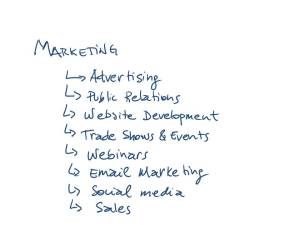
Marketing components

All of those items are under ‘marketing’. Yes, even ‘sales’ is part of marketing, that’s how we’re taught in school and how it is in the real world. In fact, books such as “Marketing Management” and “Principles of Marketing” by Philip Kotler widely used at marketing courses talk about the good and old “Four P Components” of the Marketing Mix and have as examples the following:

  • Product: product variety, quality, design, features, brand name, packaging, etc.
  • Price: list price, discounts, etc.
  • Promotion: sales promotion, advertising, sales force, public relations, etc.
  • Place: channels, coverage, assortments, locations, etc.

No, they don’t mention “webinars” or “email marketing” or “facebook” but you get the idea. Those are all tools of your marketing bag.

And Now For Something Completely Different

While many are using the term social media in everything they do, I propose something different:  just kill it from your vocabulary. You can argue about “push versus pull”, about how “inbound marketing” is the new thing and all that great stuff but keep in mind that it is all part of your marketing strategy and execution.

Talk about “integration”, about “traditional vs. new”, or “digital vs. virtual” doesn’t get you anywhere.

I know I’m not alone in trying to end the social media vs. marketing dichotomy and know that a lot of you marketers out there are getting tired of this whole thing, so let’s just try something completely different and stop talking about social media as if it were completely separate from what we do on a daily basis. It’s a tool, so let’s refer to it as one.


Marketers Listen Up: How to sharpen your social media skills

December 22, 2009

Listen before joining social media

Pressured to join the social media scene and start tweet-link-face-blogging? Hold on a minute, because first you may want to read what some experts have to say.

In one word: LISTEN.

Before letting everyone know you’re there and that your company or product is great, find out if people will care and, more importantly, find out how to engage them so that in the future they may care. Not wanting to rehash what has already been expertly written, here are some great starting points:

  1. The Six Free Listening Tools You Cannot Do Without, from Debra Askanase, is a great compilation of free tools that can get you started. Also, worth checking out is her recent post on “the case of 4,000 indifferent twitter followers“.
  2. Another good list of tools to use for listening into social media sites is given by Clay McDaniel on this MarketingProfs article.
  3. But before you go after all the shiny new tools, make sure you ask yourself the Five W’s of Social Media Listening, courtesy of Jason Falls.

There are countless other sources on the web, but I thought these are a very good summary of the basics. If you have come across other great tools or advice, please share!


The Fun Theory: How to Change Behavior

November 30, 2009

How do you change people’s behavior? Corporate America usually relies on some form of compensation system which basically uses a reward/punishment method that tries to coerce people into doing what the company wants. You have to fill out forms, get approvals, and meet goals otherwise there’s no pay raise or bonus. In other cases you try to get website visitors to navigate a certain path by placing links in strategically important places or enticing them with an offer. Books and theories exist on how to get people to perform their best or to change the way they behave (“Bringing Out The Best In People” comes to mind) but rarely we see those in action.

Volkswagen launched what became quickly a viral campaign with emails being forwarded, youtube videos with over 1 million hits and comments from all corners of the web. They call it The Fun Theory (www.thefuntheory.com) and the goal is simple: using fun to change people’s behavior for the better. The videos on their website (embedded below) are some great examples of what they mean.

How are you changing your customers and your prospects behavior? Can you make something fun that will entertain and educate them? And how about your staff or your company’s employees? Some food for thought.


Suit over Gartner’s Magic Quadrant Big Marketing Ploy

November 6, 2009

In an earlier post I wrote about ZL Technologies lawsuit over Gartner Group’s Magic Quadrant, over what it considered “multitude of illegalities”.

And not surprisingly, the judge dismissed it.

Gartner’s comment about the decision focused on them being an independent research organization and denies they use “pay for play” in the publication of their reports.

So this should be the end, right? ZL lost and will go back to its corner. Well… not so fast! The way I see it, ZL had a minor victory here. Let me explain. Had the judge sided with them, the win would surely have been better but I have to think that they knew they didn’t stand a chance. So why go through the trouble? Because ZL can use Gartner’s arguments against itself and now have it documented by a judge to prove it. As they had stated on their website they were hoping to use the proceedings to get :

  • Fair Disclosure on Conflicts of Interest
  • Fair Disclosure on Evaluation Scores
  • Better Oversight

They won’t get better oversight (and that was a real stretch) but they did get from the arguments (which are now documented) that the Magic Quadrant is nothing but Gartner’s opinion about the market and not “hard facts” as some might believe. In recent emails they have started using this as proof that “(…) the market should take note that the defense on which Gartner prevailed was its argument that its reports contain ‘pure opinions,’ namely, opinions which are not based on objective facts”.

So how’s that for a comeback? I see as a great opportunity to market themselves and when talking to CIOs and decision makers that bring up Gartner’s MQ, they can simply point them to the result of the lawsuit and say “listen, as much as you like Gartner’s Magic Quadrant, it is pure fabrication based only on their opinion. No hard facts. They said it themselves! So forget about it and let me show you the demo….”.

But how will ZL be viewed in the market? Can their tactic backfire? It seems that some people have already tweeted to this effect. Now is time for them to be very, very careful with the community they target.

Keep tuned because ZL can still come back to fight the court’s decision.