How Viral Marketing Can Kill You

July 13, 2011

Flu Shots Sign picture from Confluence! by smilla4 @ FlickrViral Marketing, or the spread of ideas (also called Word of Mouth Marketing) is usually thought of as a good thing. You create a video or a campaign and everyone starts talking about it. You go home happy and maybe even get a promotion. But sometimes the “viral” element more closely resembles the bad kind, the on that kicks you in the teeth and puts you out in bed for a week.

Scott Stratton, author of “UnMarketing: Stop Marketing. Start Engaging.” tells in his book a personal account of how a viral marketing campaign went wrong. It is the best example I’ve seen so far of a)someone owning to his mistakes, and b)a marketing idea backfiring really bad.

The Start of a Good Idea

As Scott tells in his book, he was into motivational speaking and decided to put out a short video (this was in 2004, way before YouTube became the default video sharing site) in his website. It was really a rotating slide show with background music and some inspiring text on top, nothing fancy but was well done. You can watch it at www.thetimemovie.com.

His intent was to get people to watch the video, and contact him for a speaking engagement. Did he get what he wanted? Well, yes and no. He did get over 4 million views (yes, 4 million!) but… things didn’t necessarily work according to plan. Here’s why.

Breaking the Bank

After creating and uploading the video to his server, which was just a regular ISP that hosted his site, Scott emailed a couple hundred people from his list about it. Emails started coming back saying they were getting a “Page not found” error. Oops, what’s wrong? Well, his server had a monthly bandwidth limit, meaning only a certain number of hits to the page and downloads were allowed based on the plan he had at the time. That meant people were going to his site and because he had already exceeded his monthly allotted bandwidth, the server was denying visitors the video!

As he called the ISP and asked them to remove the bandwidth limit, the video went back online and people starting watching it. In droves. He got a $1,400 bill (a bit more than the typical $9 per month he had before the video went up) due to the hundreds of thousands hits he was getting on his video page. And that was just for that last week of the month! Ouch!

Engaging Viewers

Having put up a landing page to capture people’s email addresses was a good idea, but a friend pointed out that it was too confusing, there was just too much about him on the page and no clear call to action. With a quick redesign, he increased conversion from 8% to 24% and started amassing 4,000 new emails per day that he would later use for his newsletter.

Trying to avoid even more expenses (the scar left from the monthly hosting bill was still visible) Scott then decided against using an ESP (email service provider) and went ahead to email his newly acquired list using Outlook Express. Yup, not the full featured MS Outlook businesses use via an Exchange server, but the stripped down consumer version that used to come free with every new MS Office installation.

The process was simple, but time consuming. He would download the new emails captured by the landing page (19 hours downloads) and manually cut and paste each one into the email client. Out of frustration he deleted 140,000 email addresses. In the first couple weeks.

After also playing with free open source scripts to help get the email addresses imported into his email client, and not being able to do so, Scott caved in and went with Aweber, an email service provider which made the job of getting emails and sending out newsletters much easier.

Successful Failure?

There are those who would love to win the lottery, and those who actually play it. That’s what this next episode of his viral marketing gone wrong reminds me of. Scott was trying to get speaking engagements and created a great video that went viral. The problem is that he never actually believed, or was prepared, for the number of speaker kits he received. Back in ’04 when you wanted to screen someone prior to offering an speaking engagement, you would ask for  a “speaker kit”, which consisted of a resume, pictures, and tape reel showing snippets of that person actually giving a talk.

So after two weeks of the movie going live, 50 requests came in. How many speaker kits did Scott have prepared for the eventuality? Zero. And he was personally doing every speaker kit himself (printing, making copies, punching holes, and mailing). About 785 speaker requests came in before he was able to work out a good process to fulfill them properly. Requests for one of his “Relaxation on Demand” CDs were so many he had to refund people’s money because he couldn’t have burned the CD’s (yes, he was doing it himself) on time… and people complained they just wanted the product!

So, in the end was it all a waste? I wouldn’t say so, since Scott was able to book over $100,000 in new business but he definitely lost some potential business. The worst that could have happened I guess is if his reputation had been ruined because of that, which didn’t happen.

A Viral Marketing Lesson

“Please learn from my pain” – Scott Stratten

What can we learn from Scott’s mistakes?

  • Define success: what do you consider success? How will you be able to tell whether your viral marketing campaign was successful? Define metrics that you’ll use to make sure you haven’t wasted your time or money.
  • Be prepared for the traffic: can your website, call center, sales reps, and other relevant operations handle the potential surge in traffic? Sure, today you have YouTube to host videos but make sure you have all pieces in place before you start the viral engine. You don’t want it to break as the user is clicking your “buy now” button or similar.
  • Collect and Engage: make sure you have a way to collect information from those interested in learning more about your products or services, and have a process that will make collecting such information easy on you. Tweak your landing page, and test different versions. Also have a plan for following up and keeping up the interest and dialogue.
  • Plan for the success, and for the failure: be prepared, and react fast. Whether your success is bigger than anticipated or the idea failed miserably, know how you will handle it and make sure your team (if you have one) is ready.

Failure stories abound on the Internet, I just had not seen such a detailed account of “I screwed up” from someone like Scott. For more info on his book, check out the link below.

P.S.: If you’re in San Francisco you should come to the San Francisco Marketing Book Club where we’ll be discussing UnMarketing during our upcoming meeting.

Amazon Link to UnMarketing

UnMarketing Book cover


Reinventing Marketing at GE

July 7, 2011
General Electric Ecomagination Marketing Advertising

GE's Ecomagination Ad Campaign - Result of the Marketing Transformation Process

Who would have thought that General Electric (GE), one of the most admired companies in the world didn’t have a substantial marketing organization up until recently. And I’m not talking in number of people (they had 2,500 marketers a the time), but in its role related to strategic decisions, branding, and overall market direction.

In “Unleashing the Power of Marketing“, Harvard Business Review tells us an interesting tale of how GE transformed its marketing operations and gives us an interesting framework for applying to other businesses. The goal at GE was to transform marketing from a support function to an active player in driving revenue.

“Our framework centered on giving marketing a revenue-generating role in its own right.”

It’s a story worth reading, but since you may not have access to HBR (the article above requires subscription), here’s a summary.

Marketing as a Function

Building products that sell themselves is a neat idea and had worked well for GE for years. But, as the article points out, “The businesses were maturing, and like other companies, GE was learning that it could not win simply by launching increasingly sophisticated technologies or by taking existing technologies to new markets. Some of its best-thought-out new offerings were fast becoming commodities.”

GE then started to create a framework for its marketing group and came up with three core components:

1. Principles
After a thorough assessment of their expertise and functions, GE came up with eight disciplines organized into two groups, go-to-market activities, and commercial essentials. They became the core principles driving their marketing organization.

2. People
Their next step was to understand the roles marketing should play at GE. They came up with four roles: Instigators, Innovators, Integrators, and Implementers.

3. Process
Having identified what they wanted from marketing, GE then started putting together metrics for evaluation of the marketing teams and started a process called Maturity Evaluation.

Principles of Marketing at Work

It started from the top down, with Jeffrey Immelt (the CEO) pushing marketing to have a “line” role instead of the historical “staff” role it had at GE. Marketing started to be held responsible for critical operating mechanisms like pricing and quantifying customer value. Marketing started to play a role in determining not just what the customer needed but also in applying technology to better meet customer needs.

As marketing started to work in new innitiatives, expanding its role, more funding was provided and new offerings were created.

“In all these initiatives marketing gets into the game at the start, sizing “white space” opportunities, meshing unmet needs with new technologies, and moving our brand in new directions.”

A new Marketing Framework was created, comprised of eight disciplines:

  • Strat­egy and innovation
  • Brand­ing and communications
  • Sales force effectiveness
  • “New World” skills
  • Mar­ket knowledge
  • Seg­men­ta­tion and targeting
  • Value cre­ation and pricing
  • Com­mer­cial activation

Throughout the transformation process, this framework was refined and always referred to.

Key Marketing Roles

As they progressed with their marketing transformation, GE also identified a few key marketing roles that would become essential for transforming the organization:

The Instigator
Marketers have to challenge the status quo and look for new and better ways of doing things.

At GE some units had a tendency to develop products because they could, not because the market needed them. Marketing helped business leaders think outside their usual market and started to identify opportunities that weren’t even on the table previously. It’s more than market research, is looking outside and understanding the changes happening in the marketplace, in buying decisions, and in who your target market really is. Armed with data, marketing leaders could then discuss new directions with business leaders and show other approaches to growth.

The Innovator
Turning marketplace insights into untested products, services, or solutions.

While in the past marketing was relegated to simply passing information along to the groups responsible for innovation (R&D or engineering), the new marketing team started taking an active role in more than just advertising or market research expanding its reach beyond product features and functionality to include pricing, delivery, customer engagement, and new business models.

For example, in the Aviation market GE used to sell engines on the basis of thrust and other quantitative metrics and has since changed its approach to focus on operational efficiency and resource productivity.

“Innovative marketers use unique marketplace insights to come up with products, services, or solutions based on untested ideas.”

The Integrator
Building bridges across silos and functions and between the company and the market.

At GE it was recognized that marketers sometimes have to be translators. They have to speak product language with R&D and customer language to the sales force. But more than that, marketing has the capability of bringing disparate groups in the organization together to assess market dynamics and help the company cross-sell bundled products. During crisis (like the recent economic downturn), marketing can help bridge the gap between businesses and help them have an integrated view of distribution, pricing, sales, and more.

The Implementer
Executing on ideas.

“Getting things done” is probably the most critical skill of a marketer, even more at GE where those without direct P&L responsibility have a tough time getting resources and driving change.

“Marketing leaders have to build coalitions and persuade others, using functional expertise, insights, and teamwork rather than authority”

At GE, for example, marketing had to gain trust little by little. First, by giving business units competitive information, industry analysis, and the like. With time, and success in the early efforts, other units started to request help with specific projects.

Marketing Maturity and Knowledge Gap

Understanding what needs to be done is only half the battle, the other half is getting people to actually execute. GE started to hire marketers effectively doubling the marketing organization in size from 2,500 people in 2003 to 5,000 today. CMO’s were appointed for each GE business and also at the corporate level, tapping both internal staff as well as hiring from the outside.

They also conducted a Marketing Maturity Evaluation, to better understand what was missing from their marketing toolbox. This evaluation became an annual affair where CMO’s would convene their marketing teams and go through the survey for measuring specific skills, performance results, and understanding possible gaps.

The maturity evaluation surveys had a list of 35 skills and 140 definitions. Each capability had a description of what success looks like. The teams would score their units and review the assessments with business leaders, then they would roll up the score to eight capability areas and see if the scores were aligned across the organization. As marketing teams worked on these self-audits, they created a common language across all marketing staff regardless of business unit. With results in hand, CMOs and CEOs started to see areas that needed improvemeent and could work towards getting the right training or resources needed.

Transforming Your Marketing Organization

Think you have a tough time? Well, if GE can transform its marketing organization and reinvent itself in only a few years, think how much more you could do and how much faster!

Start by looking at what marketing capabilities you need in your team. Then, do a gap analysis (or maturity analysis like GE) and candidly assess where you and your team stand. Put a plan in place to either hire or train people to reach the level you require and also identify what roles marketing should play in your company.

Do you see marketing as Instigator, Innovator, Integrator, or Implementer? Maybe different situations require a different profile, but in that case be ready to get your team members up to speed on what each role requires.

If you have to get different results and don’t know how to start, I hope this story gave you some food for thought.


Further Reading

Additional resources related to General Electric’s marketing transformation:


12+ Tips for Trade Show Success

June 29, 2011

Trade Show pic by jeckman from FlickrMake Your Trade Shows Count

The old fashioned trade show may not be the hottest topic coming through your inbox these days but odds are that you may still be doing quite a few events and have trade shows as part of your marketing budget. So how do you make the most out of it?

A recent MarketingProfs article, Is Tradeshow Marketing Dead?, brings 12 tips for ensuring shows deliver the leads you expect. It’s a good basic list to get you pointed in the right direction (and I’ll add my two cents right after):

  1. Start planning early
  2. Make sure the audience is a good fit
  3. Get on the presentation agenda
  4. Establish a service level agreement with sales
  5. Negotiate for the full list of registrants
  6. Promote your participation to customers and prospects prior to the show
  7. Demand aggressive and professional performance from booth staff
  8. Capture detailed lead information
  9. Provide giveaways, raffles, and tchotchkes
  10. Enter all leads into a CRM system for Sales follow-up
  11. Continue post-show marketing with an appropriate offer
  12. Hold a post-mortem review with Sales and Marketing

A few more tips

As I said, a good list but I would also add the following:

A. Hold a pre-show meeting

  • Get everyone, especially sales, who will be attending the show to jump on a conference call (or conference room if everyone is in the same building) and go over the show plan. This includes reviewing show and expo dates, setup and tear down times, and working out a schedule for staffing the booth. Tell the sales reps what the giveaways are going to be, any details about lead capture devices, and other relevant information. The goal is to get everyone on the same page and be productive once the show starts.

B. Promote your session

  • If you’re presenting a session at the show (like item number 3 of the MarketingProfs list says), then try to promote the session at your booth. Print small reminder cards and give to people that stop by, and check with show organizers if you can do a prize drawing during your session (good for driving attendance).

C. Put marketers to work

  • Ideally at least one person from the marketing team should be at the show, even if for only one day. Marketing’s goal is to help out with sales efforts and interact with customers and prospects. That’s a great opportunity for marketers to get to know the target market better and listen first-hand to what customers have to say about the company, product, and competition. Talking about competition, marketing folks should walk around the expo floor and check out what the competition is doing. Take pictures of booths and stands that are interesting, make notes of cool giveaways. Everything at the show floor is good food for thought that can help improve your own presence at the next show.

D. Blog about the show

  • Use the tradeshow as an opportunity for content creation. Blog about the show attendance, take pictures of your customers and post them in your blog. Talk to other vendors about the industry or the show, and get them to also post comments in your blog. The event can generate a good couple of blog posts at least!

E. Take pictures

  • As in the previous suggestion, take lots of pictures. If you’re giving away a prize, take picture of the winner(s). As customers stop by to say hi, take pictures of them and their sales reps. Show organizers came over to check how things are going? Take a picture of them in front of your booth. Why? Everyone loves pictures, especially if they’re in the picture. As you send out post-show emails (thanking people for stopping by, etc.), place a link to the pictures you took. Pictures also make for good blog post after the show.

F. Provide content people want to read

  • Think “content marketing” and put your content marketer hat during the show. If you or anyone else from the marketing team can’t stay for the duration of the show, make a point to get help from sales or a business partner to jot down some notes about the sessions going on at the show. If after the event you can writeup a short blog post or email with “ten great lessons from the show”, you’ve got yourself a great content piece people will read and forward.

So there you have it, 12 plus 6 additional tips for making your tradeshow a successful event!


A Tough Road for Marketing Automation

June 20, 2011

Marketing Automation is a hot topic. News about multi-million dollar investments in the space has sparked not only interest from marketers but a multitude of competitors crowding an already jammed market. Is like driving down the highway only to see the traffic stopping right after you take the next curve. As the traffic is slowly moves, some cars faster than others, many drivers start wondering if they should take the next exit.

What’s Ahead for Marketing Automation Vendors

Continue reading my thoughts on what’s ahead for marketing automation vendors on a recently published article at the Marketing Automation Times website.


Marketing Automation is More Than Technology

June 1, 2011

A new research study by Sirius Decisions, “Calculating the Return on Marketing Automation“, sponsored by Marketo talks about the different levels of companies implementing marketing automation platforms (or MAP, as they call it).

“Companies using technology alone to solve their demand creation issues may actually experience negative return where it matters most”

The report breaks down companies into three segments:

  1. No Marketing Automation, and no processes
  2. Marketing Automation and wither no or weak processes
  3. Marketing Automation with average processes

Although talking about processes is not new, what I liked is that instead of just stating the obvious (no process won’t make the technology work) they try to quantify and answer the more important question of How much does a well defined process really contribute towards your overall marketing automation efforts?

Increasing Response Rates

From the report, it seems the key critical element that is impacted the most by marketing technology when it comes to automating campaign response, nurturing, and scoring your leads is the increase in response rates.

The best way to think about it is to imagine the traditional funnel. As you move from one stage to the next (inquiries, leads, qualified leads, etc.) there are only two ways to impact the outcome, either you get more inquiries or you increase the number going from one stage to the next.

According to Sirius, Marketing Automation technology paired with good processes can yield 4x to 5x the number of closed deals. The magic relies on the higher conversion rates throughout the sales cycle. Is not about getting more leads or more inquiries, is about getting the right ones and improving the odds of closing a deal at each stage.

It’s About Content and Processes

But how are processes helping make sure the system works? Here’s the intersting part, because anyone can implement technology to automate what goes out to customers and prospects. The pairing of processes means more than ensuring emails go out when they should, it takes care of ensuring the right message is sent to the right person at the right time.

And when the process includes both sales and marketing working together on definitions, on content strategy, and qualification criteria companies see higher response rates overall. As the report states:

With a handoff process in place, sales now accepts and processes more than 58percent of MQLs; the higher quality of these leads in turn yield a third conversion rate of roughly 49 percent to opportunity, and an increased close rate of a bit more than 23 percent.

Adding technology without processes may make you feel better at first, but will only serve to highlight the problems you always had. The key is to rethink your approach and use technology to leverage your processes, not the other way around.


A Buyer Persona Template for the B2B Marketer

May 20, 2011

With the new hype of content creation now making the rounds of webinars, books, and whitepapers another term has regained the spotlight: the buyer persona.

I was reminded once again of the importance of creating buyer personas during Bulldog Solutions event on Marketing Benchmark in which Rob Solomon walked us through their five step process for organizing your marketing programs:

  1. Business Case
  2. Infrastructure
  3. Process Planning
  4. Program Execution
  5. Measurement

While going through each step should be another post entirely, there were a few really good key insights that defined their approach:

  • Establish a goal and structure all your efforts towards it
  • Map your content
  • Measure and share your results

I’m oversimplifying it but without these three key actions your efforts will prove fruitless. When talking about content mapping, the buyer persona discussion emerged and it became clear that what can come across a simple marketing exercise is actually the pillar of your content creation strategy. Afterall, as Stefannie Tilton best said, “You can’t make a connection with your audience unless you know who you’re trying to reach“.

Personas Drive Content Quality

David Meerman Scott argues that one of the benefits of creating buyer personas is that it will force you to create meaningful, easy to digest content that will actually make a difference in the buying process. In his words:

“Truly understanding the market problems that your products and services solve for your buyer personas, you transform your marketing from mere product-specific, ego-centric gobbledygook that only you understand and care about into valuable information people are eager to consume and that they use to make the choice to do business with your organization”

I couldn’t agree more.

Who’s Involved in Creating Personas

During the Bulldog Solutions event, we discuss this issue of how to create one and who should be involved. The agreement was that Sales should be the driver of the creation of the persona, with Marketing only helping the process. This won’t work in all companies, and aguably there might be some pushback to creating personas as a waste of time or it being “just a marketing thing”. Another common problem you might encounter when trying to create Buyer Persona profiles, is that it may be confused with User Persona – something totally different. We, marketers, are concerned with the buyer (we want to influence the purchase) while other departments like Development and Product Management will want to focus on the person actually using the product (a User Persona).

So, from a Buyer Persona standpoint, is only natural that Sales, who is most in touch with the person actually making the buying decision will be front and center in the creation of the profile and it will be a great exercise to align sales and marketing.

Buyer Personas for the B2B Marketer

While buyer personas have a long history (starting to be widely publicized in the early 90’s), what I’ve seen from all the templates that I could find is they are mostly focused on the B2C market adding strong emphasis to demographics, which in the B2B world are not as relevant as say, the person’s title or role in the purchasing process.

Another interesting development that is shaking the B2B space is the increase influence of social media in buying decisions. Buyer Persona Insights makes a good argument when it says that buyers in B2B marketplaces are becoming more social in their interactions.

“B2B buyers today are becoming more social and not just in technology usage but in terms of what the influence of the technology has done to make buyers behave more socially.” – Buyer Persona Insights

Buyer Persona Templates and guides can be easily found on the web, for example:

But don’t just stick with the standard templates, customize them based on your industry, and needs. When you are done, you can then proceed to map out your content to the multiple buyer personas you created. A good way to understand what type of content should be created for each buyer profile has benn outlined by Jeff Ogen on a post “Using Buyer Personas for B2B Marketing“. If you can use the persona you created to answer those questions, your content creation strategy will now have a good framework.

Want another good reason to start working on your buyer personas? According to a Frost&Sullivan Research Report, only 46% of marketers have developed buyer personas, so there are good chances your competition isn’t among them and you can start taking advantage of buyer persona development to improve your content creation. But more importantly, take alook at how Brand Regard improved 3x click-through for their website. They did it, you can too.


Marketing Charts and Trends

May 18, 2011

With an impressive collection of charts, HubSpot released The Marketing Data Box. Get it for free either in PDF or PPT format.

There are 65 charts on 54 data slides showing:

  • The benefits and consequences of social media to US Adults
  • Whether Americans are willing or not to pay for online news
  • The average cost per lead for outbound vs. inbound marketing
  • The percentage of mobile users that own smartphones
  • What activity dominates mobile internet time (and it’s not social networking)
  • Ecommerce growth rates
  • What percent of US population search online for health information, and where they are most likely to go
  • The TV programming that will make your ads more likely to be thought of as trustworthy
Marketing Data Box

The Rise of the Content Marketer

May 9, 2011

Content Needs a King in Marketing

Content Needs a King

I know I don’t have to argue the value of content to readers of this blog. If you are even remotely interested in marketing it is clear that the more the web has transformed the way we promote our products, the more firmly ‘content’ has planted itself as the center of our lives.

Besides the rise of social media as marketing channel, the emergence of marketing technology, more specifically Marketing Automation systems, in which you can configure the automated distribution of content to customers and prospects has been changing the way marketers see and create conent.

The power of marketing automation is the ability to target your marketing database with specific content based on their behavior and stage in the purchasing process. According to a recent report from Forrester Research titled “B2B Marketers Must Better Prepare for Marketing Automation” (get it from Marketo for free), marketers have to really focus their efforts on content creation if they are to succeed:

“If they only push this type of content out in campaigns, they push their audiences away, since business buyers have a low tolerance for commercial messages. When companies start to tailor content to different audiences and stages of the buying cycle, they greatly increase the amount of content, and the type of content needed changes”

Marketing Roles Are Evolving

Marketing used to have clearly defined roles. Marketing Directors and Managers on top, Marketing Coordinators, Marketing Specialists in the middle, followed by Copywriters, Designers, Web Masters, and more at the bottom. Add a few other roles such as events coordinator and more recently email marketing specialist and maybe even something related to social media and you have the hierarchical organization of 90% of marketing departments today.

With the change and addition of new marketing channels, marketers now see themselves more as content creators than anything else. Twitter feeds need updating, Facebook pages need commenting, blog posts need editing, and YouTube videos have to be tagged. All of this new material requires some form of marketing organization, or better yet, organization and support from the marketing team.

What used to be clear roles (i.e. the copywriter writes copy for the ad while the designer makes the ad look pretty), is now morphing into a free for all. Interns are ‘liking’ pages on facebook while the events coordinator is Tweeting about the trade show giveaway at their booth. Sales reps are sharing webinar recordings with prospects, the CEO is blogging his latest thoughts on the industry, the human resources manager is updating the company’s LinkedIn page.

Does it sound familiar? And scary? Yup!

A new role is starting to take shape. I first heard a term I think will become norm at the last Power of eMarketing Conference in San Francisco, during a panel discussion in which Chris Baggott, Compendium’s CEO, talked about the “Content Coordinator“.

The Content Coordinator

The Content Coordinator is basically the person on your marketing team responsible for coordinating content creation and distribution. Note that this person is not necessarily responsbile for creating the content per se, and in fact some will argue that content creation and copywriting are the same, but rather helping with maintaining a consistent message across all channels (content creation should actually be encouraged throughout the company and a good social media policy put in place).

How you think about what content is for your company will determine how big this role is. Think about:

  • Videos
  • Webinars
  • Presentations
  • eBooks
  • Whitepapers
  • Sales Collateral
  • Blog Posts
  • Tweets
  • Facebook Comments/Likes/etc
  • LinkedIn (company page, discussions, etc.)
  • Website

And the list could go on a few more bullets. But you get the idea… content can be as simple or complex as you make it. The important thing is how consistent, or integrated your message and branding is across channels. And unless you have someone paying attention to it, you’re likely to lose the opportunity to influence people towards buying your product.

So while adding another person to your marketing budget may seem tricky at first, maybe you don’t have to hire an additional person (although for larger organizations that should definitely be the case). You could simply rework some job descriptions to free someone’s time to focus more on the whole content coordination aspect. This could be a good stepping stone for a promising young Marketing Coordinator, for example. The important thing is to make it official and empower this individual to really take charge of content inside your organization. This will save everyone (especially the Marketing Manager) a lot of time and avoid headaches down the road.

Larger organizations may even start thinking of a higher level role, of Chief Content Officer, created in order to plan, coordinate the execution, and report on content ROI.

Whether you decide to formally create this new marketing position or keep things the way they are for now, one thing is certain – your content is more king than ever. How you decide to work with it will determine whether you succeed or fail.


Marketing Automation Catching On Fire

February 16, 2011

According to the recent report by Marketing Sherpa, “CMO Perspectives on B2B Marketing Automation” (offered for FREE by Marketo until March 1st), “the majority of CMOs have either implemented, are in the process of implementation, or are at least considering implementation of marketing automation software“.

34%: Our marketing automation software is partially implemented

19%: Our marketing automation software is fully implemented

17%: We have not began implementation but plan to

30%: We have not began implementation and don’t plan to

This is probably good news for the vendors, which are competing in an increasingly crowded market. Some have even suggested that marketing automation market is floundering, but it is such a new market and offering that is innevitable to have doubts, especially with these many vendors in the space. With time, a shake out is likely (in fact, the recent acquisition of Unica and Aprimo may point to consolidation) and the evolution of solutions will ensure marketing automation has a place in most marketing organizations, much like CRM is now standard for sales departments.

A Marketing Automation Timeline

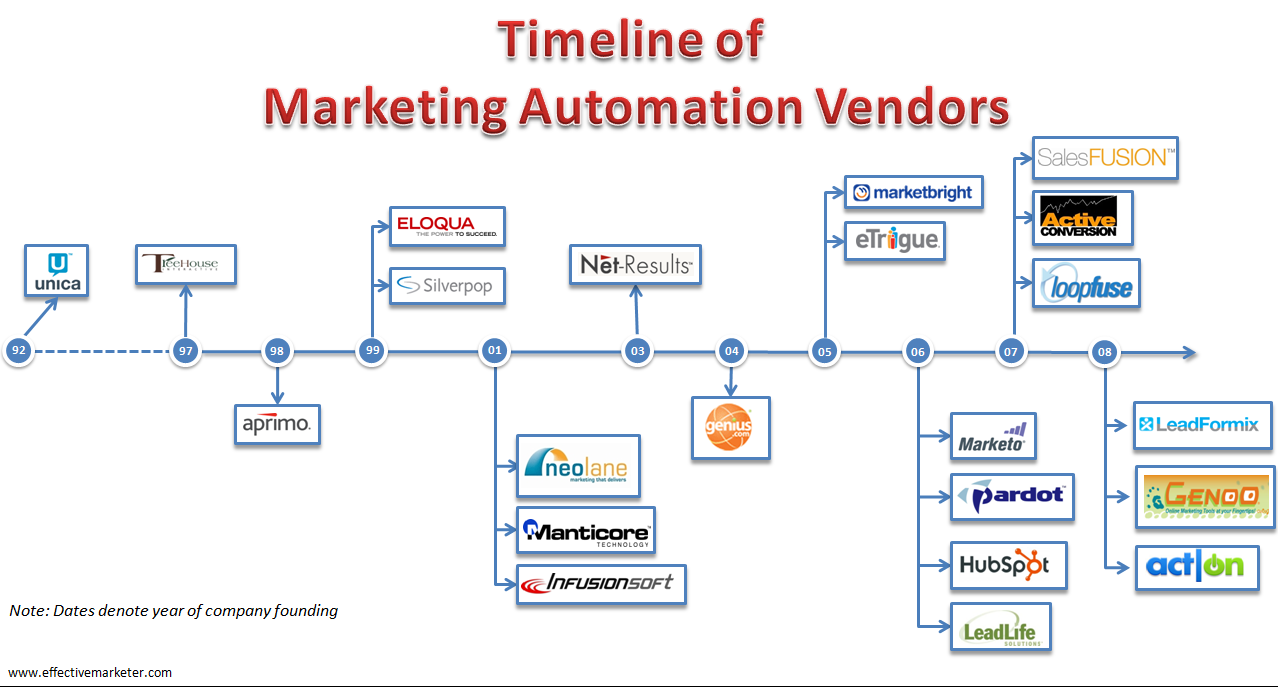
So let’s take a look at the marketing automation companies in play today (mostly US based in this case) and when they were founded. Interesting to note that the majority of the players only came to existence not even 5 years ago. This nascent industry still has lots of growth to do.

Timeline of Marketing Automation Vendors

You may spot some companies that were not considered to be “marketing automation” players just a year or so ago. That points to the evolving nature of the market, and the key functions of lead nurturing, scoring, and automated triggers becoming part of email marketing and other marketing solutions. Marketing Automation Software Guide published a B2B Marketing Automation market map that shows a few other players I ignored for the timeline above, like SAP and Oracle because although they do have marketing automation capabilities it is not their core business (and I don’t agree with tagging Salesforce.com as a marketing automation solution).

Investment in Marketing Automation

Another interesting factor to consider in the marketing automation industry and why it seems to be catching on fire is the money that is flowing towards some of the key players. Just a few marketing automation companies have already raised over $170 million dollars combined. Whether they will all be around a couple years from now is still to be seen, but it does make for a highly competitive environment. With cash to burn, these companies are focusing on growing the customer base first, with hopes that revenue will follow.

Total invested in Marketing Automation vendors

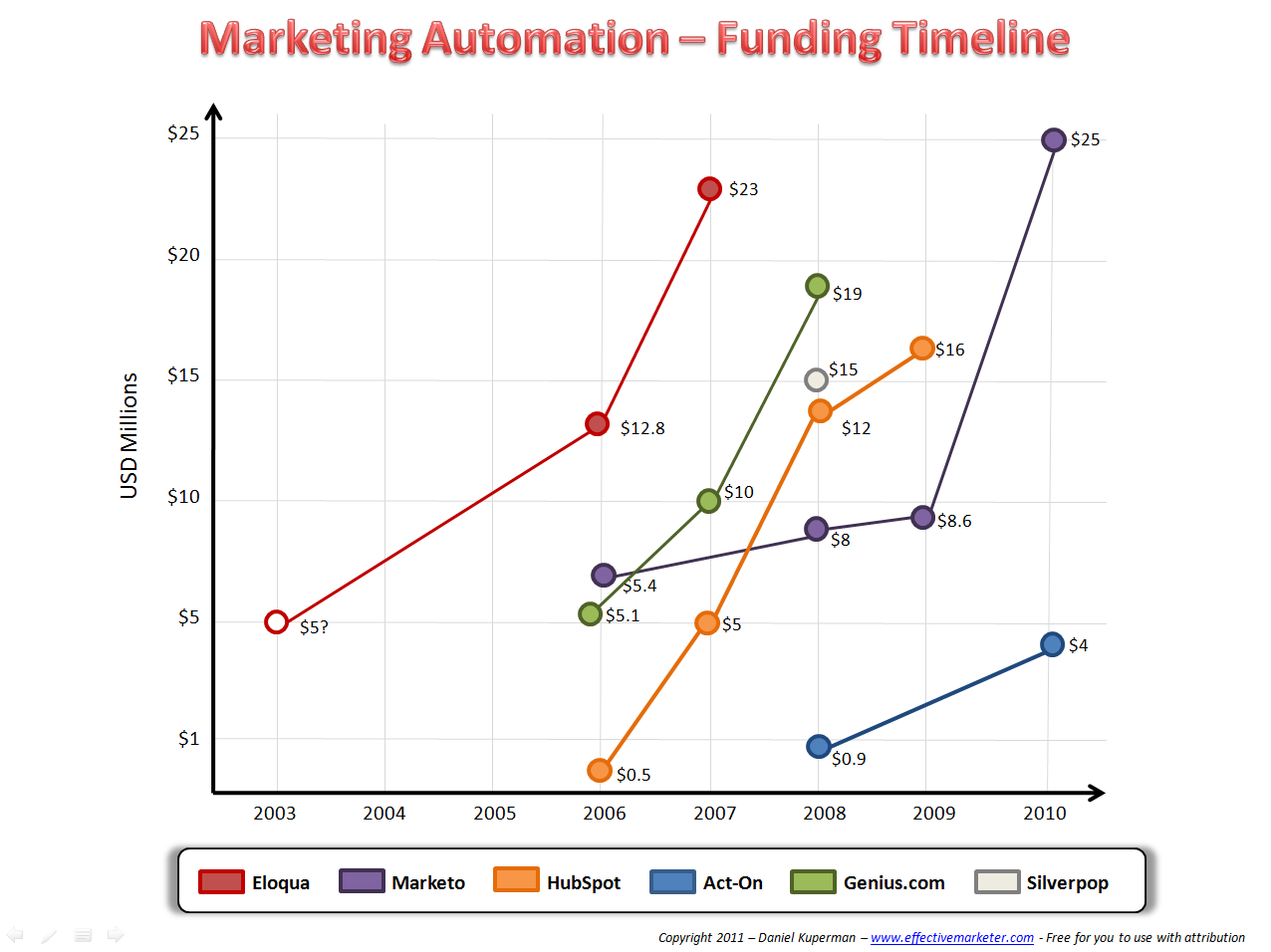
The marketing automation infographic above (click to enlarge) shows the top players in the MA space that have raised over $1 million dollars. Also interesting to note that if you break down the fundraising of each of the above vendors into a timeline (like I did below), most of the investment has been made in the past couple years.

Marketing automation funding timeline

You may have to click to enlarge the funding timeline infographic above.

Note: I used publicly available data and wasn’t able to find Eloqua’s Series A, so I deducted based on valuation of their second round.

The Marketing Automation Market

The Marketing Automation market is at an interesting stage. Companies are fighting for customers, trying to educate the market, and we may be seeing the beginnings of consolidation. Based on the investment figures above it seems is catching on fire, but at the same time there’s fierce rivalry and still a lot of room to improve… what will happen? I don’t know but it promises to be really interesting!

What do you think ?

P.S. Let me know if I missed any MA company in the graphics above or if I got incorrect data. I’d be happy to fix the infographics for benefit of everyone.


What Makes a Great Creative Brief?

January 7, 2011

A similar question was posted on Quora and elicited a number of different but very interesting responses. It just goes to show that there is still a lot of controversy when it comes to creative briefs in marketing. If you come from the agency side, you are used to a certain format. Big companies and small companies have different needs, and so their briefs are also formatted differently.

From the discussion thread I liked two presentations that were shared, posted below. The first is an interesting research done by Jasmin Cheng (from Twist Image) about creative briefs in the industry, and the second is a presentation by Nick Emmel on how to properly write a creative brief. While they don’t settle the discussion, are good sources for inspiration nonetheless.

And, if you’re interested in looking at some different formats for creative briefs, check out this blog post on creative brief template review.