Marketing Charts and Trends

May 18, 2011

With an impressive collection of charts, HubSpot released The Marketing Data Box. Get it for free either in PDF or PPT format.

There are 65 charts on 54 data slides showing:

  • The benefits and consequences of social media to US Adults
  • Whether Americans are willing or not to pay for online news
  • The average cost per lead for outbound vs. inbound marketing
  • The percentage of mobile users that own smartphones
  • What activity dominates mobile internet time (and it’s not social networking)
  • Ecommerce growth rates
  • What percent of US population search online for health information, and where they are most likely to go
  • The TV programming that will make your ads more likely to be thought of as trustworthy
Marketing Data Box

The Rise of the Content Marketer

May 9, 2011

Content Needs a King in Marketing

Content Needs a King

I know I don’t have to argue the value of content to readers of this blog. If you are even remotely interested in marketing it is clear that the more the web has transformed the way we promote our products, the more firmly ‘content’ has planted itself as the center of our lives.

Besides the rise of social media as marketing channel, the emergence of marketing technology, more specifically Marketing Automation systems, in which you can configure the automated distribution of content to customers and prospects has been changing the way marketers see and create conent.

The power of marketing automation is the ability to target your marketing database with specific content based on their behavior and stage in the purchasing process. According to a recent report from Forrester Research titled “B2B Marketers Must Better Prepare for Marketing Automation” (get it from Marketo for free), marketers have to really focus their efforts on content creation if they are to succeed:

“If they only push this type of content out in campaigns, they push their audiences away, since business buyers have a low tolerance for commercial messages. When companies start to tailor content to different audiences and stages of the buying cycle, they greatly increase the amount of content, and the type of content needed changes”

Marketing Roles Are Evolving

Marketing used to have clearly defined roles. Marketing Directors and Managers on top, Marketing Coordinators, Marketing Specialists in the middle, followed by Copywriters, Designers, Web Masters, and more at the bottom. Add a few other roles such as events coordinator and more recently email marketing specialist and maybe even something related to social media and you have the hierarchical organization of 90% of marketing departments today.

With the change and addition of new marketing channels, marketers now see themselves more as content creators than anything else. Twitter feeds need updating, Facebook pages need commenting, blog posts need editing, and YouTube videos have to be tagged. All of this new material requires some form of marketing organization, or better yet, organization and support from the marketing team.

What used to be clear roles (i.e. the copywriter writes copy for the ad while the designer makes the ad look pretty), is now morphing into a free for all. Interns are ‘liking’ pages on facebook while the events coordinator is Tweeting about the trade show giveaway at their booth. Sales reps are sharing webinar recordings with prospects, the CEO is blogging his latest thoughts on the industry, the human resources manager is updating the company’s LinkedIn page.

Does it sound familiar? And scary? Yup!

A new role is starting to take shape. I first heard a term I think will become norm at the last Power of eMarketing Conference in San Francisco, during a panel discussion in which Chris Baggott, Compendium’s CEO, talked about the “Content Coordinator“.

The Content Coordinator

The Content Coordinator is basically the person on your marketing team responsible for coordinating content creation and distribution. Note that this person is not necessarily responsbile for creating the content per se, and in fact some will argue that content creation and copywriting are the same, but rather helping with maintaining a consistent message across all channels (content creation should actually be encouraged throughout the company and a good social media policy put in place).

How you think about what content is for your company will determine how big this role is. Think about:

  • Videos
  • Webinars
  • Presentations
  • eBooks
  • Whitepapers
  • Sales Collateral
  • Blog Posts
  • Tweets
  • Facebook Comments/Likes/etc
  • LinkedIn (company page, discussions, etc.)
  • Website

And the list could go on a few more bullets. But you get the idea… content can be as simple or complex as you make it. The important thing is how consistent, or integrated your message and branding is across channels. And unless you have someone paying attention to it, you’re likely to lose the opportunity to influence people towards buying your product.

So while adding another person to your marketing budget may seem tricky at first, maybe you don’t have to hire an additional person (although for larger organizations that should definitely be the case). You could simply rework some job descriptions to free someone’s time to focus more on the whole content coordination aspect. This could be a good stepping stone for a promising young Marketing Coordinator, for example. The important thing is to make it official and empower this individual to really take charge of content inside your organization. This will save everyone (especially the Marketing Manager) a lot of time and avoid headaches down the road.

Larger organizations may even start thinking of a higher level role, of Chief Content Officer, created in order to plan, coordinate the execution, and report on content ROI.

Whether you decide to formally create this new marketing position or keep things the way they are for now, one thing is certain – your content is more king than ever. How you decide to work with it will determine whether you succeed or fail.

WordPress Plugins for Marketers

February 22, 2011

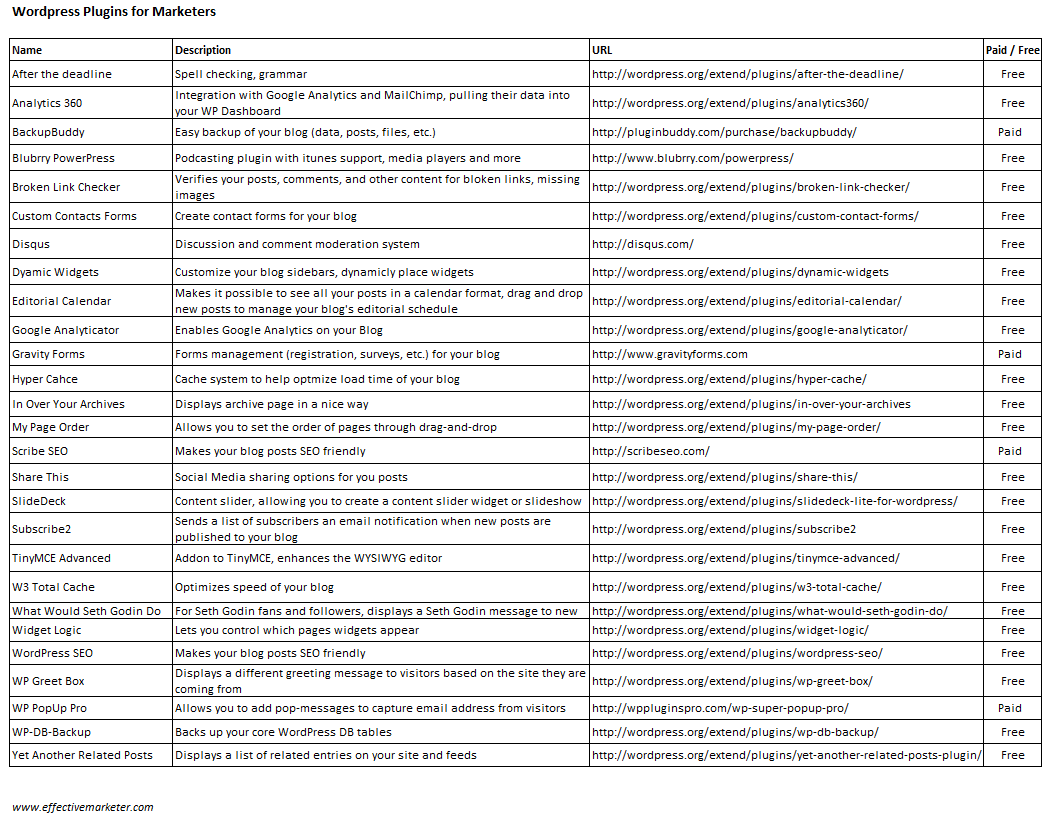
A recent question on the Marketing Over Coffee LinkedIn group about WordPress plugins generated a really great list of tools marketing professionals should consider when running a personal or company blog. To make it easier for everyone I’ve compiled the suggestions from the group into an easy-to-read list (sorted alphabetically). An Excel file is available at the end of the post with all this info.

WordPress Plugins

WordPress Plugins for Marketers (click to zoom)

Note: Only WordPress.org (the free, host-it-yourself version of WordPress) allows for plugins.

The list is not all inclusive and depending on the focus of your blog you may have to search for that specific plugin elsewhere, but it seems there is an agreement that at minimum you need some kind of SEO and Analytics plugin, and if your blog has enough traffic, a cache plugin is justified. For corporate blogs using a backup plugin is probably a good investment as well and the editorial calendar plugin is a great help for planning content especially coordinating among different team members.

Click to download the WordPress Plugins for Marketers in Excel (XLS) format.

Is there a plugin you simply “must have” or recommend that I have not listed? Let us know!


Marketing Automation Catching On Fire

February 16, 2011

According to the recent report by Marketing Sherpa, “CMO Perspectives on B2B Marketing Automation” (offered for FREE by Marketo until March 1st), “the majority of CMOs have either implemented, are in the process of implementation, or are at least considering implementation of marketing automation software“.

34%: Our marketing automation software is partially implemented

19%: Our marketing automation software is fully implemented

17%: We have not began implementation but plan to

30%: We have not began implementation and don’t plan to

This is probably good news for the vendors, which are competing in an increasingly crowded market. Some have even suggested that marketing automation market is floundering, but it is such a new market and offering that is innevitable to have doubts, especially with these many vendors in the space. With time, a shake out is likely (in fact, the recent acquisition of Unica and Aprimo may point to consolidation) and the evolution of solutions will ensure marketing automation has a place in most marketing organizations, much like CRM is now standard for sales departments.

A Marketing Automation Timeline

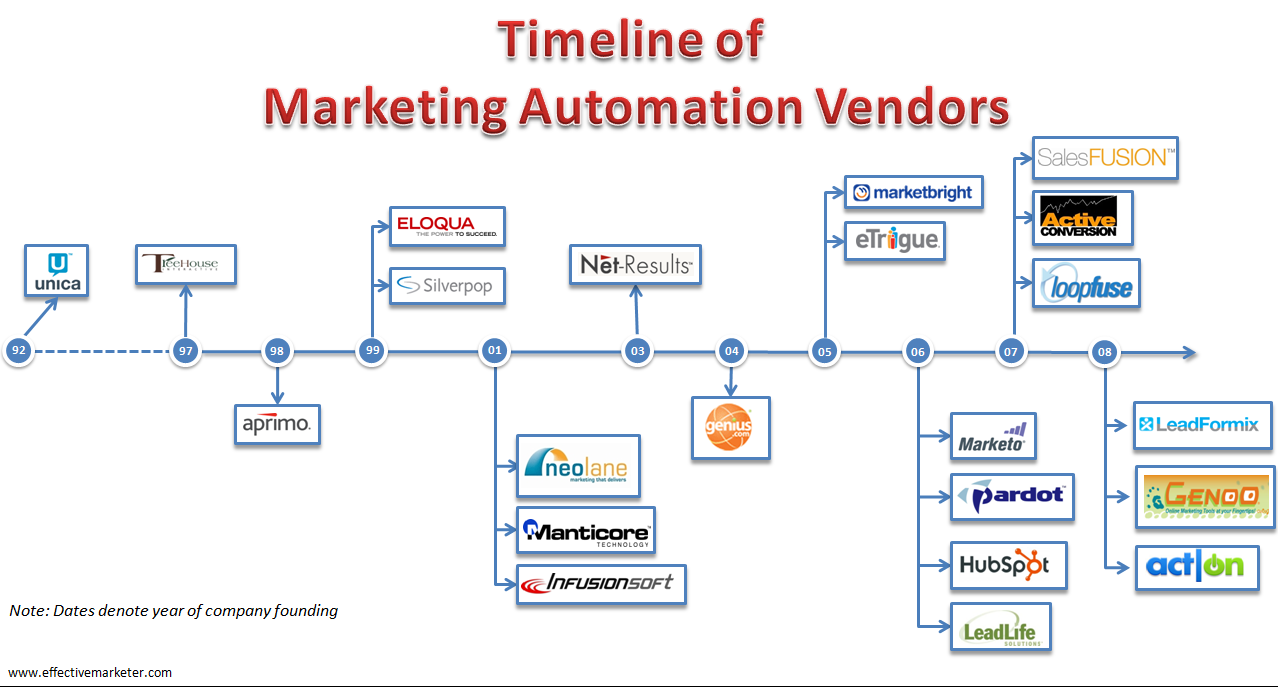
So let’s take a look at the marketing automation companies in play today (mostly US based in this case) and when they were founded. Interesting to note that the majority of the players only came to existence not even 5 years ago. This nascent industry still has lots of growth to do.

Timeline of Marketing Automation Vendors

You may spot some companies that were not considered to be “marketing automation” players just a year or so ago. That points to the evolving nature of the market, and the key functions of lead nurturing, scoring, and automated triggers becoming part of email marketing and other marketing solutions. Marketing Automation Software Guide published a B2B Marketing Automation market map that shows a few other players I ignored for the timeline above, like SAP and Oracle because although they do have marketing automation capabilities it is not their core business (and I don’t agree with tagging Salesforce.com as a marketing automation solution).

Investment in Marketing Automation

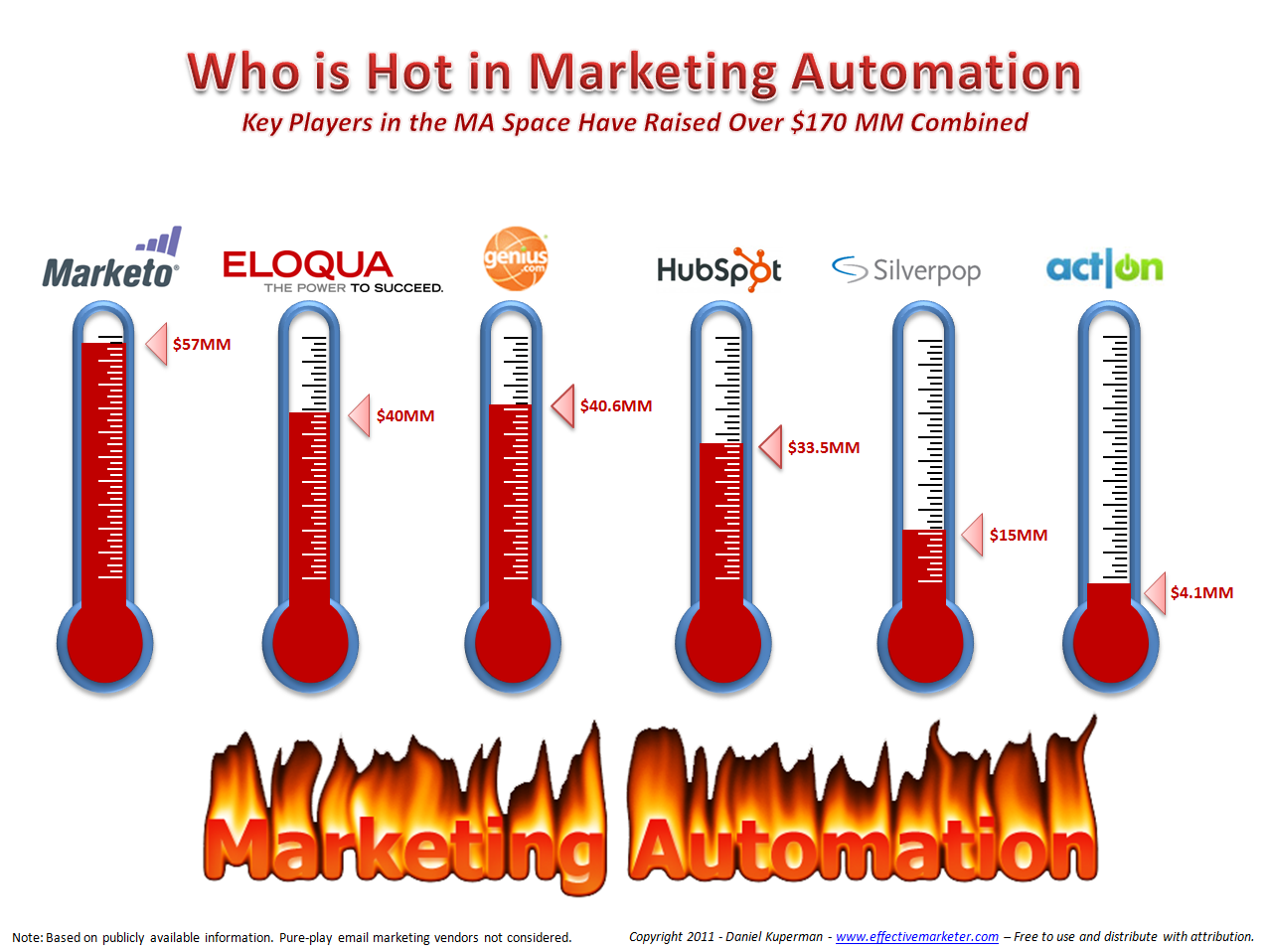
Another interesting factor to consider in the marketing automation industry and why it seems to be catching on fire is the money that is flowing towards some of the key players. Just a few marketing automation companies have already raised over $170 million dollars combined. Whether they will all be around a couple years from now is still to be seen, but it does make for a highly competitive environment. With cash to burn, these companies are focusing on growing the customer base first, with hopes that revenue will follow.

Total invested in Marketing Automation vendors

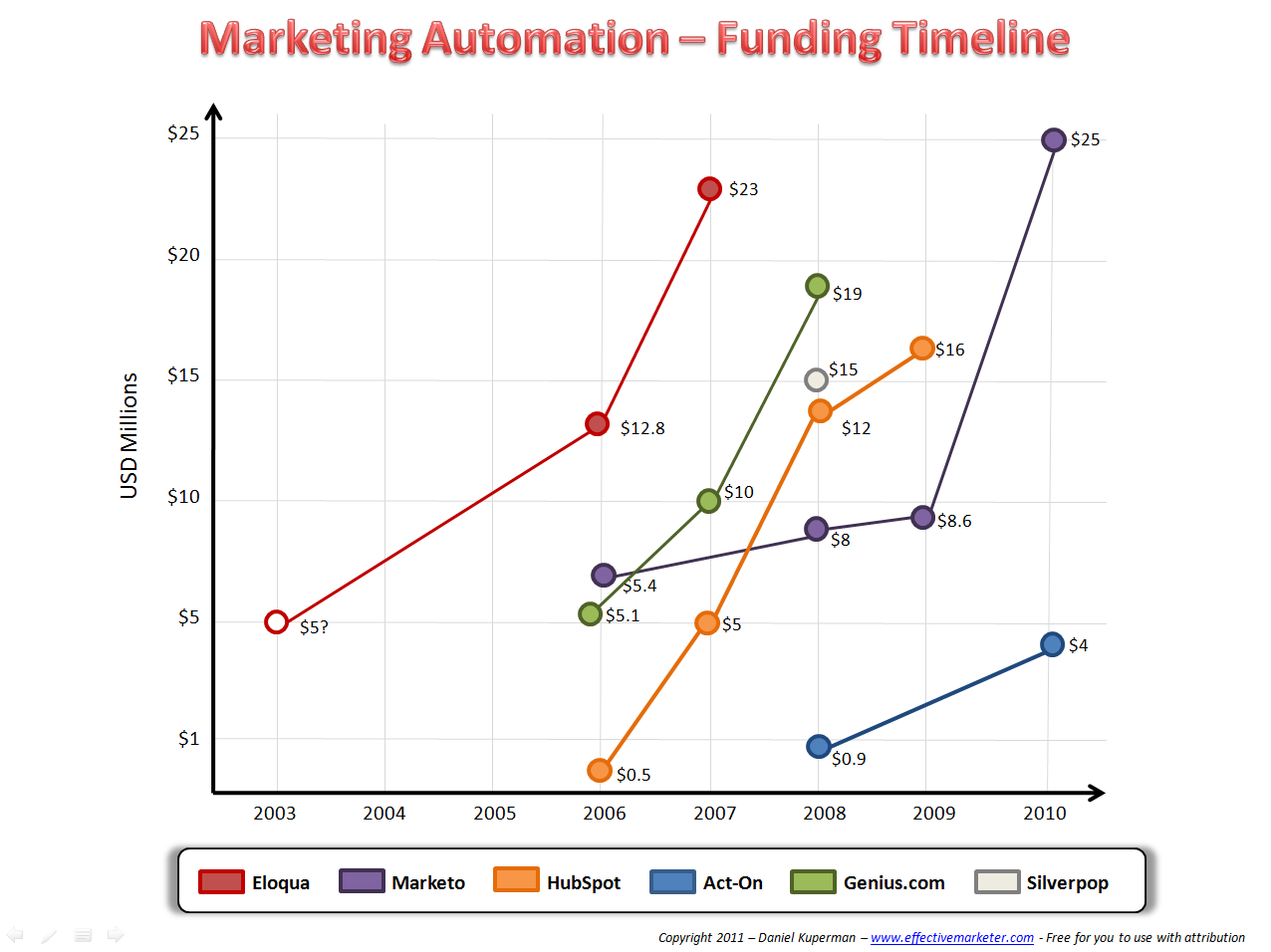
The marketing automation infographic above (click to enlarge) shows the top players in the MA space that have raised over $1 million dollars. Also interesting to note that if you break down the fundraising of each of the above vendors into a timeline (like I did below), most of the investment has been made in the past couple years.

Marketing automation funding timeline

You may have to click to enlarge the funding timeline infographic above.

Note: I used publicly available data and wasn’t able to find Eloqua’s Series A, so I deducted based on valuation of their second round.

The Marketing Automation Market

The Marketing Automation market is at an interesting stage. Companies are fighting for customers, trying to educate the market, and we may be seeing the beginnings of consolidation. Based on the investment figures above it seems is catching on fire, but at the same time there’s fierce rivalry and still a lot of room to improve… what will happen? I don’t know but it promises to be really interesting!

What do you think ?

P.S. Let me know if I missed any MA company in the graphics above or if I got incorrect data. I’d be happy to fix the infographics for benefit of everyone.


The Science of Email Marketing

February 10, 2011

I just attended “The Science of Email Marketing” online webinar, hosted by HubSpot and presented by social media scientist Dan Zarrella.

Slides should be available for download soon here.

Key takeaways:

  1. Businesses are consumers (the boundaries between B2C and B2B are blurred when it comes to reading email)
  2. Try sending emails on weekends
  3. Send very early in the morning
  4. Optimize for mobile
  5. Use lots of links
  6. Include reference information in your emails
  7. Serialize and label your emails
  8. Give your subscribers special access
  9. Send email from someone they’ve heard of
  10. Don’t be afraid to send too much email
  11. Your newest subscribers are your best
  12. Make them want to get your emails
  13. Ask people to follow you

The presentation was based on data collected via focus groups and from MailChimp’s email database of over 9.5 billion emails sent.

I like Dan’s presentation for its brevity and focus on key action items based on solid data. What I wish he had shared is how the data from focus groups and MailChimp is broken down. How many B2B vs. B2C companies, industries, and even job titles. It’s easy to say that B2B and B2C email patterns are similar, but without seeing the data underlying that assumption I’m very skeptic. Also, MailChimp is now known to be used by large corporations (they focus on SMB market) therefore the data may not take into account larger organizations.

As with all analysis and reports out there, you have to take all of the recommendations with a grain of salt. Test them, see if they work, then be the judge. No one knows your industry and customers better than you.


Making the Most of Your Webinars

February 7, 2011

A recent report from On24, “Webcast Benchmarks and Best Practices for Lead Generation“,  has some interesting numbers when it comes to how webinars are being used and their effectiveness at lead generation. Take for instance the following:

  • The average webcasts captures 441 registrants
  • Attendee participation is usually 50-60% of registrations
  • 15-30% of registrants are sales-qualified opportunities

The numbers above should be enough for you to go back to your own metrics and see how you compare. Sure, depending on your industry the numbers might be skewed but at least you have a benchmark and something to show (or not!) senior management when your results are being questioned.

The report goes a bit further and also tells us that 52% of all registrations occur within 10 days before a scheduled webinar and 15% registering on the day of the webcast. In my experience this is accurate, and sometimes during the day (or the day before) of the event tends to bring an increasing number of new registrations. We are all procrastinators it seems when it comes to registering for online events.

What’s the ROI of webcasting?

According to the survey webcasts have a $22.60 cost per registrant for those with an average of 441 registrants and $39 per participant if the average is 256 participants. I personally think these numbers are high, but it depends heavily on the webinar platform you’re using. On24 is not the lowest priced one on the market (Adobe Connect, WebEx, and GoToWebinar all charge less for webinars), but this should be easy enough for you to calculate for your specific situation. Oh, but note that the cost involves “audience generation programs, to produce and promote a webcast”, so you have to add your email marketing costs (again, different platforms will charge differently) and any additional method you typically use to get people to register and attend.

I encourage you to download the FREE report from On24 and check out some additional nuggets that can help you evaluation your own webcasting program.


Upcoming Marketing Conferences

February 3, 2011

It’s February already and you keep thinking “what the heck happened to January”? You’re note alone. A few good events have come and gone, like the Digital Marketing Forum, MarketingSherpa’s Email Marketing Summit, and the Email Evolution Conference and I completely missed them.

Sure, budget is short and you can’t attend every single event, but is good to know what’s coming up so that you can prepare yourself and pick the ones you should go. Also, the earlier you register usually the better deal you can get. So here you go, this is the list of marketing events and marketing conferences coming up (US only) for the first half of 2011. Check them out, pick a couple and start planning!

Upcoming marketing conferences

==February==

Online Marketing Summit
February 7-11
San Diego, CA
Link: http://www.onlinemarketingsummit.com/

Social Media Strategies Summit
February 8-10San Francisco, CA
Link: http://socialmediastrategiessummit.com/

Frost & Sullivan Marketing World
February 8-11
New Orleans, LA
Link: http://www.frost.com/prod/servlet/summits-details.pag?eventid=200426011

Social Media Camp
February 9New York, NY
Link: http://socialmediacampny.com/

Social Media Masters
February 11San Diego, CA
Link: http://socialmediamasters.com/

Content Marketing Strategies Conference
February 16-17
Berkeley, CA
Link: http://contentmarketingstrategies-mashable.eventbrite.com/

Social Fresh Tampa
February 21-22
Tampa, FL
Link: http://socialfresh.com/tampa/

DMA Mobile Marketing Day
February 22
New York, NY
Link: http://www.the-dma.org/councilevents/mobileday/

==March==

Marketing Research Executive Forum
March 6-8
Atlanta, GA
Link: http://www.marketingpower.com/Calendar/Pages/default.aspx

Search Marketing Expo
March 8-10
San Jose, CA
Link: http://searchmarketingexpo.com/

Conversion Conference
March 14-15
San Francisco, CA
Link: http://conversionconference.com/west/home.html

Search Engine Strategies
March 21-15
New York, NY
Link: http://www.searchenginestrategies.com/newyork/

==April==

Forrester Marketing Forum
April 5-6
San Francisco, CA
Link: http://www.forrester.com/events/eventdetail/0,9179,2511,00.html

AdTech
April 11-13
San Francisco, CA
Link: http://www.ad-tech.com/sf/adtech_san_francisco.aspx

The Power of eMarketing Conference
April 19-20
San Francisco, CA
Link: http://www.emarketingassociation.com/2011/SF/index.html

Mobile Marketing Strategies Summit
April 26-28San Francisco, CA
Link: http://mobilemarketingstrategiessummit.com/

==May==

Marketing Innovation Summit
May 2-5
Boston, MA
Link: http://www.mis2011.com/Boston/Home

Sirius Decisions Summit
May 4-6
Scottsdale, AZ
Link: http://www.siriusdecisions.com/live/home/document.php?dA=ConfAnnSummit2011

Event Marketing Summit
May 16-18
Chicago, IL
Link: http://emsummit.eventmarketer.com/

==June==

International BMA Conference
June 1-3
Chicago, IL
Link: http://www.marketing.org/i4a/pages/index.cfm?pageid=5288

MarketingProfs B2B Forum
June 13-15
Boston, MA
Link: TBD

==

And the following are some of the marketing conferences I’ll keep watch and decide as we get closer.

MarketingSherpa B2B Marketing Summit Boston
09/26-27
Boston, MA

MarketingSherpa B2B Marketing Summit SF
10/24-25
San Francisco, CA

Dreamforce 2011
August 30-Sept 2
San Francisco, CA

BlogWorld Expo
October 14-16
Las Vegas, NV

Conferences abound, but they are a great way to learn new things, network, and more importantly get out of the office and focus for a couple days.

P.S.: I’ll be presenting at the upcoming The Power of eMarketing Conference, so if you plan on going to that one let me know so we can meetup.

Did I forget a conference? Let me know and I’ll update the list.


B2B Marketing Summit Shows Old Problems Persist

October 14, 2010

So it seems MarketingSherpa’s B2B Summit 2010 is over and from what I read in their wrap up post, the same old problems plaguing marketers for the last 5 years are still here today. First of all, what is this summit? According to their post:

“Last week in San Francisco, 211 business-to-business marketers spent two days sharing insights, case studies and advice on social media marketing, lead generation, Sales and Marketing alignment, and other hot-button issues on the West Coast swing of MarketingSherpa’s seventh annual B2B Marketing Summit.”

MarketingSherpa is known for quality content and I have attended a couple conferences (I was a speaker at the Email Marketing Summit 2008) and have always thought that the best you get from attending an event like this is more in the form of networking than in content itself. The other good thing about going to such a conference for me, is that I get dedicated time to really think through all the topics being discussed, without being interrupted for meetings, phone ringing and people walking in the office.

The many takeaways from this year’s B2B Marketing Summit (West Coast) according to MarketingSherpa, were:

  1. Begin with the end in mind
  2. Put yourself in your customers’ shoes
  3. Getting a lead is just the beginning…
  4. For successful lead generation and nurturing, you need quality content
  5. Use measurements that matter
  6. It all happens on the landing page
  7. Be strategic about presenting your campaigns and your vision to the C-level

None of the takeaways above strike me as particularly new or groundbreaking, but that’s how it always goes. Sometimes we just need to be reminded of the obvious so that we can focus on the essential.


Making Website Reviews Easy

October 5, 2010

64/365 - mapping by Jenn Vargas @ Flickr

The website is a few years old, there are some inconsistencies in font and the colors don’t match all that well. On top of that, now you have videos you want to showcase and the home page was not designed with that in mind. In sum, the website needs a complete makeover. Sounds familiar?

When reviewing websites and discussing design elements, you invariably end up drawing all over the whiteboard, asking your designer to come up with some mockups and then annotating those and sending them back. How about using some technology to make things easier? I’ve already discussed the use of PowerPoint for website reviews and if you’re starting from scratch it not only provides you with a grate starting point but is a low cost solutions.

For reviewing existing websites, I have used my tablet PC to make screen annotations and save them as images to the team, but what if you have people remote or if you want them to review and add their own comments about the site on their own time?

Below are a few useful tools out there for this problem.

Website Review and Annotation Tools

ShiftSpace.org is an interesting app that gives you the ability to comment on any website using your browser, but others have to have ShiftSpace installed to see them.

Google Sidewiki is an extension for Google Chrome that lets you comment on any website, but falls short on the drawing options (arrows and circles and such).

Diigo allows you to add sticky notes and highlights to websites and share with other people, and they do not have to have diigo installed. Problem is, you can’t draw circles or squares on the site to illustrate changes in the design.

Sharedcopy.com takes a screenshot of a site, let’s you annotate, send to other people, where they can add their own comments to it. Requires users to have the sharecopy bookmark app on their browsers, but works nicely.

Notable is a paid app that gives you great tools for annotations and commenting on any site.

Bounce is my favorite so far, because not only is a free version of Notable, but is the easiest to use. No registrations, no downloads required. Simply go to the Bounce site, enter a URL and start annotating. Then save the comments and share the unique link with your team. If there’s one thing missing is the ability to draw on the page.

Any other tools I have missed?


How Success is Misunderstood

September 29, 2010

How do you define success? Number of leads generated? Amount of sales or deals closed? If you answered “it depends”, then you’re thinking smart. Success can be based on a number of different factors and it also varies based on who you talk to, after all, we all have different objectives (personal and professional).

Now let’s go one step further. If you see another company being successful (however you define success) and you try to apply the same method, can you guarantee you will also achieve success? If you said “it depends”, you just got yourself an extra point! As marketers we all know it’s not that simple. Questions about what the target market is, what industry are you talking about, and such are the first things that come to mind. A method of selling hot-dog on the street can be used to sell software, but I wouldn’t follow it by the letter.

That’s why it still amazes me that discussions about following a formula for success often get stuck in how you define “success” instead of discussing the differences between target markets. If you are a blogger and your readers are software entrepreneurs, you can’t really expect that the bag of tricks used to attract social media consultants will work the same way. A B2B company applying tactics used by B2C companies can be very successful but only after some necessary translation is done.

How do YOU define success and do you have a special formula?