The Challenges in Adoption of Marketing Technology

May 3, 2011

A recent webinar hosted by Neolane, “Crack the Code – Getting C-Suite Buy-In for Your Marketing Tech Purchases” had a very interesting presentation by Suresh Vital from Forrester Research.
Based on a recent report on Marketing Technology Adoption for 2011, the findings of their research shed some light on the challenges we face when it comes to marketing technology.

The Goal of Marketing Software

The need for marketing software comes from the necessity to better understand customer behavior across multiple channels. Companies need to be able to track and measure customer interactions from a reliable source and that has driven a lot of the recent interest in Marketing Automation and Customer Intelligence technologies. The goal is to make use of cross channel marketing strategies to target the customer at the right moment and influence purchase decisions.

Not a new trend, but rather a need that has ben greatly amplified by the prevalence of social media channels which in turn is making companies look for technology solutions. Without solid customer data, cross channel strategies become increasingly difficult to implement.

Marketers as Technologists

According to Forrester’s research, data driven marketers are divided about technology investments. 53% of Customer Intelligence professionals (those who own the customer data and are responsible for customer analytics) consider themselves as technology leaders while 47% said they were technology followers.

While personalities play a role, I think corporate policies and the marketing leadership play a big role in shaping up how marketing technology is brought into the company.

Mobile technologies were also a clear trend for 2011, having the majority of marketers saying they are planning on using or increasing the use of mobile marketing technology. Improving customer experience across channels was also top of mind.

Technology and the Marketing Budget

Technology accounts for 10 to 14% of the marketing budget, according to the research. Marketers are starting to play a strong role in defining the needs and in the selection process when it comes to purchasing marketing technology. This is a shift from the traditional back-seat marketers take for software purchases, typically letting the IT department decide.

27% of marketers say they are the final decision makers

Adoption Problems with Marketing Technology

A surprising finding was that the most important criteria for selection of marketing technology is cost, quickly followed by functional alignment.

82% of respondents say cost is number one factor in deciding marketing technology

This means marketers are settling for solutions that are more economical as long as they match most of their needs. Those solutions that praise themselves for being the all encompassing [fill in the blank] for marketing may be surprised to find out that they are losing deals to lesser competitors simply because of pricing, but that’s not all they should focus on.

As part of the adoption issues, the research found out that the top three barriers for using marketing technology are:

  • 49% Cost
  • 47% Uncertain ROI
  • 40% No Budget

This makes sense. With markeeting budgets still being threatened due to economic uncertainty, marketers are pressed to justify their purchases and show ROI. New tools on the block (social media monitoring and others are the likely candidates) may have a tough time showing solid ROI, therefore their purchases being delayed. Vendors should therefore really work with their customers and prospects in trying to justify the purchase. Marketers also need to work on their justifications and their business cases to make senior management understand why a technology can help the company especially when Facebook, Twitter, and other channels are still a mystery for most corporate executives.


Selecting the Right Email Marketing Provider

April 6, 2011

You either have or will have to evaluate and select an email marketing software provider at some point in your marketing career. And there’s a good reason most people dread this project, after all with so many ESP (email service providers) out there, is really a daunting task.

That’s why I wrote a comprehensive guide to help you in your email selection process. Published in a 3-part series by Email Vendor Selection website, it shows a proven approach to quantitatively help you narrow down your choices and select the solution that will be the best fit for your organization.

Check out part 1 of the “Taking control of the email vendor selection process” article and let me know what you think!


Why Sales and Marketing Don’t Get Along

March 24, 2011

Talk to marketing mangers and sales managers about their biggest complaint and you will likely hear “They don’t follow up on leads!” from the marketing guy and “Their leads suck!” from the sales guy. No news there. But why is that this fight on lead quality continues?

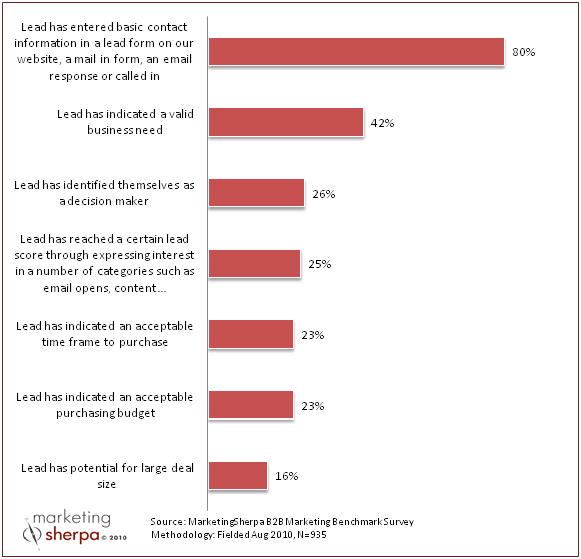
According to a recent chart published by MarketingSherpa (below), 80% of marketers don’t spend time qualifying leads before sending them to sales.

B2B Lead Qualification Requirements

What information is required before leads are passed to sales?

It is interesting that back in 2009, MarketingSherpa had published a chart showing the key challenges marketers faced and “generating high quality leads” was the top one. Sales keeps insisting on receiving better leads, marketing knows that is an issue, but still they are not delivering. In their “CMO Perspectives on B2B Marketing Automation” this challenge for high quality leads is shown as having increased from 69% in 2009 to 76% in 2010.

A Gartner Group presentation on allocation of Marketing Budgets for 2011 showed that the top three marketing priorites for this year are:

  • Acquire new customers
  • Improve customer retention
  • Support sales including lead generation programs

If the budget is there, then maybe more companies will be able to finally put some technology in place to help with lead quality, more specifically marketing automation with the goal of improving lead quality. Because the solution to the disconnect facing marketing and sales today is to fix the “lead problem”, once leads are better qualified the two organizations can be friends again.


How Everybody Wins with HubSpot’s Funding

March 10, 2011

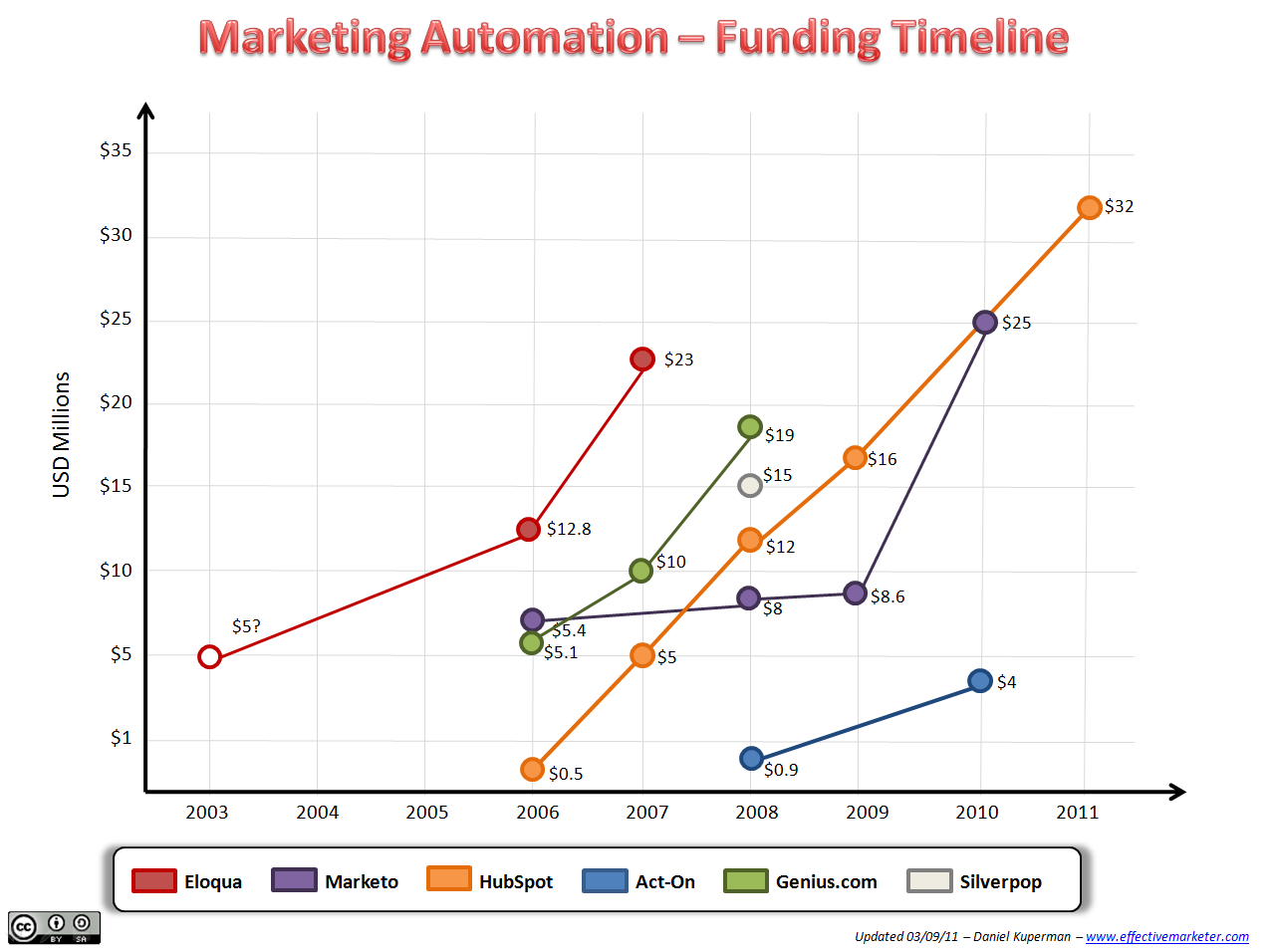
As everyone in the marketing industry surely knows by now, HubSpot raised $32 million in additional funding. This means that is time to update my previous charts on marketing automation funding (see below) and the funding timeline, because HubSpot just surpassed Marketo as the highest funded marketing software vendor to date. (Note: yes, I wouldn’t necessarily say HubSpot is a ‘marketing automation’ vendor per se, but they are moving towards that end).

Click to enlarge

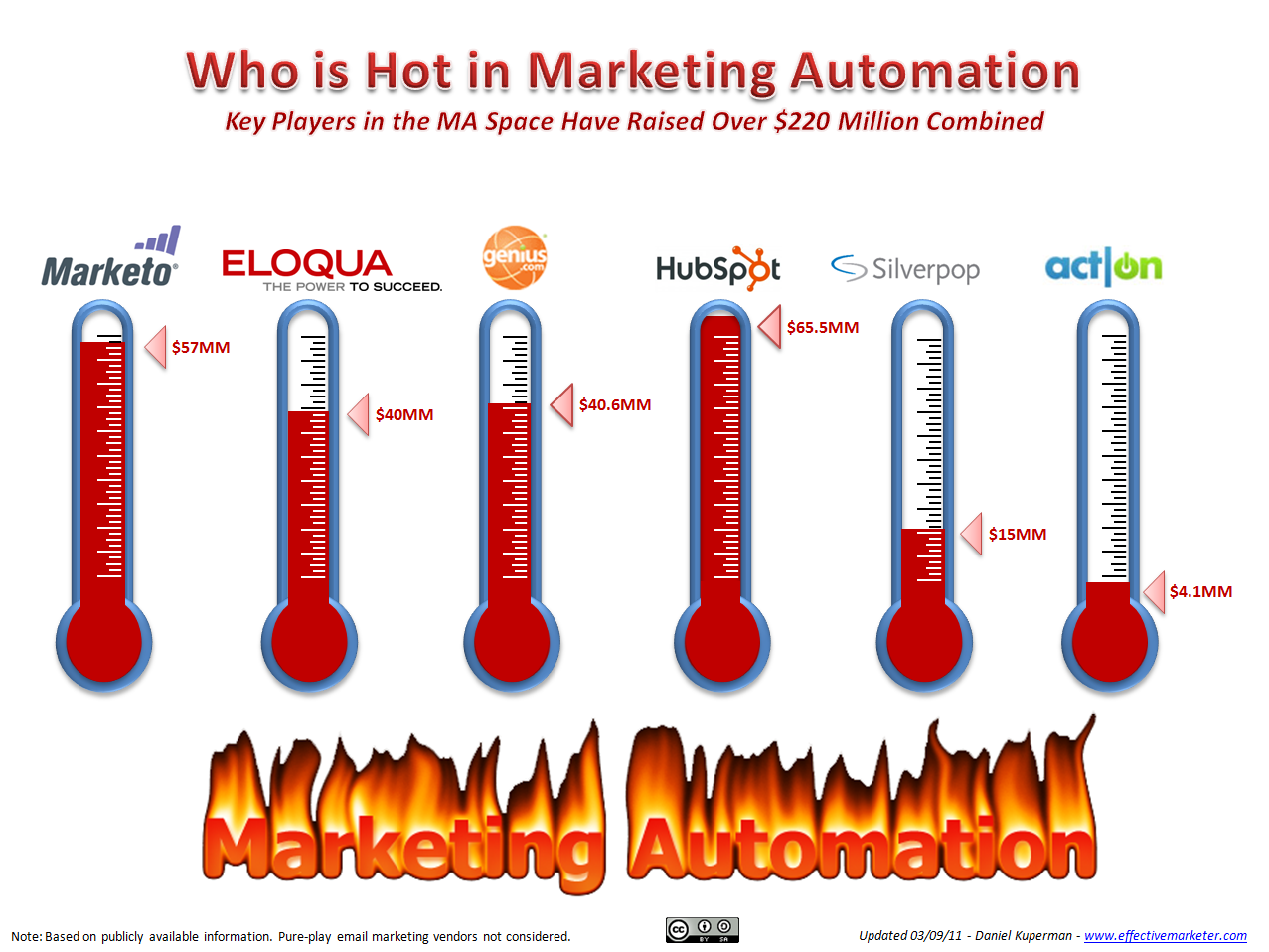
With the new round of financing, HubSpot now leads the pack in terms of VC funding and takes the total amount raised to date by key marketing players to over $220 million.

Click to enlarge

Updated above is the timeline of funding for the key players in the marketing automation space (you may argue HubSpot is not a marketing automation vendor, this is subject for another post).

Everyone Wins

But it also means something else. The money flowing to companies like HubSpot is impressive, and the results of the investment will not only benefit them but also the whole marketing automation and marketing software industry in general. Is almost like a virtuous cycle, where money goes to marketing software vendors, who use it to build better products and educate the market, which then learns about the benefits of such solutions, purchase those solutions, and publicize it themselves and pay those vendors for services.

Industry Impact

Should established marketing automation players be worried about HubSpot’s sudden infusion of capital? After all, now that they have the deep pockets to invest in improving their product, maybe their solution will start looking more like what marketing automation vendors have been selling for some time now. For Eloqua, at least, they say there’s no need to worry since HubSpot is serving a very different market.

Market Segmentation

And here is worth pausing for a moment. We sometimes tend to bundle all of the vendors into one big basket, because a search for marketing software solutions will show more results than you would care to browse and the sales literature of most of them will make you think they all do very similar things. Nothing could be further from the truth, since after taking a few of those solutions out for a spin you will discover there’s much difference under the hood… but that is a topic for another post, since it can take some time to untangle the value propositions and real benefit all the marketing software vendors make.

So HubSpot’s recent capital infusion should be treated as good news by all marketing vendors. It does seem the whole industry is due for a shake-down but until then, the awareness and market education will benefit everyone.


Marketing Automation Catching On Fire

February 16, 2011

According to the recent report by Marketing Sherpa, “CMO Perspectives on B2B Marketing Automation” (offered for FREE by Marketo until March 1st), “the majority of CMOs have either implemented, are in the process of implementation, or are at least considering implementation of marketing automation software“.

34%: Our marketing automation software is partially implemented

19%: Our marketing automation software is fully implemented

17%: We have not began implementation but plan to

30%: We have not began implementation and don’t plan to

This is probably good news for the vendors, which are competing in an increasingly crowded market. Some have even suggested that marketing automation market is floundering, but it is such a new market and offering that is innevitable to have doubts, especially with these many vendors in the space. With time, a shake out is likely (in fact, the recent acquisition of Unica and Aprimo may point to consolidation) and the evolution of solutions will ensure marketing automation has a place in most marketing organizations, much like CRM is now standard for sales departments.

A Marketing Automation Timeline

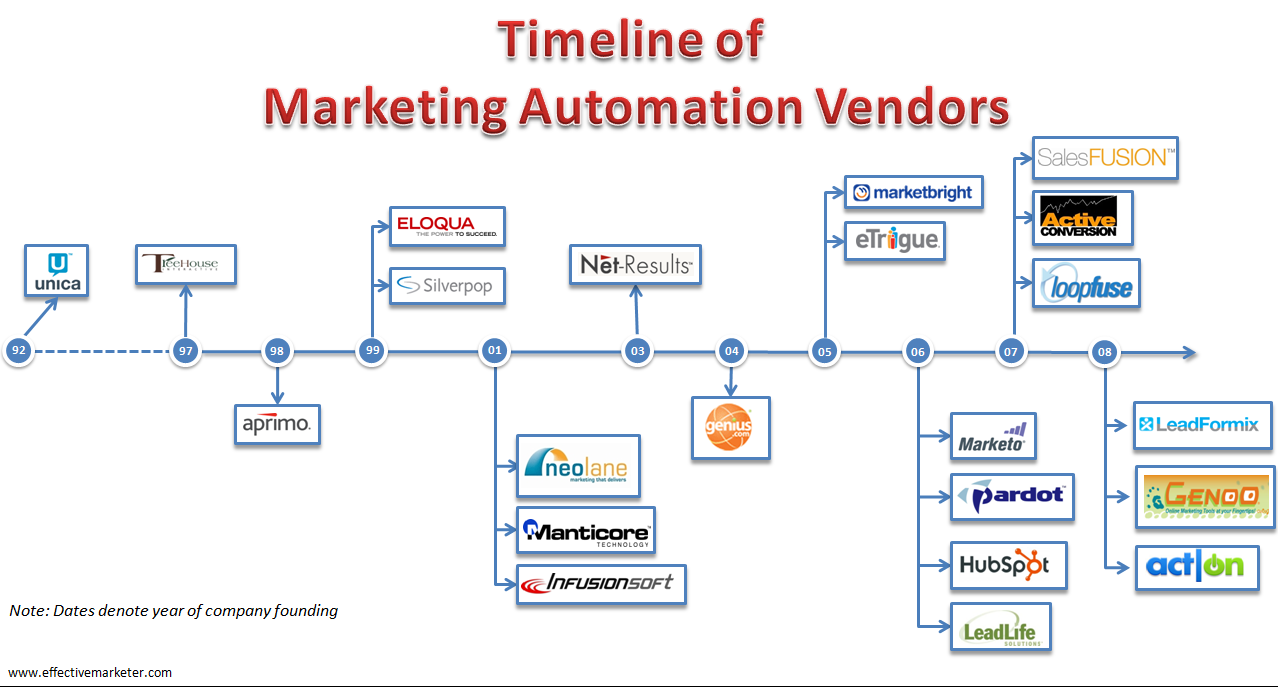
So let’s take a look at the marketing automation companies in play today (mostly US based in this case) and when they were founded. Interesting to note that the majority of the players only came to existence not even 5 years ago. This nascent industry still has lots of growth to do.

Timeline of Marketing Automation Vendors

You may spot some companies that were not considered to be “marketing automation” players just a year or so ago. That points to the evolving nature of the market, and the key functions of lead nurturing, scoring, and automated triggers becoming part of email marketing and other marketing solutions. Marketing Automation Software Guide published a B2B Marketing Automation market map that shows a few other players I ignored for the timeline above, like SAP and Oracle because although they do have marketing automation capabilities it is not their core business (and I don’t agree with tagging Salesforce.com as a marketing automation solution).

Investment in Marketing Automation

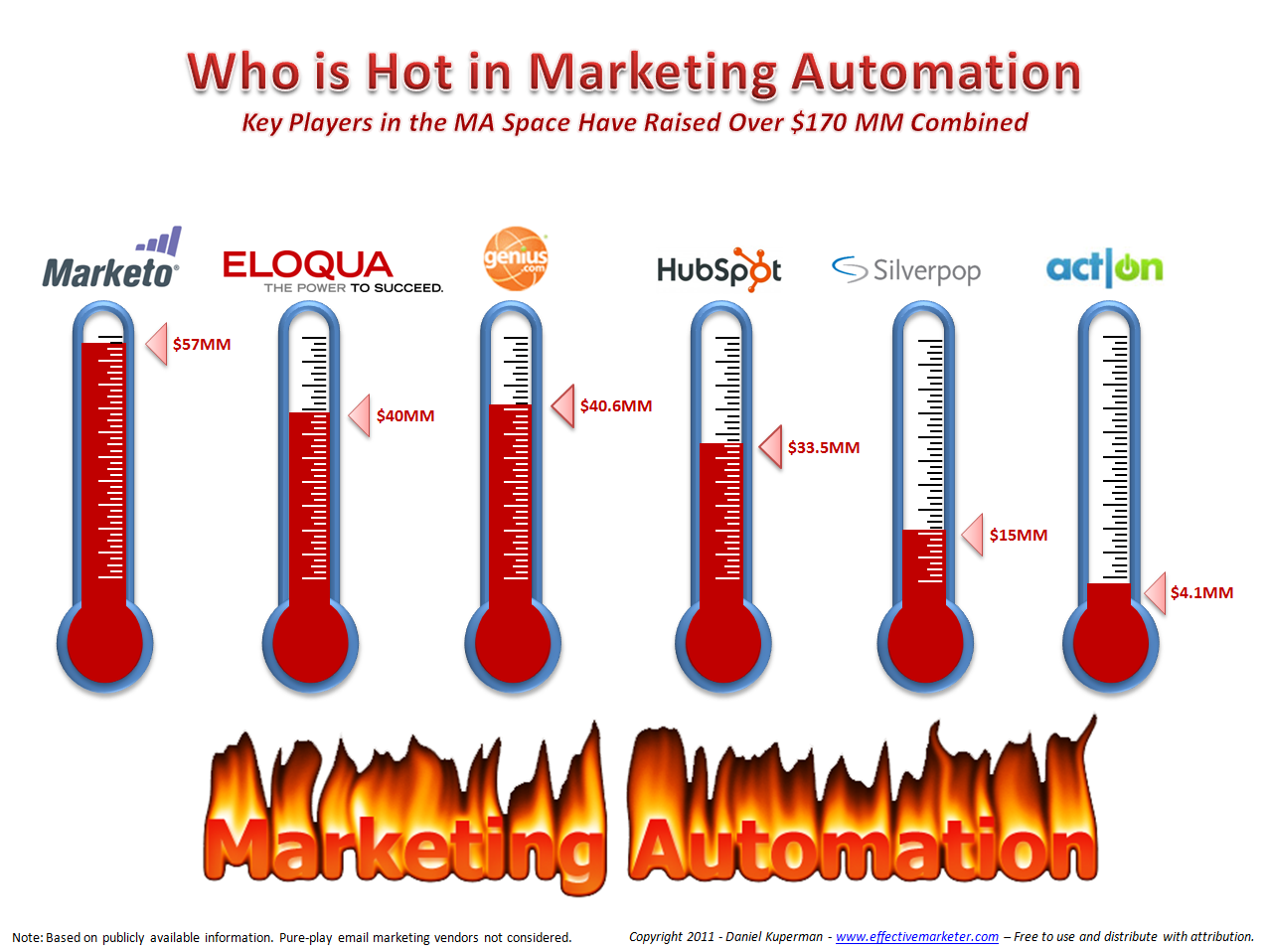
Another interesting factor to consider in the marketing automation industry and why it seems to be catching on fire is the money that is flowing towards some of the key players. Just a few marketing automation companies have already raised over $170 million dollars combined. Whether they will all be around a couple years from now is still to be seen, but it does make for a highly competitive environment. With cash to burn, these companies are focusing on growing the customer base first, with hopes that revenue will follow.

Total invested in Marketing Automation vendors

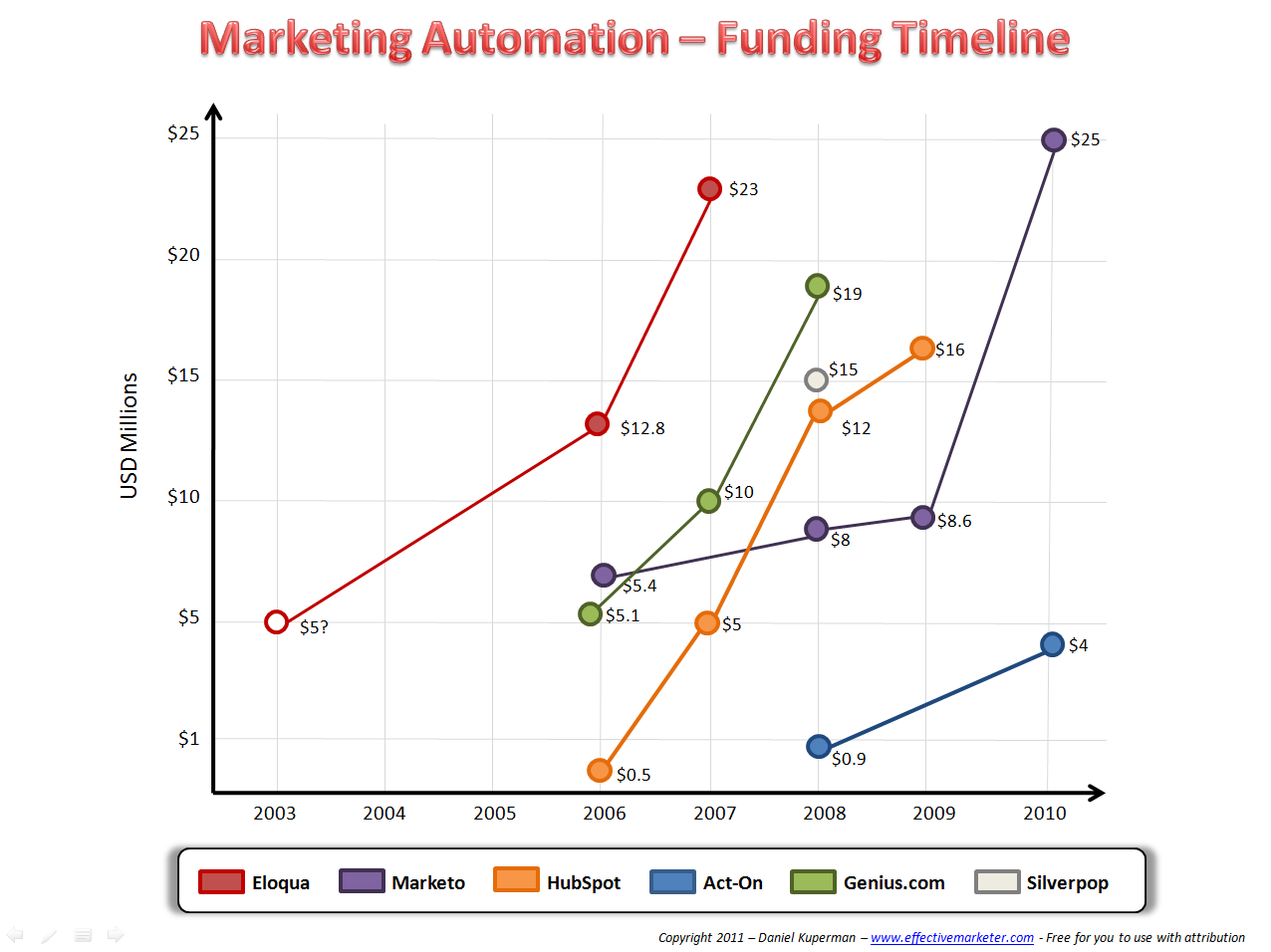
The marketing automation infographic above (click to enlarge) shows the top players in the MA space that have raised over $1 million dollars. Also interesting to note that if you break down the fundraising of each of the above vendors into a timeline (like I did below), most of the investment has been made in the past couple years.

Marketing automation funding timeline

You may have to click to enlarge the funding timeline infographic above.

Note: I used publicly available data and wasn’t able to find Eloqua’s Series A, so I deducted based on valuation of their second round.

The Marketing Automation Market

The Marketing Automation market is at an interesting stage. Companies are fighting for customers, trying to educate the market, and we may be seeing the beginnings of consolidation. Based on the investment figures above it seems is catching on fire, but at the same time there’s fierce rivalry and still a lot of room to improve… what will happen? I don’t know but it promises to be really interesting!

What do you think ?

P.S. Let me know if I missed any MA company in the graphics above or if I got incorrect data. I’d be happy to fix the infographics for benefit of everyone.


Marketing Automation Monday is Here!

December 8, 2010

On Monday I attended a Marketing Automation Monday event, put together by the Marketing Automation Association, a newly formed group of marketing professionals that discusses all things related to marketing automation and best practices. It was really fun and if you are interested in learning how other marketers are tackling their marketing, CRM, and even sales challenges this is the place to go.

Some of the issues discussed were:

  • Who manages and who owns the CRM system in your organization?
  • How do you setup your scoring system for inbound leads?
  • What is the hand-off process with sales?
  • How do you get a feedback loop established with sales so that you can get better at scoring your leads?
  • Buyer personas and content creation

The interaction was great and the fact that we had people from both SMB and large companies was great, we could hear both sides of the story and how different size companies work with marketing automation.

One of the interesting points raised during the discussion was about content creation. Sure, you can setup all the triggers, scores and processes in your MA system but nothing will matter if you don’t have the content to support it. Most companies start off with one track for their automation and nurturing programs and expand with time. Ideally, you want to match your content with the buyer persona and the nurturing/sales stage. I.E. one type of content is sent to the IT Manager who is evaluating vendors while another is sent to the Programmer who is trying to learn more about your product.

A recent chart from MarketingSherpa touches a bit upon the content creation challenge for email marketing (see below). In it they show how automatically sending email based on triggers is more effective than allowing subscribers to specify email preferences. Interesting also that according to their research the segmentation of email campaigns based on behavior (which is a big part of a Marketing Automation program) is also less effective than the sending of emails based on triggers.

Three dimensions of relevancy tactics

As always, you have to take all of this with a grain of salt. An important point raised during the Marketing Automation Monday meeting was that you should really analyze your company’s history and understand based on your historical data (i.e. which leads turned into closed deals, where did they come from, what programs generated more closed deals, etc.) what is working best for you and what patterns can you see in your history that will help you fine tune your automation programs.

Interested in learning more about Marketing Automation and how to take advantage of it? Join the LinkedIn group and attend the next event!