Killer Presentations

May 26, 2011

As marketers is our job to create meaningful content that will help influence sales. You will eventually find yourself not only writing copy for an eBook, whitepaper or email campaign but also having to create and deliver presentations. That’s where you can shine. Let me explain.

The Suckiness Factor

Most presentations suck. That’s a fact of life and I think that there are people with genetic predisposition to put together boring presentations. No matter how hard they try, people will not be enticed  by new bullet colors and the almost funny jokes.

Think back to the past few presentations you’ve attended. Either from other departments in your company or even delivered via webinar. Now score them according to the “suckiness factor” below:

  • Zero: Outstanding presentation, didn’t feel the time go by.
  • One: Good presentation, I’ve learned something today.
  • Two: Meh, I’ve seen better.
  • Three: What time is it? Wake me up when it’s over.
  • Four: Ugh! All those bullet points are giving me headaches.
  • Five: Stop! Please make it stop! I can’t take it anymore!
This won’t make you feel better but at least you now have something to do during those presentations.

Creating Quality Presentations

The goal of understanding which presentations suck and why, is so that you can avoid the same mistakes when creating yours. Whether you will deliver them yourself or you are creating them for a sales pitch, a demo, conference, or any other event the important thing is to make sure your presentation won’t suck!

The first thing you should do is watch Garr Reynolds explaining how to create great presentations at this Google Talk recorded session (video embedded below).

After you’ve watched the video above, go buy his book, Presentation Zen. It’s an easy read that can take your current presentation and improve it 10x. I’m not kidding.


A Buyer Persona Template for the B2B Marketer

May 20, 2011

With the new hype of content creation now making the rounds of webinars, books, and whitepapers another term has regained the spotlight: the buyer persona.

I was reminded once again of the importance of creating buyer personas during Bulldog Solutions event on Marketing Benchmark in which Rob Solomon walked us through their five step process for organizing your marketing programs:

  1. Business Case
  2. Infrastructure
  3. Process Planning
  4. Program Execution
  5. Measurement

While going through each step should be another post entirely, there were a few really good key insights that defined their approach:

  • Establish a goal and structure all your efforts towards it
  • Map your content
  • Measure and share your results

I’m oversimplifying it but without these three key actions your efforts will prove fruitless. When talking about content mapping, the buyer persona discussion emerged and it became clear that what can come across a simple marketing exercise is actually the pillar of your content creation strategy. Afterall, as Stefannie Tilton best said, “You can’t make a connection with your audience unless you know who you’re trying to reach“.

Personas Drive Content Quality

David Meerman Scott argues that one of the benefits of creating buyer personas is that it will force you to create meaningful, easy to digest content that will actually make a difference in the buying process. In his words:

“Truly understanding the market problems that your products and services solve for your buyer personas, you transform your marketing from mere product-specific, ego-centric gobbledygook that only you understand and care about into valuable information people are eager to consume and that they use to make the choice to do business with your organization”

I couldn’t agree more.

Who’s Involved in Creating Personas

During the Bulldog Solutions event, we discuss this issue of how to create one and who should be involved. The agreement was that Sales should be the driver of the creation of the persona, with Marketing only helping the process. This won’t work in all companies, and aguably there might be some pushback to creating personas as a waste of time or it being “just a marketing thing”. Another common problem you might encounter when trying to create Buyer Persona profiles, is that it may be confused with User Persona – something totally different. We, marketers, are concerned with the buyer (we want to influence the purchase) while other departments like Development and Product Management will want to focus on the person actually using the product (a User Persona).

So, from a Buyer Persona standpoint, is only natural that Sales, who is most in touch with the person actually making the buying decision will be front and center in the creation of the profile and it will be a great exercise to align sales and marketing.

Buyer Personas for the B2B Marketer

While buyer personas have a long history (starting to be widely publicized in the early 90’s), what I’ve seen from all the templates that I could find is they are mostly focused on the B2C market adding strong emphasis to demographics, which in the B2B world are not as relevant as say, the person’s title or role in the purchasing process.

Another interesting development that is shaking the B2B space is the increase influence of social media in buying decisions. Buyer Persona Insights makes a good argument when it says that buyers in B2B marketplaces are becoming more social in their interactions.

“B2B buyers today are becoming more social and not just in technology usage but in terms of what the influence of the technology has done to make buyers behave more socially.” – Buyer Persona Insights

Buyer Persona Templates and guides can be easily found on the web, for example:

But don’t just stick with the standard templates, customize them based on your industry, and needs. When you are done, you can then proceed to map out your content to the multiple buyer personas you created. A good way to understand what type of content should be created for each buyer profile has benn outlined by Jeff Ogen on a post “Using Buyer Personas for B2B Marketing“. If you can use the persona you created to answer those questions, your content creation strategy will now have a good framework.

Want another good reason to start working on your buyer personas? According to a Frost&Sullivan Research Report, only 46% of marketers have developed buyer personas, so there are good chances your competition isn’t among them and you can start taking advantage of buyer persona development to improve your content creation. But more importantly, take alook at how Brand Regard improved 3x click-through for their website. They did it, you can too.


Marketing Charts and Trends

May 18, 2011

With an impressive collection of charts, HubSpot released The Marketing Data Box. Get it for free either in PDF or PPT format.

There are 65 charts on 54 data slides showing:

  • The benefits and consequences of social media to US Adults
  • Whether Americans are willing or not to pay for online news
  • The average cost per lead for outbound vs. inbound marketing
  • The percentage of mobile users that own smartphones
  • What activity dominates mobile internet time (and it’s not social networking)
  • Ecommerce growth rates
  • What percent of US population search online for health information, and where they are most likely to go
  • The TV programming that will make your ads more likely to be thought of as trustworthy
Marketing Data Box

The Rise of the Content Marketer

May 9, 2011

Content Needs a King in Marketing

Content Needs a King

I know I don’t have to argue the value of content to readers of this blog. If you are even remotely interested in marketing it is clear that the more the web has transformed the way we promote our products, the more firmly ‘content’ has planted itself as the center of our lives.

Besides the rise of social media as marketing channel, the emergence of marketing technology, more specifically Marketing Automation systems, in which you can configure the automated distribution of content to customers and prospects has been changing the way marketers see and create conent.

The power of marketing automation is the ability to target your marketing database with specific content based on their behavior and stage in the purchasing process. According to a recent report from Forrester Research titled “B2B Marketers Must Better Prepare for Marketing Automation” (get it from Marketo for free), marketers have to really focus their efforts on content creation if they are to succeed:

“If they only push this type of content out in campaigns, they push their audiences away, since business buyers have a low tolerance for commercial messages. When companies start to tailor content to different audiences and stages of the buying cycle, they greatly increase the amount of content, and the type of content needed changes”

Marketing Roles Are Evolving

Marketing used to have clearly defined roles. Marketing Directors and Managers on top, Marketing Coordinators, Marketing Specialists in the middle, followed by Copywriters, Designers, Web Masters, and more at the bottom. Add a few other roles such as events coordinator and more recently email marketing specialist and maybe even something related to social media and you have the hierarchical organization of 90% of marketing departments today.

With the change and addition of new marketing channels, marketers now see themselves more as content creators than anything else. Twitter feeds need updating, Facebook pages need commenting, blog posts need editing, and YouTube videos have to be tagged. All of this new material requires some form of marketing organization, or better yet, organization and support from the marketing team.

What used to be clear roles (i.e. the copywriter writes copy for the ad while the designer makes the ad look pretty), is now morphing into a free for all. Interns are ‘liking’ pages on facebook while the events coordinator is Tweeting about the trade show giveaway at their booth. Sales reps are sharing webinar recordings with prospects, the CEO is blogging his latest thoughts on the industry, the human resources manager is updating the company’s LinkedIn page.

Does it sound familiar? And scary? Yup!

A new role is starting to take shape. I first heard a term I think will become norm at the last Power of eMarketing Conference in San Francisco, during a panel discussion in which Chris Baggott, Compendium’s CEO, talked about the “Content Coordinator“.

The Content Coordinator

The Content Coordinator is basically the person on your marketing team responsible for coordinating content creation and distribution. Note that this person is not necessarily responsbile for creating the content per se, and in fact some will argue that content creation and copywriting are the same, but rather helping with maintaining a consistent message across all channels (content creation should actually be encouraged throughout the company and a good social media policy put in place).

How you think about what content is for your company will determine how big this role is. Think about:

  • Videos
  • Webinars
  • Presentations
  • eBooks
  • Whitepapers
  • Sales Collateral
  • Blog Posts
  • Tweets
  • Facebook Comments/Likes/etc
  • LinkedIn (company page, discussions, etc.)
  • Website

And the list could go on a few more bullets. But you get the idea… content can be as simple or complex as you make it. The important thing is how consistent, or integrated your message and branding is across channels. And unless you have someone paying attention to it, you’re likely to lose the opportunity to influence people towards buying your product.

So while adding another person to your marketing budget may seem tricky at first, maybe you don’t have to hire an additional person (although for larger organizations that should definitely be the case). You could simply rework some job descriptions to free someone’s time to focus more on the whole content coordination aspect. This could be a good stepping stone for a promising young Marketing Coordinator, for example. The important thing is to make it official and empower this individual to really take charge of content inside your organization. This will save everyone (especially the Marketing Manager) a lot of time and avoid headaches down the road.

Larger organizations may even start thinking of a higher level role, of Chief Content Officer, created in order to plan, coordinate the execution, and report on content ROI.

Whether you decide to formally create this new marketing position or keep things the way they are for now, one thing is certain – your content is more king than ever. How you decide to work with it will determine whether you succeed or fail.


WordPress Plugins for Marketers

February 22, 2011

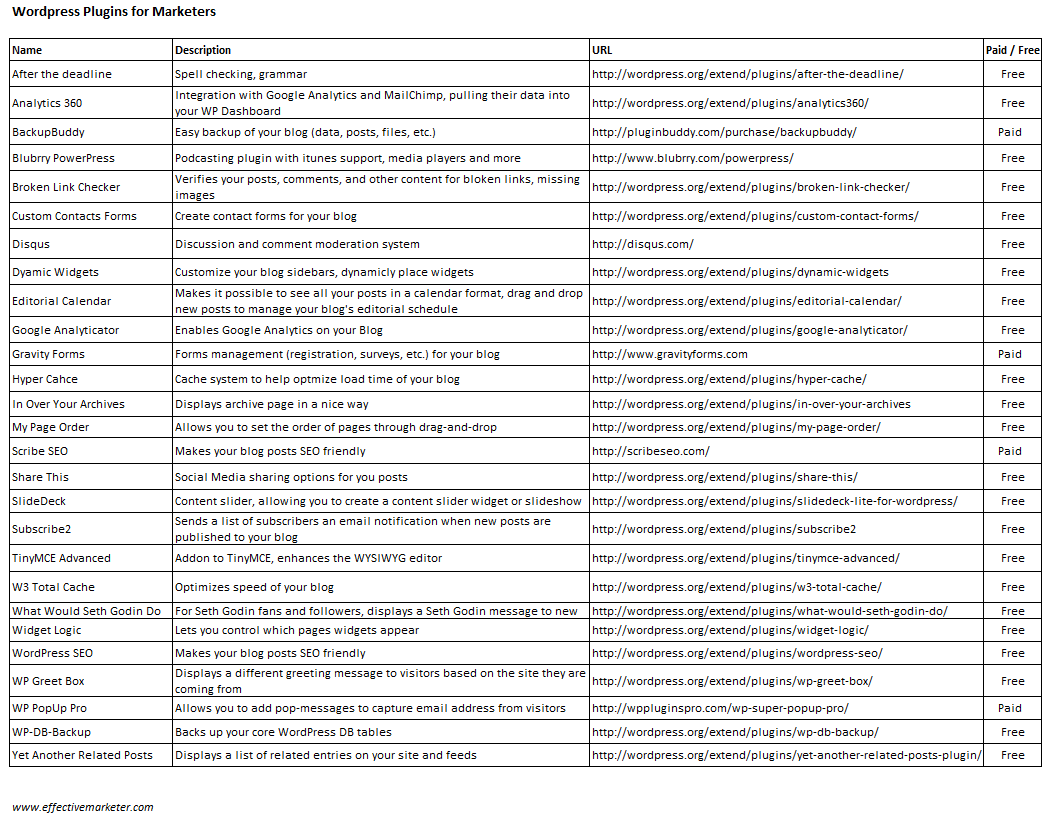
A recent question on the Marketing Over Coffee LinkedIn group about WordPress plugins generated a really great list of tools marketing professionals should consider when running a personal or company blog. To make it easier for everyone I’ve compiled the suggestions from the group into an easy-to-read list (sorted alphabetically). An Excel file is available at the end of the post with all this info.

WordPress Plugins

WordPress Plugins for Marketers (click to zoom)

Note: Only WordPress.org (the free, host-it-yourself version of WordPress) allows for plugins.

The list is not all inclusive and depending on the focus of your blog you may have to search for that specific plugin elsewhere, but it seems there is an agreement that at minimum you need some kind of SEO and Analytics plugin, and if your blog has enough traffic, a cache plugin is justified. For corporate blogs using a backup plugin is probably a good investment as well and the editorial calendar plugin is a great help for planning content especially coordinating among different team members.

Click to download the WordPress Plugins for Marketers in Excel (XLS) format.

Is there a plugin you simply “must have” or recommend that I have not listed? Let us know!


What Makes a Great Creative Brief?

January 7, 2011

A similar question was posted on Quora and elicited a number of different but very interesting responses. It just goes to show that there is still a lot of controversy when it comes to creative briefs in marketing. If you come from the agency side, you are used to a certain format. Big companies and small companies have different needs, and so their briefs are also formatted differently.

From the discussion thread I liked two presentations that were shared, posted below. The first is an interesting research done by Jasmin Cheng (from Twist Image) about creative briefs in the industry, and the second is a presentation by Nick Emmel on how to properly write a creative brief. While they don’t settle the discussion, are good sources for inspiration nonetheless.

And, if you’re interested in looking at some different formats for creative briefs, check out this blog post on creative brief template review.


B2B Marketing Summit Shows Old Problems Persist

October 14, 2010

So it seems MarketingSherpa’s B2B Summit 2010 is over and from what I read in their wrap up post, the same old problems plaguing marketers for the last 5 years are still here today. First of all, what is this summit? According to their post:

“Last week in San Francisco, 211 business-to-business marketers spent two days sharing insights, case studies and advice on social media marketing, lead generation, Sales and Marketing alignment, and other hot-button issues on the West Coast swing of MarketingSherpa’s seventh annual B2B Marketing Summit.”

MarketingSherpa is known for quality content and I have attended a couple conferences (I was a speaker at the Email Marketing Summit 2008) and have always thought that the best you get from attending an event like this is more in the form of networking than in content itself. The other good thing about going to such a conference for me, is that I get dedicated time to really think through all the topics being discussed, without being interrupted for meetings, phone ringing and people walking in the office.

The many takeaways from this year’s B2B Marketing Summit (West Coast) according to MarketingSherpa, were:

  1. Begin with the end in mind
  2. Put yourself in your customers’ shoes
  3. Getting a lead is just the beginning…
  4. For successful lead generation and nurturing, you need quality content
  5. Use measurements that matter
  6. It all happens on the landing page
  7. Be strategic about presenting your campaigns and your vision to the C-level

None of the takeaways above strike me as particularly new or groundbreaking, but that’s how it always goes. Sometimes we just need to be reminded of the obvious so that we can focus on the essential.


Flip the Funnel Book Review

October 13, 2010

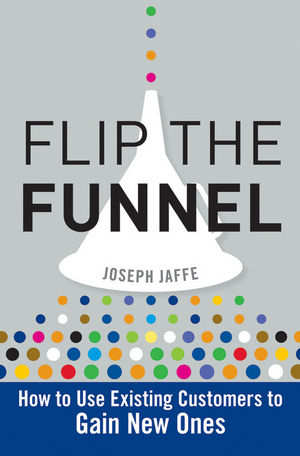
At the San Francisco Marketing Book Club meeting last week we discussed “Flip the Funnel: How to use existing customers to gain new ones“, by Joseph Jaffe. 
What’s the verdict?  Buy the book. OK, now the explanations and caveats.

First, the book talks about the essential function of customer service and how to leverage it with today’s current technologies, including (of course) social media. If you haven’t read much about customer service or if marketing isn’t your background, then the book will be a good starting point. For those that have some experience and background on the topic of excellence in customer service and have read one of the many classic books out there, then a lot of it will be just a review of what has already been said.

My biggest disappointed was that the author used mostly well known examples to illustrate his points. JetBlue, Domino’s, United Airlines, Zappos, and others are cases that we marketers already know. I would have liked to see other companies that he has worked with and are not so obvious and how they implemented his recommendations or how they have failed to recognize the importance of “flipping the funnel”. But then, maybe I’m not the target market for this book.

The other thing to be aware is that Mr. Jaffe is a bit verbose. If you have listened to his podcasts or seen his videos, then you know what I’m talking about. I felt like skipping a few pages just so I could get right to the point. Others may be ok with his style, but it just made it much harder for me to make progress. You should read an excerpt or check it out at the local bookstore to see if you like how he writes before buying the book.

But don’t be fooled, there are some really good ideas in the book:

Where is the money going?

Early in the book he makes the case that we’re spending money on the wrong side of the funnel. “Shouldn’t we be spending money against qualified prospective buyers versus shots in the dark at bagging a random stranger?”. He continues saying “The marketing funnel produces customers – but then does nothing with them.”

How right he is! Why is it we spend all that money and effort into getting people interested just to forget about them once we get the purchase order? There’s gold to be mined in existing customers and the book treats this as the new mantra for marketing. In Jaffe’s words “Keeping, cultivating, and nurturing existing customers and establishing unbreakable bonds with them”.

Segment and Treat Customers Differently

Although the methodology varies based on your industry and whether you are a B2B or B2C company, the big picture is clear. “The more opportunities we give our customers to engage us (as opposed to us engaging them), the more likely they’ll be able to do just that”, and I completely agree. According to Jaffe, we should segment customers into “walkers”, “talkers”, and “hybrid”, and deploy distinct approaches for each one. His new “flipped funnel” approach to doing that is called A.D.I.A (Acknowledgement, Dialogue, Incentivization, and Activation).

The Customer Experience

The whole point of the “new” flipped funnel approach is to create this unique “customer experience”, which means giving customers ways in which they can interact with the brand, and we can interact back with them. Sure, this is not new, but he suggests that “companies need to have an intensive, omnipresent approach to dealing with their customers”. Does this sound like your company? I know, everyone talks about how important the customer is, etc but very few companies really put the necessary resources behind that. The payback, he argues, is that “customers will pay a premium for higher perceived value”, and such value is likely to be how customers are treated. Customer service becomes your product, or better yet, the differentiator between your product and your competitor’s.

Social Media Still Not Treated Seriously

Where I think the book falls short is on the implementation side. It talks about companies having to deploy capabilities across every single customer touchpoint, connecting the dots between the physical and virtual world and giving customer service the strategic value it deserves, but there’s not much in terms of HOW companies are doing that. Although, if the research from MS&L mentioned in the book is correct (one third of companies are not incorporating social media in marketing efforts, and of 63% that were, a full two-thirds had not made changes to products or marketing based on customer feedback), then the problem is actually there aren’t many good examples to follow. Are we entering a new world, travelling a path very few have survived? We’ll see.


In sum, if you’ve already read a few books on the subject, you’re not going to gain anything new but for the novice or uninitiated this book may be just what you need to get your company on the right track to flipping the funnel and gaining new customers.


Making Website Reviews Easy

October 5, 2010

64/365 - mapping by Jenn Vargas @ Flickr

The website is a few years old, there are some inconsistencies in font and the colors don’t match all that well. On top of that, now you have videos you want to showcase and the home page was not designed with that in mind. In sum, the website needs a complete makeover. Sounds familiar?

When reviewing websites and discussing design elements, you invariably end up drawing all over the whiteboard, asking your designer to come up with some mockups and then annotating those and sending them back. How about using some technology to make things easier? I’ve already discussed the use of PowerPoint for website reviews and if you’re starting from scratch it not only provides you with a grate starting point but is a low cost solutions.

For reviewing existing websites, I have used my tablet PC to make screen annotations and save them as images to the team, but what if you have people remote or if you want them to review and add their own comments about the site on their own time?

Below are a few useful tools out there for this problem.

Website Review and Annotation Tools

ShiftSpace.org is an interesting app that gives you the ability to comment on any website using your browser, but others have to have ShiftSpace installed to see them.

Google Sidewiki is an extension for Google Chrome that lets you comment on any website, but falls short on the drawing options (arrows and circles and such).

Diigo allows you to add sticky notes and highlights to websites and share with other people, and they do not have to have diigo installed. Problem is, you can’t draw circles or squares on the site to illustrate changes in the design.

Sharedcopy.com takes a screenshot of a site, let’s you annotate, send to other people, where they can add their own comments to it. Requires users to have the sharecopy bookmark app on their browsers, but works nicely.

Notable is a paid app that gives you great tools for annotations and commenting on any site.

Bounce is my favorite so far, because not only is a free version of Notable, but is the easiest to use. No registrations, no downloads required. Simply go to the Bounce site, enter a URL and start annotating. Then save the comments and share the unique link with your team. If there’s one thing missing is the ability to draw on the page.

Any other tools I have missed?


Marketing Content That Sells

August 30, 2010

When talking with lead nurturing and marketing automation vendors they all make it seem very easy.

You setup a campaign, define the nurturing stages, and even add some points to different interactions to score the lead and customize the nurturing experience. Then with all the triggers in place, sit back and watch the software do the job of sending the right message to the right prospect at the right time. Wow, it’s magical!

Yes, except for one little detail. Who’s going to write all that new content? Do you have the staff to do it? Will you have to outsource? Do you even know what kind of content you need for each nurturing stage? Yup, it is more complicated when you get to the implementation phase of the program, and that’s where most companies fail.

But why the focus on content? David Meerman Scott, in his book The New Rules of Marketing and PR points out that creating quality content is the new imperative:

“The tools of the marketing and PR trade have changed. The skills that worked offline to help you buy or beg or bug your way in are the skills of interruption and coercion. Online success comes from thinking like a journalist and a thought leader”.

You’d think that everyone would be doing it by now, but that’s not the case.

I recently finished reading Trust Agents, by @chrisbrogan and @julien, who approach this subject by saying:

“The difficulty in creating content that will get a recommendation, the one that most companies tend to get wrong, is that they don’t think creatively about how their content can be exciting to the average population”.

Ha! That reminds me of what I see when I visit most B2B companies’ websites.

We have all been there. You are researching a new product or service and Google points you to a website, one of the key vendors in that space, and you have to read the page twice to really get it what they are trying to say. How is it that your product or service will benefit me? What is that acronym you keep using? How do I get in touch with someone who can explain all of this? In the B2B marketing space this is notorious. Go to a trade show and the situation gets really bad. Trade show booths with slogans and taglines that don’t mean anything and sales brochures that are full of “features” and screenshots but lack detail of how they solve a problem.

While I still struggle to write good content, I did find some useful resources online that I hope will also help you out.

The resources above are a great start. The key ideas that seem to be present across them all are:

  • Buyer persona is key for content generation
  • Guest writers (employees, competitors, etc.) can help tremendously especially if you can’t dedicate a resource full time for the content writing job
  • Lists seem to be a favorite item on the web and a great way to get more viewers, just figure out what topic should your list cover
  • Content reuse, multiple formats for the content is a nice way of creating lots of content without having to come up with new ideas all the time (formats include webinar, recording, eBook, blog post, etc.)
  • Time the content for the right stage in the buying cycle / lead nurturing process – this is the most difficult, because it requires you to really know your customers and prospects

What has been your main challenge with content marketing?