Your Marketing Focus

December 5, 2012

Out of Focus by Tim Cummins @ FlickrWhether you have 5 or 50 people in your marketing team odds are that the demands for more whitepapers, a new website redesign, additional email campaigns, and overall more content creation are increasing. If recent reports like this one are any indication, marketers across the board are being pressured to produce more and more content.

How do you do it? The answer is focus.

The marketing focus I am talking about is not the concentration of all your efforts into producing content while forgetting everything else, but rather the focus of knowing exactly what type of content to produce.

I’ve seen big and small companies alike fall into this content creation trap. It starts with a brainstorming session to talk about all content that should be produced, followed by assigning priorities to each content piece and getting it in a schedule with respective owners assigned.

What’s wrong with this approach? It misses the point entirely. FOCUS means understanding what message you need to tell, then focusing on the story and making sure each content piece created tells and reinforces the same story.

It is less about creating a lot of content for creation sake but creating content that helps your audience (i.e. prospects) understand why your company is different and what story it is telling. To do that I like to ask marketing teams to get out of the brainstorming of content types (videos, whitepapers, ebooks, etc.) and think first of the topics, themes, or high-level stories that have to be told. Then we figure out which types of content will help tell that story. We focus on how to tell the story and disseminate the story so that we reach the higher number of prospects instead of just trying to create content like crazy.

Focus is the name of the game if you want to get more done with the same resources.


What Do Buyers Want?

November 6, 2012

You have created all that content, invested in a marketing automation system, and still the leads are not converting. Who is to blame? First, take a closer look at your content and answer the following questions:

1. Does it have your product name sprinkled throughout?

2. Does it focus on what your product does and describe features?

3. Does it use technical terms and acronyms?

If you answered “yes” to at least one question, your content might be the one to blame. So it’s time to clean up the house.

Cleaning Up Your Content

The best way to start cleaning up your content is to review it with a buyer’s eyes. What do buyers want? Try this:

A. The CFO doesn’t want another financial management system, she wants month-end closings to happen faster and without errors.

B. The VP Sales doesn’t need a new CRM system, he needs a better way to keep in touch with current opportunities and gain better visibility into the pipeline.

C. The Marketing Manager is not looking to replace the email software, she wants a better way to generate qualified leads.

Sometimes marketers and especially product marketers suffer of what I am going to call industry-induced content myopia. Just because every other vendor in the industry uses certain terms and creates certain types of content, it doesn’t mean you should follow their lead. Instead, take a breather, spend some time in another department, and ask for your 8 year old to review the latest customer case study you just published.

Yes, is tough to create content that will rise above the noise, that will get picked up and shared, but creating content that talks about what the buyer really wants is a good first step. What are you waiting for?


The Importance of Content Continuity

October 8, 2012

If good content marketing equates to telling a good story, then content continuity is getting that story to become memorable. Let me explain.

When you create a piece of content, why stop at the first distribution channel? Sure you can re-purpose the content so that it will be used at another channel but content continuity means more than simply taking the content and fitting it in another medium. It involves using that content and expanding it, working different angles, but keeping the core message intact. It’s not that difficult, but it requires some planning.

A good example might be that presentation one of your executives delivered at the trade show. The PowerPoint slides can be uploaded to SlideShare where people who didn’t attend the session can now access it (this is re-purposing the content). But if you take the presentation, and add a few more slides to it in order to emphasize a key message, or if you take that message and link it to a video or an eBook that reinforces the story, then you are creating continuity.

Why is this distinction important? First, because if you simply take the exact same message and just change the publishing format (from PowerPoint to video, for example) it may attract different readers but it doesn’t help promote or further expand the message, it’s just a rehash of what has already been said in another format. Second, if you simply repurpose content you already created then you may lose the opportunity to create important links between the multiple stories your products or services support.

So instead of creating pieces of content that stand alone, create a “content network” (for lack of a better term) in which each node reinforces another, where a story you started telling is continued and extended with the next piece of content.

Next time you create some content (eBook, whitepaper, blog article, video, etc.), don’t just publish and forget; think of it as part of a broader theme or story. Good stories don’t have to end and neither does your content (think of it as “Your Content – Part II”, like in Hollywood).


How to Maintain Great Content Curation

June 19, 2012

A guest post by Lior Levin.

Content CurationOn the surface, content curation sounds like a great way to generate content with little to no time or effort. After all, you don’t actually have to write much new content, just find interesting items on the Web and point others to them, becoming a hub for all that’s relevant to your field.

However, doing content curation well means a lot more than just plastering your site with a bunch of synopses and links. Doing content curation right takes a lot of time and requires almost as much investment as creating original content.

Doing content curation poorly, though easy and quick, is often seen as spam and is likely to raise copyright and plagiarism issues for you. On the other hand, proper content curation can be a powerful tool for both building your site and driving traffic to it. In fact, in the best possible cases, it can make you an indispensable part of your niche’s ecosystem.

So how do you curate content in a way that both attracts visitors and makes you a hero to your peers? Here are a few tips to help you get started.

1. Participate in Your Community

If you want respect from your community, you need to do more than simply share their links. You need to create at least some original content and, equally importantly, connect with and interact with those around you.

Instead of just linking to a post, take the time to comment on it as well. Interact with other webmasters on social media and encourage them to send you interesting links. The more you contribute and interact with the community, the more they will respect and embrace you. That embracing not only makes the environment less hostile, but it also opens up new opportunities for cooperation that can make your offerings truly unique.

2. Be Careful How You Aggregate

Be careful about what you use and how you use it. Remember that the works you’re referencing are copyrighted and other webmasters, if they feel they are being infringed, may come after you.

Use only what you need, short snippets of text (usually under 50 words), headlines and links should be more than enough. If you find yourself writing a 400-word summary of a 500-word article, you likely need to rethink your approach.

Also, always attribute everything you use. Not only is it the right thing to do ethically, but it keeps you from making enemies needlessly.

3. Don’t Automate

When you have a site or service that seems perfectly relevant to your topic, it might be tempting to grab everything that it posts by RSS or another automated tool.

Don’t do it.

The benefit a curator brings to a niche is human involvement. If you’re not selecting the best posts to share, you miss out on adding value to your readers or community. Anyone can subscribe to a site via RSS, and no site is going to be 100% relevant.

In short, automatically shooting out everything that a site or a group of sites puts out is not only very spammy, but it is of no benefit to the reader or the community.

4. Be Where the Audience Is

While this is great advice for any site, it is even more true for curated content as curation is about convenience. You don’t want to make your readers work for your content so it’s important to be where they are.

Have an audience that spends a lot of time on Reddit? Be on Reddit. Are they active on Facebook? Be on Facebook.

Don’t be afraid of multiple platforms as the time needed to add a Tumblr or a Twitter is fairly minor. On the other hand, don’t be afraid to ditch services that aren’t working out for you.

5. Create Expectations and Meet Them

Very quickly, answer these questions for your readers:

  1. What are you going to post?
  2. How much are you going to post?
  3. And When are you going to post it?

Readers need this information so they know what to expect from your curation and know if they want to subscribe. Create a plan and stick to it.

Whether you want to curate ten links weekly about whales or five articles a day about modern medicine, tell your readers what to expect and deliver reliably.

In the end, great curation is a lot of work, but it’s that work that adds value to the reader and the community. Bad curation is, at best, mere spam and at worst copyright infringing.

As a curator, you can’t afford to be a parasite as you need a healthy, welcoming community for your efforts to thrive.

So don’t look for shortcuts with your curation efforts and, instead, focus on providing the best value you can, especially over the long haul. Your community, your readers and even the people you link to will all thank you and reward you for it.

This guest post is written by Lior Levin, a marketing consultant for a neon sign store that offers a variety of custom neon signs for businesses and individuals, and who also consults for a company that specializes in a to do list app.


How to Include Webinars in Your Content Plan

May 21, 2012

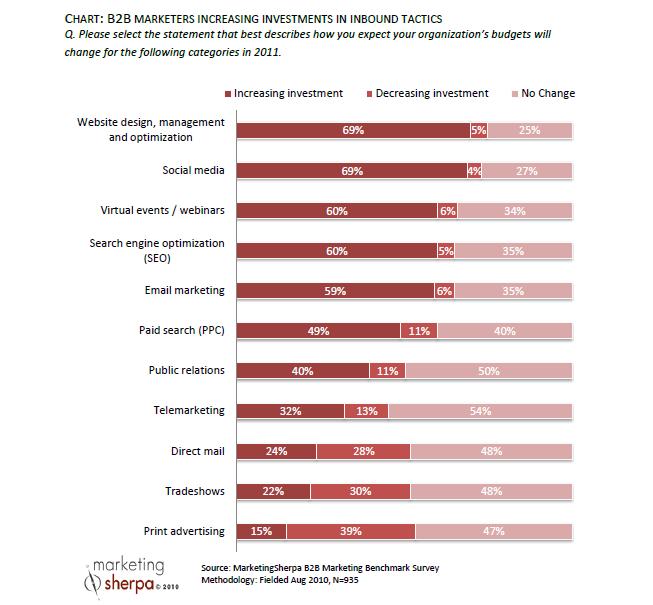
If the myriad of webinar platforms out there with new entrants every year is not an indication that webinars are hot marketing tactic, then take a look at the following chart from MarketingSherpa:

MarketingSherpa B2B inbound tactics chart

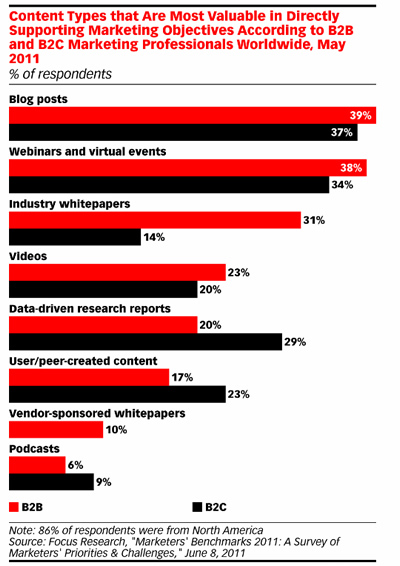
Webinars, together with virtual events were ranked top three marketing tactics to have their budgets increased in 2011. The same result was voiced by Focus Research, pointing to webinars as one of the most valuable tools for B2B marketers.


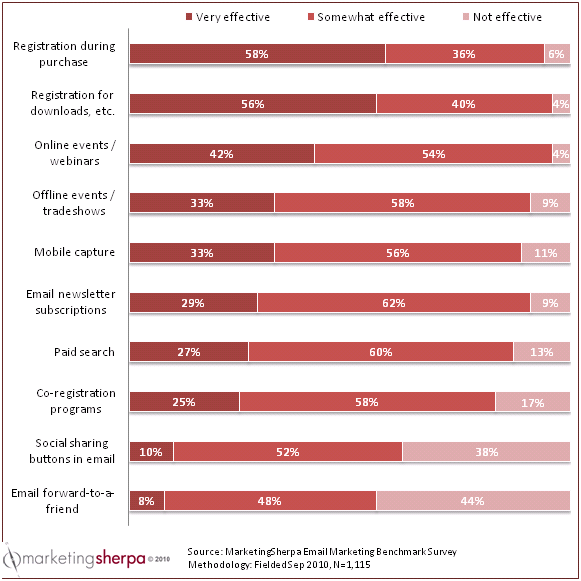
Supporting this sentiment, MarketingSherpa puts Webinars again at top three most effective lead generation tactics.

MarketingSherpa Effective Lead Generation Tactics

All Webinars Are Not the Same

Problem is, knowing that webinars are a good tool to have in your marketing arsenal is not enough. To get the most out of it, make sure to include it as part of your content planning efforts and use the best type of webinar to the best type of persona. For example, consider the following types of webinars and how they can be used:

What: Product demo
Focus: Product features and functions
Typical Audience: Prospects that are evaluating solutions, technical buyers, training of new employees or business partners

What: New product release walkthrough
Focus: Key features of the new release, benefits of upgrading
Typical Audience: Current customers on previous release, sales team, business partners

What: Customer training
Focus: Step-by-step product walkthrough, business scenarios, best practices
Typical Audience: New customers, existing customers with new users

What: Case Study
Focus: One or more customers of your product tell their story of how it helped them overcome a problem that others in their industry also face
Typical Audience: Early stage prospects, current customers of another product (cross-sell) or different version (up-sell)

What: Educational (non-product)
Focus: Topic relevant to your prospective buyer
Typical Audience: Suspects, early stage prospects

And these are just a few examples. You can also host partner webinars where you host training sessions for business partners, you could do employee training webinars that talk to new employees about policies and procedures or guide them on how the company works, and you could have sales training webinars where tips are shared or new products are showcased.

Mapping Webinars to Your Content Plan

Webinars are a great channel to include in your content marketing plan. If you plan on creating a eBook or Whitepaper, a webinar is a great way to promote the highlights of what the whitepaper or eBook is about. New product coming out? Get a webinar in addition to the typical press release. Going to a trade show? Host a webinar the week prior to the show and give tips on how to make the most out of the show. Just came from a trade show? Host a webinar to share all the great stuff you learned during the show.

The longer webinars (more than 30 mins) can later be chopped down into easily digestible segments and posted on your Youtube channel. For the product demo webinars, you can also select specific segments of the recording and place them throughout the website to give emphasis to certain features of the product.

Customer testimonial webinars are great to include in your website and you can select key moments of a series of testimonials and stitch them together and publish as a Testimonial Reel.

Not all webinars are created the same, but each type can enhance your content plan and provide one more channel for your customers, prospects, partners, and even employees.


What My Paper Route Taught Me about Content Marketing

May 3, 2012

Note: This is a guest post by Brad Shorr. See his bio at the end.

My career in content marketing started at age 12. Every day I’d load up my red Schwinn Varsity bicycle with The Aurora Beacon News and head out to make deliveries, learning valuable lessons about digital content marketing that just starting to sink in lately. Here are a few of these lessons, which I’m sure you will pick up a lot faster than I did!

Old man using a laptop with his grand son reading a newspaper1.     Content Marketing Is Hard Work

Delivering content may not be as physically demanding as it once was, but today it is a combination of strategic planning, thorough execution, meticulous review and continual improvement. There are no shortcuts, either. Back in the day, if I cut across a neighbor’s yard to get to the next house … I’d get yelled at. Today, if you try to skip steps or gloss over them, you’ll similarly be punished. Shortcuts to avoid include things such as –

  • Trying to pass off lame, rehashed content as something new and relevant
  • Relying on automated feeds to push content rather than building genuine social media connections
  • Putting content marketing processes on autopilot in order to shift attention to shiny new marketing toys

2.     Reader Convenience Is Everything

In the print era, there was nothing more convenient than having the latest news delivered literally to your doorstep. Newspapers thrived in part because of their efficient and ultra-convenient delivery system. The principle still applies in the age of digital content. Making content easy for the reader to obtain and consume makes all the difference:

  • Site loading speed. A big consideration, one that is so important that Google now uses loading speed as a ranking factor. If I showed up at a subscriber’s house an hour late … I’d get yelled at. Today, if readers have to wait five seconds for a page to load, they will click off.
  • On-page usability factors. Facilitating easy content consumption means adhering to best practices for typography, navigation, page layout and design. Tripping up in any one of these areas invites readers to make a hasty exit and leave with a bad taste in their mouths.
  •  Multiple search options.It should be as easy as possible for readers to find relevant content on a business site or blog. Among the techniques to accomplish this:
    • Internal search engines
    • “Most Popular” blog posts listed on the sidebar
    • “Most Commented” blog posts listed on the sidebar
    • “Recent” blog posts listed on the sidebar
    • User-friendly archiving
    • Meaningful blog categories
  • Multiple delivery options.  In the past, there weren’t many ways to deliver news. Today, content marketers must support readers who find content via RSS, email subscriptions, bookmarking sites, social media, and organic search. This necessitates optimizing content for search and social sharing, and engaging with multiple communities on multiple social networks.

3.     Consistent Delivery Matters

My paper route taught me how much we humans are creatures of habit. If I showed up 15 minutes behind schedule … I’d get yelled at. Some people would even freak out if I showed up early. Well, even though content marketing technology has changed enormously, human nature remains the same. This means content marketers must bring a certain degree of consistency to their execution, including –

  • Theming. Is the big-picture, underlying message consistent, or does it change from one day to the next? Inconsistencies dilute brand identity and put obstacles in front of prospects that are trying to figure out what a company does and why they should care.
  • Publishing. Are blog posts and e-newsletters delivered on a consistent, predictable schedule, or haphazardly? Digital marketers can learn a LOT from the newspaper industry on this score: when people know when to expect information, they have a greater appetite for it.
  • Social Sharing. Because people are habitual, they hang out on Facebook, Twitter and other networks at fairly regular times throughout the day. By testing and analyzing re-shares and mentions, content marketers can develop intelligent timetables for both scheduled posting and active engagement.

About the Author

Brad Shorr is Director of Content & Social Media for Straight North, a search engine marketing firm in Chicago. They work with middle market B2Bs in industries as diverse as restaurant merchant processing and bulk gloves. Brad is an experienced content strategist, SEO copywriter and blogger. He still rides a bicycle. 


Ten Tips On How To Promote Your Website Through Content

May 1, 2012

Note: This is a guest post by David Tully. See his bio at the end.

Image by mdurwin2 via Flickr

The emphasis on creating quality content has increased markedly since Google put the hammer down on many old tried and tested SEO tactics. Below I have listed 10 tips on how you can promote your website through content.

1. Offer How to Guides/Whitepapers/Analysis – Good first hand analysis or guides in relation to the niche you are in can really help boost visitor numbers to your website. You are giving valuable, relevant information which they will appreciate.

2. Utilizing personas – Always write content from the perspective of the intended reader. Questions that a reader may have such as “why is this information useful?” and “what benefits are there to me?” should be in your mind when writing content so as to hook the reader in.

3. Understand what works and what doesn’t – Get a form of site analytics set up on your site to assess what type of content works. You may find that a particular type of blog post does a lot better than others.  Optimizing content in this way can help rank better as more of your content is shared and read by web users.

4. Incorporate user feedback – The more interactivity you have with readers the better. If someone asks you a question of Facebook, Twitter or in blog comments, it is a good idea to create some content about it as it is more likely than that others within your niche market have the same question.

5. Regular posting – Many websites fall down on this last point. People will come to your site often for fresh content, if you don’t provide it, your audience will cease visiting. Google will also see the lack of fresh content and rank your far lower.

6. Repurpose content into different forms – If you have had a very popular blog post, there is every possibility that the content will do well if you repurpose it as a video, podcast or infographic. Each form may reach a slightly different audience helping to boost your website.

7. Social media promotion – The most important aspect for promoting your site through content. Google ranks websites depending on indicators from social media. In addition, the more something is shared on Facebook or retweeted on Twitter, the more site visitors you will have. Creating content which is more likely to be shared is therefore crucial.

8. Share your content on PDF sharing websites – PDF sharing websites such as DocStoc and SlideShare always rank highly in Google. If you have a great piece of content and want it spread as widely as possible, create a PDF file and share it on these websites.

9. Content Curation – Curating content is becoming ever more popular in marketing online. Basically, you are sharing quality content and adding your own take on stories or issues within your market. As long as you link back to your original source, this is an excellent way of using content to help improve site numbers.

10. Use of video – Some niches are not very interesting and when marketing your website, getting the message across in an inventive video can really make a difference. It has a greater possibility of going viral and helping your site.


About the Author:

David Tully has written many articles on content marketing and is currently a regular contributor to content marketing strategy website Bright Authority.


Why Seeding Your Content is Key to Making it Viral

April 26, 2012

First Seeds Planted by Pictoscribe - Home again @FlickrIs great to see scientific research being done on social media, viral videos, and marketing in general (see previous post on the New Science of Viral Ads). Problem is, many research papers contradict each other. A recent study published on Marketing Journal titled “Seeding Strategies for Viral Marketing: An Empirical Comparison” (requires registration), by Oliver Hinz, Bernd Skiera, Christian Barrot, & Jan U. Becker, tries to get some of the contradictions resolved when it comes to what makes something “go viral“.

4 Critical Factors for Viral Success

According to the authors, there are four critical factors for viral marketing success:

1: Content, or the attractiveness of a message makes it memorable

2: The structure of the social network 

3: The behavioral characteristics of the recipients and their incentives for sharing the message

4: The seeding strategy, which determines the initial set of targeted consumers chosen by the initiator of the viral marketing campaign

The authors attribute the fourth component, Seeding Strategy, the higher weight. It’s all about who you are sending your video to, they say.

“Seeding the “right” consumers yields up to eight times more referrals than seeding the “wrong” ones” – Hinz, Skiera, Barrot, Becker

So how do you go about “seeding” it right? Here’s where many researchers disagree. There are typically three types of people you can target:

  • Hubs:  well-connected people with a high number of connections to others
  • Fringes: poorly connected people
  • Bridges: those who can connect two otherwise unconnected parts of the network

Network

Hubs tend to be better informed because of their social links and they can also influence their networks (hey, if I got this from Bob it must be good!). However, Hubs may not be optimal channels because if the person that acts as a hub doesn’t like or doesn’t agree with the content, they will not pass it on to their network. As big targets for new content, hubs are constantly bombarded with information and therefore may ignore or not see your new content which will prevent it from being spread.

Adoption of a new idea can then start at the “fringes” and make its way through the network. It has also been argued that fringes are more easily influenced than hubs and therefore may be good targets for spreading content. Bridges, for their ability to connect different areas of a network have also been targets because they can influence a portion of the network otherwise immune to the ‘viral’ content you have created.

The Optimal Seeding Strategy

In their research, the authors encountered four studies that recommend seeding hubs, three recommend fringes, and one recommends bridges. No wonder there is so much confusion when it comes to social media and viral videos! They then conducted experiments to prove those theories to the test to see which one would emerge as the winning seeding strategy.

The result was that “Marketers can achieve the highest number of referrals, across various settings, if they seed the message to hubs or bridges“. They also go on to say that “companies should use social network information about mutual relationships to determine their viral marketing strategy”.

Check out a summary of the study and results published by the authors on SlideShare (link below):

The Social Network

Understanding the social structure of potential networks is an important part when planning your social strategy. It pays off then for companies to mine the data they already have about their customers in order to determine the best people to seed your campaign. If high-connected people are picked to seed the campaign, the probability that it will spread is greatly increased.

Finally, it remains to be seen whether Facebook and other social networks will start playing a very active role in providing companies with detailed network information in order to help with their seeding efforts. Companies already have access to demographics, is just a matter of expanding the data set and, of course, avoiding potential privacy concerns.


What Makes Ads Go Viral?

April 16, 2012

Face Masks, Japan By shibuya246 via FlickrLooking for a recipe to get your new video to go viral? In a recent Harvard Business Review article “The New Science of Viral Ads”, assistant professor Thales Teixeira from HBS outlines the ingredients you will need:

1. Utilize “Brand Pulsing”: weave your brand throughout the ad instead of placing it front and center. Example is the “Happiness Factory” video for Coca-Cola.

2. Create joy, or surprise right away: keeping viewers involved is key to get your video watched, so you have to use both joy (hey, this is funny) and surprise (wow!). Example is Bud Light’s “Swear Jar”.

3. Build an emotional roller coaster: people are most likely to keep watching if they experience emotional ups and downs.

4. Surprise but don’t shock: this is where you’ve got to be careful not to push the video too far… some surprise is good, but shocking may diminish the virality effect (nude people in the video makes it unlikely to be shared with office co-workers).

5. Target viewers who will share the ad: sounds obvious but is more difficult than you imagine. Is hard to target viewers based on their personality, but different types of personalities (extroverted vs. introverted) are a key ingredient in ensuring the video will get shared. Some people share it for ‘status’, or to rank up higher in social media circles, or to be seen as savvy in a subject.

The Science Behind Viral Videos

Interesting that the experiments Prof. Teixeira conducted made use of some high tech equipment. They setup infrared eye-tracking scanners so that they could determine where people were looking when the ads played and they used a system that analyzes facial expressions and were able to determine, based on slight changes on their facial muscles (this reminded me of micro-expressions and the Lie To Me series) what emotion they were experiencing.

HBR Viral Video Experiment

High tech gear monitored users as they watched videos

It’s All About The Content.. or Is It?

Interesting that four out of five key ingredients in the study deal directly with the content of your ad or video. You shouldn’t, however, discount the last factor of who you are sending that video to because as the article explains, if people don’t share your video… it won’t go viral (duh!). What good is creating great content if the reader is not willing to share? 

Makes you think not only about how to structure your content creation strategy but also how to plan for your content distribution.

The Videos

Here are the videos mentioned in the article:

“Brand Pulsing” example: Coca-Cola Happiness Factory

“Open with Joy” example: Mr. Bean

“Roller Coaster” example: Bud Light Swear Jar

“Surprise but don’t shock” example: Bud Light Clothing Drive

Using all ingredients example: Evian Roller Babies


Deconstructing an Email Marketing Campaign

April 10, 2012

What does it take to put together a successful email campaign? It all sounds pretty simple when you think of it. Segment your list, create the email, send it out, evaluate results, repeat. Right? Well, not so fast.

I’ve now spoken to small business owners and startup founders and they have the same initial feeling that it should just work. But, when it comes time to actually execute, something is missing. Although “email marketing” is the name of the game, there are actually many pieces you have to put into play and organize in order to make the most of it. There are landing pages, thank you pages, linking all to a CRM system and ensuring you are capturing leads and nurturing them.

So in order to help those thinking about how to start their own email marketing programs, and also for those interested in looking at the whole process in more detail to see what else can be done to improve results, let’s take a moment to deconstruct a typical email marketing campaign. The following is like the anatomy of an email marketing process with the pieces each dissected and analyzed.

Anatomy of an Email Marketing Campaign

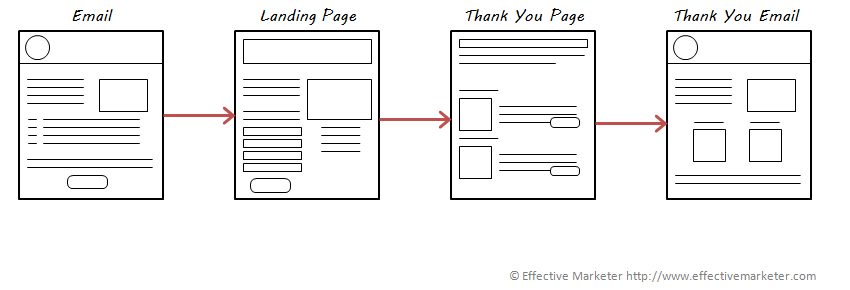
In general, most email marketing campaigns will look something like the image shown below. You have an Email that is created, which will have a link to a specific Landing page, which in turn will link (not always, but usually if you have a form) to a Thank You page, which typically triggers a final Thank You email.
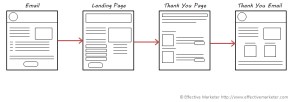
Anatomy of Email Marketing Campaign

Click to Enlarge

The Email

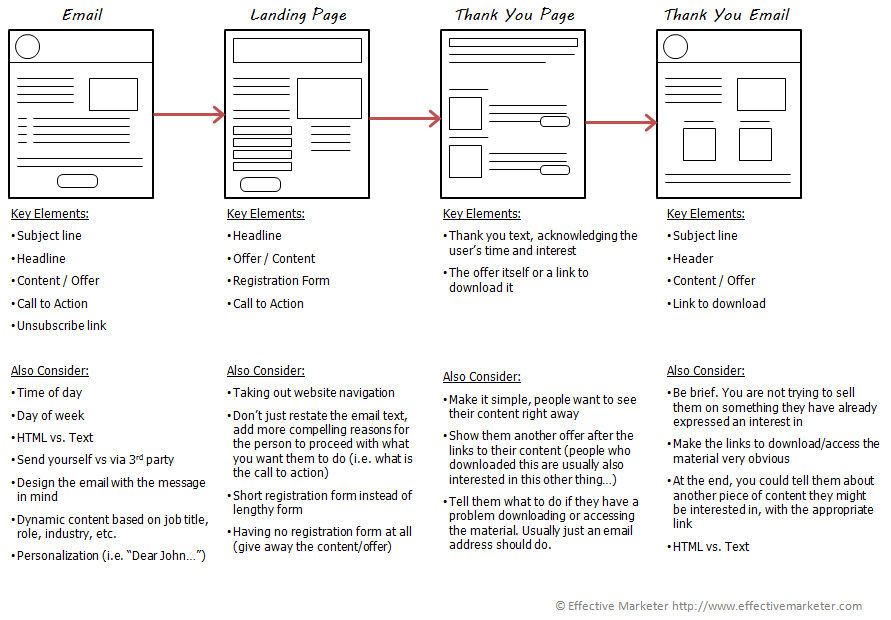
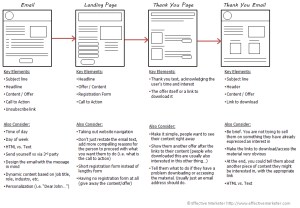
The email is the message you are sending out to a segment of your list. It contains the following key elements:

  • Subject line
  • Headline
  • Content / Offer
  • Call to Action
  • Unsubscribe link

Things to consider when crafting your email are:

  • Time of day
  • Day of week
  • HTML vs. Text
  • Send yourself vs via third party
  • Design the email with the message in mind
  • Dynamic content based on job title, role, industry, etc.
  • Personalization (i.e. “Dear John…”)

All of these combined will influence well your email will perform.

The Landing Page

The landing page is the web page that holds the offer you talked about in your email. It doesn’t need to be an “offer” like in sales promotion, it could simply be a piece of content that you download or watch online.

The landing page contains usually the following elements:

  • Headline
  • Offer / Content
  • Registration Form
  • Call to Action

Things to consider when crafting the landing page:

  • Taking out website navigation
  • Don’t just restate the email text, add more compelling reasons for the person to proceed with what you want them to do (i.e. what is the call to action)
  • Short registration form instead of lengthy form
  • Having no registration form at all (give away the content/offer)

Having people click on an enticing offer in an email is only half the battle. Will they actually go through with their intent and do what you want them to do, whether it is downloading the whitepaper, watching the video, or filling out a form? The design and content of your landing page is critical.

The Thank You Page

If your landing page has a registration form, you will need one of these. What happens after the person fills out your form? They should get access to the content they registered for. Your thank you page typically has:

  • Thank you text, acknowledging the user’s time and interest
  • The offer itself or a link to download it

Things to consider in your thank you page:

  • Make it simple, people want to see their content right away
  • Show them another offer after the links to their content (people who downloaded this are usually also interested in this other thing…)
  • Tell them what to do if they have a problem downloading or accessing the material. Usually just an email address should do.

The Thank You Email

Not doing this one is a missed opportunity. After someone registers for your content, make sure they are able to download the offer by emailing them a quick “thank you” email containing a link to the material they were promised.

Your thank you email will typically consist of:

  • Subject line
  • Header
  • Content / Offer
  • Link to download

Other things to consider when crafting the thank you email are:

  • Be brief. You are not trying to sell them on something they have already expressed an interest in
  • Make the links to download/access the material very obvious
  • At the end, you could tell them about another piece of content they might be interested in, with the appropriate link
  • HTML vs. Text

Leveraging Email Analytics

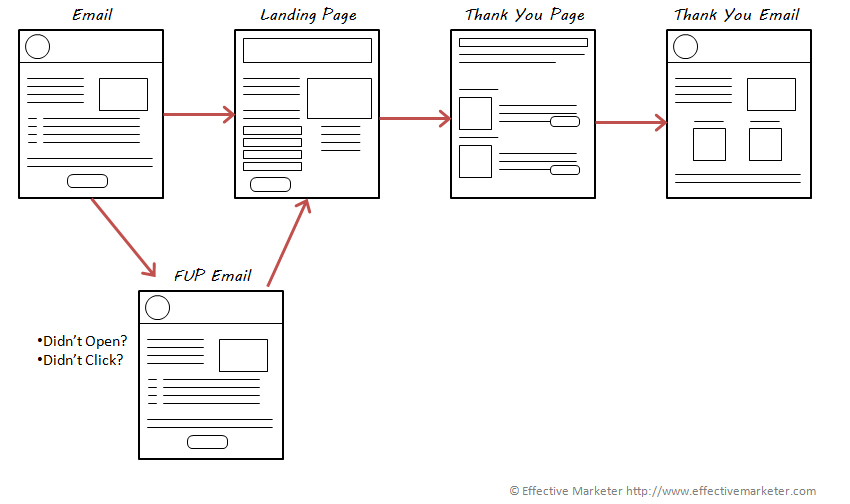
You can also leverage your email marketing analytics to further enhance your campaign. After that first email goes out, you may want to craft a follow up email to people who didn’t take any action. For example:

  • People who didn’t open the email
  • People who didn’t click in any links in the email
  • People who clicked but didn’t complete the registration form

The follow up email is a good opportunity to re-think the message and craft a different email that might entice those who didn’t take any action after the first one went out.

The image below shows the process taking into account the new email you may want to add to your email marketing process flow.
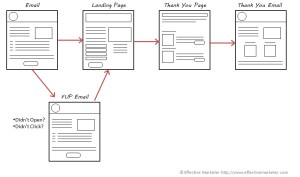
Email Marketing With Follow Up Email

Click to Enlarge

What Happens Behind the Scenes

As people click through your email, register on your landing page, and download your offer, you will want to make sure it is all being captured in a database somewhere. There isn’t a single email marketing software vendor out there that won’t have at least the simplest of analytics. From the moment you schedule your campaign to go out the email software is tracking everything. It will tell you who it was delivered to, who opened and didn’t open, which ones bounced, etc.

The next step, the landing/registration page should also have a way to communicate back to you the registrations. The least you want done is to have a way to get that information back to your CRM system so that you can track which prospects or customers interacted with the campaign and registered or downloaded your offer.

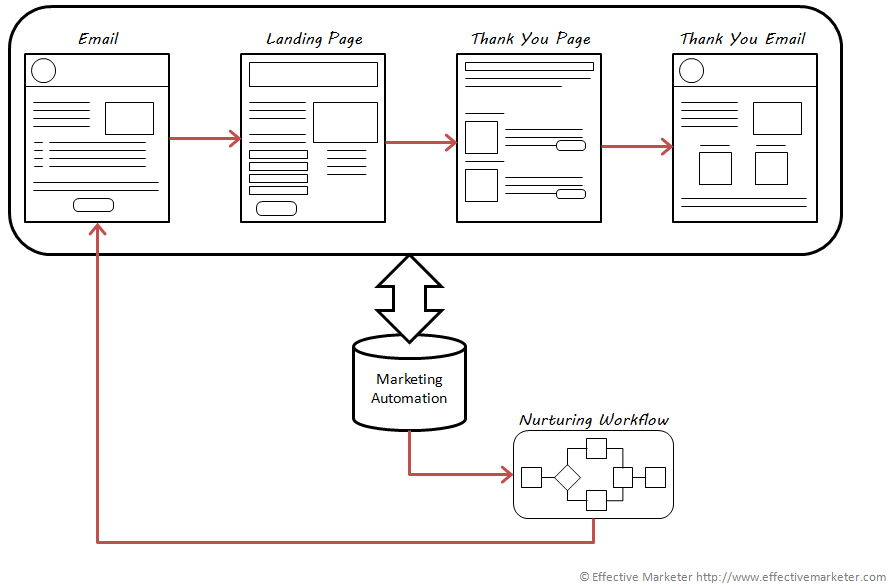
As you get to a point where Email Marketing becomes  a key ingredient in your marketing toolbox you will want to start investing in a Marketing Automation solutions, because most of the MA solutions out there will give you some way to make this whole process a bit easier. The Marketing Automation software can not only track the email responses, but also the registrations from your landing page (if you used a form) and the downloads. In addition, the Marketing Automation software will help get people who responded to your email campaign into a lead nurturing process. In fact, many of your email marketing campaigns, once you have a Marketing Automation solution in place, will start looking very much like part of a bigger nurturing process themselves!

The image below shows the process flow with the Marketing Automation solution component.
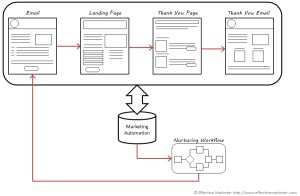
Email Marketing with Marketing Automation

Click to Enlarge

And how about scoring? As you start playing with Marketing Automation, that’s the next step in thinking through your email campaign process. How will you score different interactions between all components? What score will people receive for opening but not downloading your offer? What score will you attribute to different offers on your landing page? And what score will you attribute to different fields in your registration form (if you have one)?

Where To Go From Here

Don’t worry if this sounds like too much to digest. Start small and go slowly. Don’t have a Marketing Automation solution yet? No worries.. use your Email Marketing system and just make sure that you have a way to get the results back to your CRM or whatever contact database you are using. Then, as you get more comfortable and grow your list and the frequency of campaigns, you can start looking at Marketing Automation.

The important thing is to use this anatomy of email marketing to think through all the steps and components and make sure that you are crafting compelling, consistent messages and that each step of the process is being optimized. I hope this brief exercise helped you get a better understanding of what goes on in creating an email marketing campaign.
Email Marketing Process Flow

Click to Enlarge