Why Social Media Needs to Die

April 14, 2010

OK, this may be a bit harsh, but all the talk about social media versus traditional marketing is driving me crazy. Sure, gurus, experts, and agencies alike want to tout they are the latest and greatest when it comes to the new marketing tools on the block and so it makes sense for them to brand themselves as “social media agencies” or “social media experts”. But what about the “traditional marketing” as they call it? It’s all the same thing, but with different adjectives.

Trends and the Obvious

Isn’t it funny how some numbers on a screen, a nice chart and statistically sounding papers can make you believe in anything at all? I found it amusing when reading about two new surveys about social media adoption were released that some of the highlights were:

  • Companies are spending more on social media and plan on increasing social media budget
  • Companies are switching more money from traditional marketing to digital marketing
  • Small and large companies alike are turning to social media
  • Social media is becoming a viable took in the marketing mix

Let’s say someone just came out with this new thing called the Television. And not only that, after a few years it is now in color and families are gathering around it for their favorite shows. Wow, you may say, let’s jump into that and get our own commercial there! Social media, like any other tool (or vehicle of communication to be exact) is the same thing. The new shinny object is obviously attracting people to it and the more you try it out, the better you’ll be at mastering the right message.

Another obvious trend being reported talks about how companies are integrating social media into their marketing efforts (a couple of reports discussed here and some discussion here too). Really?! Wow, these marketers must be really smart to be integrating social media… but how about the ones that say they haven’t integrated social media into their marketing mix? Are they losers? Maybe they are still trying out the waters, creating a twitter account to listen to the market before jumping right in. This “integration” talk is another useless discussion because it really doesn’t help you do anything better today. So what if most marketers are not integrating social media into their strategy? How can this data help you? Don’t tell me that you need that to “sell social media” internally into your organization because that’s a lame excuse. Agencies might like the data because it tells them how easy or how hard it will be to sell their new “social media” strategy service.

The Academic Debate No One Cares

I think I had enough of the whole social media versus marketing discussion when I listened to the Six Pixels of Separation Podcast talking about digital marketing agencies vs. traditional marketing agencies vs. social media agencies.

I wholeheartedly agree when Mitch Joel saysLet’s not make it bigger than it is.”

The discussion of where social media fits, and whether is part of marketing or not is purely academic and has no practical purpose.

For those not in the marketing field, let me clarify this with the simple diagram below:
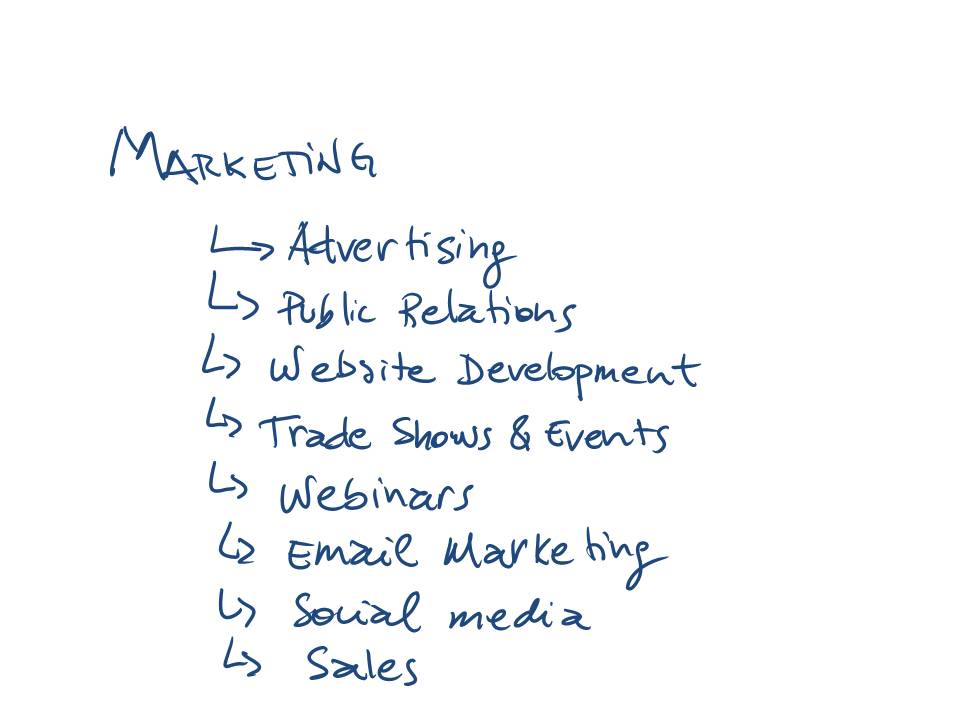
Marketing components

All of those items are under ‘marketing’. Yes, even ‘sales’ is part of marketing, that’s how we’re taught in school and how it is in the real world. In fact, books such as “Marketing Management” and “Principles of Marketing” by Philip Kotler widely used at marketing courses talk about the good and old “Four P Components” of the Marketing Mix and have as examples the following:

  • Product: product variety, quality, design, features, brand name, packaging, etc.
  • Price: list price, discounts, etc.
  • Promotion: sales promotion, advertising, sales force, public relations, etc.
  • Place: channels, coverage, assortments, locations, etc.

No, they don’t mention “webinars” or “email marketing” or “facebook” but you get the idea. Those are all tools of your marketing bag.

And Now For Something Completely Different

While many are using the term social media in everything they do, I propose something different:  just kill it from your vocabulary. You can argue about “push versus pull”, about how “inbound marketing” is the new thing and all that great stuff but keep in mind that it is all part of your marketing strategy and execution.

Talk about “integration”, about “traditional vs. new”, or “digital vs. virtual” doesn’t get you anywhere.

I know I’m not alone in trying to end the social media vs. marketing dichotomy and know that a lot of you marketers out there are getting tired of this whole thing, so let’s just try something completely different and stop talking about social media as if it were completely separate from what we do on a daily basis. It’s a tool, so let’s refer to it as one.


The Dirty Side of Marketing

February 19, 2010

Marketing is Dirty

Recent grads and people from other fields usually have the wrong idea about marketing. After multiple years of interviewing people for marketing positions, working with marketing interns, and discussing marketing with non-marketers it seems that the non-practitioners form their ideas about marketing from:

  • Having watched Mad Men and thinking that  marketing is advertising and it involves coming up with a crazy creative, tough negotiation, and a lot of romance
  • Reading Seth Godin books and feeling like it’s about coming up with purple cows, telling stories, and something about forming a big tribe
  • Watching  the mistakes that SouthwestUAL, Baja Fresh and TGI Fridays, and others have made and then thinking they would  never do that because they are smarter than those big dumb brands
  • Using Twitter and Face book on a daily basis and thinking that just because they have 100+ followers/friends and have top scores on MafiaWars/Farmville/InsertYourAnnoyingAppHere they are experts in social media and think is the only useful marketing vehicle
  • Surfing the web for hours and wondering why don’t all those companies simply re-design their websites

I could go on, but you get the idea.

And then what happens? They get a job.  And with the job comes meetings. And in one of those meetings the  Sales Manager starts talking about quality of leads coming from Marketing, the CFO asks about  Return On Investment, and the CEO  discusses how marketing goals need to be aligned to the overall strategy and asks for comparison with what competitors are doing. Then some negotiation about budget goes on and when the marketing staff regroups there are a lot of spreadsheets being thrown together for metrics.

And those metrics take time. Metrics for email results (clickthroughs, open rates, deliverability, etc.), metrics for the website (visitors, pageviews, clickpaths, conversions, etc.) and for the pay-per-click campaigns (impressions, daily budgets, word rankings, conversions, etc.), and the list goes on. At the end of the day our brave new marketer starts wondering what happened to all the nice marketing creativity, brainstorming sessions, and cool toys he saw on movies and expected to be part of.

The harsh reality is that marketing, let me rephrase that, effective marketing is a dirty job. Sure there is creativity, there is coming up with new ads, a new website, brand discussions and user personas, but it is all backed by serious analytics. Results are what marketers are after. Everything else is a means to that end.

This bucket of cold water thrown at the newbies leave many upset. Our schools are partly to blame because very little practical marketing is taught (recent graduates know the four P’s but have no idea of how exactly to use them and what tools are available). Inevitably some will get disillusioned and leave the field of marketing. Others ‘get it’ and take the analytics side of marketing with gusto and become excellent at slicing data and putting it to work.

With time all that number crunching and metrics become second nature and while they are still important, the “fun” aspects of creative brainstorming, marketing positioning and message, filling walls with post-it notes, and even going to offsite meetings for some R&R before that big push towards a deadline are what you remember most.

To sum it up: Marketing is dirty. Numbers, statistics, and real grunt work is done behind the scenes. But we love it because our work is what makes or breaks a company. We love it!


The Danger of Email Marketing Benchmarks

February 15, 2010

A recent article from BtoB Online about email deliverability reminded me of how dangerous this whole thing of email marketing deliverability numbers can be. Studies from multiple email marketing service providers show different numbers when it comes to delivery rates, bounce rates, open rates, clickthrough rates, and more.

I work for a B2B software company and we do regular email blasts. Our open rates average 30%. Is this good? If I were to look at benchmark data from MailChimp we are doing way better than their published rate of 18% for companies in the software industry.  If I decided to spend the money for MarketingSherpa’s Email Marketing Benchmark Guide their benchmark open rate would probably be different.

Comparing Apples and Airplanes

You know that comparing different industries is irrelevant and that emailing B2C is nothing like B2B, but when you see reports that paint a good or bad picture about how email is doing in your industry, you tend to look at it carefully. Just beware of that inevitable question “why are we not getting the same results?” from your boss. Reading these isolated numbers and trying to use them as your overall goal will only lead to frustration. Yes, looking at different email marketing metrics is good to give you and your team an overall sense of how others are doing and also to spot trends but you should set your goals based on your overall objectives and historical performance.

Instead of asking how to match the industry averages, ask instead:

  1. How can we improve deliverability?
  2. How can we improve open rates?
  3. What can we do to improve clickthrough rates and, more importantly, to get people to buy/download/register?
  4. What are the most important metrics we should track?

The last question is probably the most important. The more you try to track, the less you will be able to do. Focus on the 3 to 5 key metrics for your email marketing program and the rest will follow. Evaluate how you are doing on a monthly and quarterly basis and try to improve every time. Analyze the results you get by segment (geography, products purchased, industry targeted, job titles, etc.) and start fine tuning the message, email design, subject line, date and time sent, and other relevant variables to each segment and you will start creating your own baseline.

OK, if you insist, here are some links to benchmarks I found online. A good starting point is the major email service providers (ExactTarget, Silverpop, Lyris, Eloqua, ConstantContact, Emma, etc.).

As I said, look at them but don’t bet on them or try to set your goals based on what others are supposedly doing. Industry benchmarks are only useful for bathroom reading.


Free Stuff That Sells. Maybe.

June 13, 2009
Free Marketing Stuff Can Sell

Free Marketing Stuff Can Sell

As marketers our job is to generate brand awareness, educate our prospective customers on the benefits of our products and get them to purchase. Effective marketing is about generating sales. Sure, leads and nurturing and all of that are all good but the reality is that unless a sale is made, all that money was spent without any return. Part of the challenge is reaching enough people with your message so that at least a significant number of them decide to buy. And how do you reach even greater number of prospects? Give away free stuff.

Can free stuff sell?

There is a natural resistance among marketers to give whitepapers, webinars, even product spec sheets out for free, especially without requiring any kind of registration. We want names, titles, email addresses, phone numbers, company revenues, number of employees, and while we’re at it give us your annual budget too. What do we do with it? We send it along to the sales reps so tat they can chase these “leads” like eagles diving for their prey. Eagles rarely come back empty handed, though. But that’s another story.

Back to the free marketing stuff. I am enrolled in a free course called Inbound Marketing University, created by HubSpot. It is a free week long online training program featuring some great speakers on topic such as blogging, SEO, viral marketing, email marketing, lead nurturing… all the tools online marketers need to know.

So, why is it free? Because if they charged for it not as many people would register.  Also, the classes (delivered via online webinars, with the archives available afterwards) feature speakers from other respected companies that would love to be able to sell their products to the attendees. I’m not saying that it will be sales pitch university, but I am skeptical. Will it really have all the great insight you get from quality paid courses? Will I get sales calls from each company that is presenting a class? I sure hope yes for the first and no for the second.

As an attendee the question is whether the content will be good. As a marketer (HubSpot in this case) the question is whether sales will follow.

Free marketing that sells

Free marketing stuff can definitely help a company improve its brand and get new customers. People love free stuff, and if it is quality free stuff that you don’t have to regiser for they will tell more people to check it out and those people will tell even more people (viral marketing anyone?). Odds are that someone may eventually buy the product or service. David Meerman Scott is a master at this. His eBook “The New Rules of PR” was offered for free without requiring any registration from his website and was downloaded 250,000 times. When he came out with his hardcover book “The New Rules of Marketing & PR”, it reached number 1 in sales quickly. When people download his eBook and like it, they are more likely to purchase his new book. On top of that, by recognizing David as an expert on the subject and someone that is not emailing you every week with stuff you never asked for, he and his company (Pragmatic Marketing) may get some customers that otherwise would not have even thought about them.

And if you do a simple Google search, you’ll find tons of other free stuff that does not require registration. From free PPC tips, free guide on Facebook for business, free eBook on Twitter for Business, free email marketing guide, and other miscellaneous free stuff (some of which you wish you had never found).

Does it mean we should all offer free stuff without registration on our websites? And how about going a step further and forgo registration for everything else we have on the site, just let people take it? Of course not, but putting some thought into getting quality content available without too many hurdles for the users couldn’t hurt either. Going back to the Inbound Marketing University, what I liked about their registration process is that it was painless, they ask minimum information and so far only relevant emails about the course have been sent.

Whether Inbound Marketing University ends up delivering a great program or just more sales presentations, I will let you know throughout the week as I take their classes (probably more archive classes than live ones, for my free time during the day is fairly limited). The free offer has at least picked my interest so you could say that the strategy is working… for now.

Does free stuff appeal to you? Or you try to stay away from it? Do you offer free marketing materials without registration on your website? Please share your experiences! 🙂