The Rise of the Content Marketer

May 9, 2011

Content Needs a King in Marketing

Content Needs a King

I know I don’t have to argue the value of content to readers of this blog. If you are even remotely interested in marketing it is clear that the more the web has transformed the way we promote our products, the more firmly ‘content’ has planted itself as the center of our lives.

Besides the rise of social media as marketing channel, the emergence of marketing technology, more specifically Marketing Automation systems, in which you can configure the automated distribution of content to customers and prospects has been changing the way marketers see and create conent.

The power of marketing automation is the ability to target your marketing database with specific content based on their behavior and stage in the purchasing process. According to a recent report from Forrester Research titled “B2B Marketers Must Better Prepare for Marketing Automation” (get it from Marketo for free), marketers have to really focus their efforts on content creation if they are to succeed:

“If they only push this type of content out in campaigns, they push their audiences away, since business buyers have a low tolerance for commercial messages. When companies start to tailor content to different audiences and stages of the buying cycle, they greatly increase the amount of content, and the type of content needed changes”

Marketing Roles Are Evolving

Marketing used to have clearly defined roles. Marketing Directors and Managers on top, Marketing Coordinators, Marketing Specialists in the middle, followed by Copywriters, Designers, Web Masters, and more at the bottom. Add a few other roles such as events coordinator and more recently email marketing specialist and maybe even something related to social media and you have the hierarchical organization of 90% of marketing departments today.

With the change and addition of new marketing channels, marketers now see themselves more as content creators than anything else. Twitter feeds need updating, Facebook pages need commenting, blog posts need editing, and YouTube videos have to be tagged. All of this new material requires some form of marketing organization, or better yet, organization and support from the marketing team.

What used to be clear roles (i.e. the copywriter writes copy for the ad while the designer makes the ad look pretty), is now morphing into a free for all. Interns are ‘liking’ pages on facebook while the events coordinator is Tweeting about the trade show giveaway at their booth. Sales reps are sharing webinar recordings with prospects, the CEO is blogging his latest thoughts on the industry, the human resources manager is updating the company’s LinkedIn page.

Does it sound familiar? And scary? Yup!

A new role is starting to take shape. I first heard a term I think will become norm at the last Power of eMarketing Conference in San Francisco, during a panel discussion in which Chris Baggott, Compendium’s CEO, talked about the “Content Coordinator“.

The Content Coordinator

The Content Coordinator is basically the person on your marketing team responsible for coordinating content creation and distribution. Note that this person is not necessarily responsbile for creating the content per se, and in fact some will argue that content creation and copywriting are the same, but rather helping with maintaining a consistent message across all channels (content creation should actually be encouraged throughout the company and a good social media policy put in place).

How you think about what content is for your company will determine how big this role is. Think about:

  • Videos
  • Webinars
  • Presentations
  • eBooks
  • Whitepapers
  • Sales Collateral
  • Blog Posts
  • Tweets
  • Facebook Comments/Likes/etc
  • LinkedIn (company page, discussions, etc.)
  • Website

And the list could go on a few more bullets. But you get the idea… content can be as simple or complex as you make it. The important thing is how consistent, or integrated your message and branding is across channels. And unless you have someone paying attention to it, you’re likely to lose the opportunity to influence people towards buying your product.

So while adding another person to your marketing budget may seem tricky at first, maybe you don’t have to hire an additional person (although for larger organizations that should definitely be the case). You could simply rework some job descriptions to free someone’s time to focus more on the whole content coordination aspect. This could be a good stepping stone for a promising young Marketing Coordinator, for example. The important thing is to make it official and empower this individual to really take charge of content inside your organization. This will save everyone (especially the Marketing Manager) a lot of time and avoid headaches down the road.

Larger organizations may even start thinking of a higher level role, of Chief Content Officer, created in order to plan, coordinate the execution, and report on content ROI.

Whether you decide to formally create this new marketing position or keep things the way they are for now, one thing is certain – your content is more king than ever. How you decide to work with it will determine whether you succeed or fail.


The Challenges in Adoption of Marketing Technology

May 3, 2011

A recent webinar hosted by Neolane, “Crack the Code – Getting C-Suite Buy-In for Your Marketing Tech Purchases” had a very interesting presentation by Suresh Vital from Forrester Research.
Based on a recent report on Marketing Technology Adoption for 2011, the findings of their research shed some light on the challenges we face when it comes to marketing technology.

The Goal of Marketing Software

The need for marketing software comes from the necessity to better understand customer behavior across multiple channels. Companies need to be able to track and measure customer interactions from a reliable source and that has driven a lot of the recent interest in Marketing Automation and Customer Intelligence technologies. The goal is to make use of cross channel marketing strategies to target the customer at the right moment and influence purchase decisions.

Not a new trend, but rather a need that has ben greatly amplified by the prevalence of social media channels which in turn is making companies look for technology solutions. Without solid customer data, cross channel strategies become increasingly difficult to implement.

Marketers as Technologists

According to Forrester’s research, data driven marketers are divided about technology investments. 53% of Customer Intelligence professionals (those who own the customer data and are responsible for customer analytics) consider themselves as technology leaders while 47% said they were technology followers.

While personalities play a role, I think corporate policies and the marketing leadership play a big role in shaping up how marketing technology is brought into the company.

Mobile technologies were also a clear trend for 2011, having the majority of marketers saying they are planning on using or increasing the use of mobile marketing technology. Improving customer experience across channels was also top of mind.

Technology and the Marketing Budget

Technology accounts for 10 to 14% of the marketing budget, according to the research. Marketers are starting to play a strong role in defining the needs and in the selection process when it comes to purchasing marketing technology. This is a shift from the traditional back-seat marketers take for software purchases, typically letting the IT department decide.

27% of marketers say they are the final decision makers

Adoption Problems with Marketing Technology

A surprising finding was that the most important criteria for selection of marketing technology is cost, quickly followed by functional alignment.

82% of respondents say cost is number one factor in deciding marketing technology

This means marketers are settling for solutions that are more economical as long as they match most of their needs. Those solutions that praise themselves for being the all encompassing [fill in the blank] for marketing may be surprised to find out that they are losing deals to lesser competitors simply because of pricing, but that’s not all they should focus on.

As part of the adoption issues, the research found out that the top three barriers for using marketing technology are:

  • 49% Cost
  • 47% Uncertain ROI
  • 40% No Budget

This makes sense. With markeeting budgets still being threatened due to economic uncertainty, marketers are pressed to justify their purchases and show ROI. New tools on the block (social media monitoring and others are the likely candidates) may have a tough time showing solid ROI, therefore their purchases being delayed. Vendors should therefore really work with their customers and prospects in trying to justify the purchase. Marketers also need to work on their justifications and their business cases to make senior management understand why a technology can help the company especially when Facebook, Twitter, and other channels are still a mystery for most corporate executives.


Marketing Automation Catching On Fire

February 16, 2011

According to the recent report by Marketing Sherpa, “CMO Perspectives on B2B Marketing Automation” (offered for FREE by Marketo until March 1st), “the majority of CMOs have either implemented, are in the process of implementation, or are at least considering implementation of marketing automation software“.

34%: Our marketing automation software is partially implemented

19%: Our marketing automation software is fully implemented

17%: We have not began implementation but plan to

30%: We have not began implementation and don’t plan to

This is probably good news for the vendors, which are competing in an increasingly crowded market. Some have even suggested that marketing automation market is floundering, but it is such a new market and offering that is innevitable to have doubts, especially with these many vendors in the space. With time, a shake out is likely (in fact, the recent acquisition of Unica and Aprimo may point to consolidation) and the evolution of solutions will ensure marketing automation has a place in most marketing organizations, much like CRM is now standard for sales departments.

A Marketing Automation Timeline

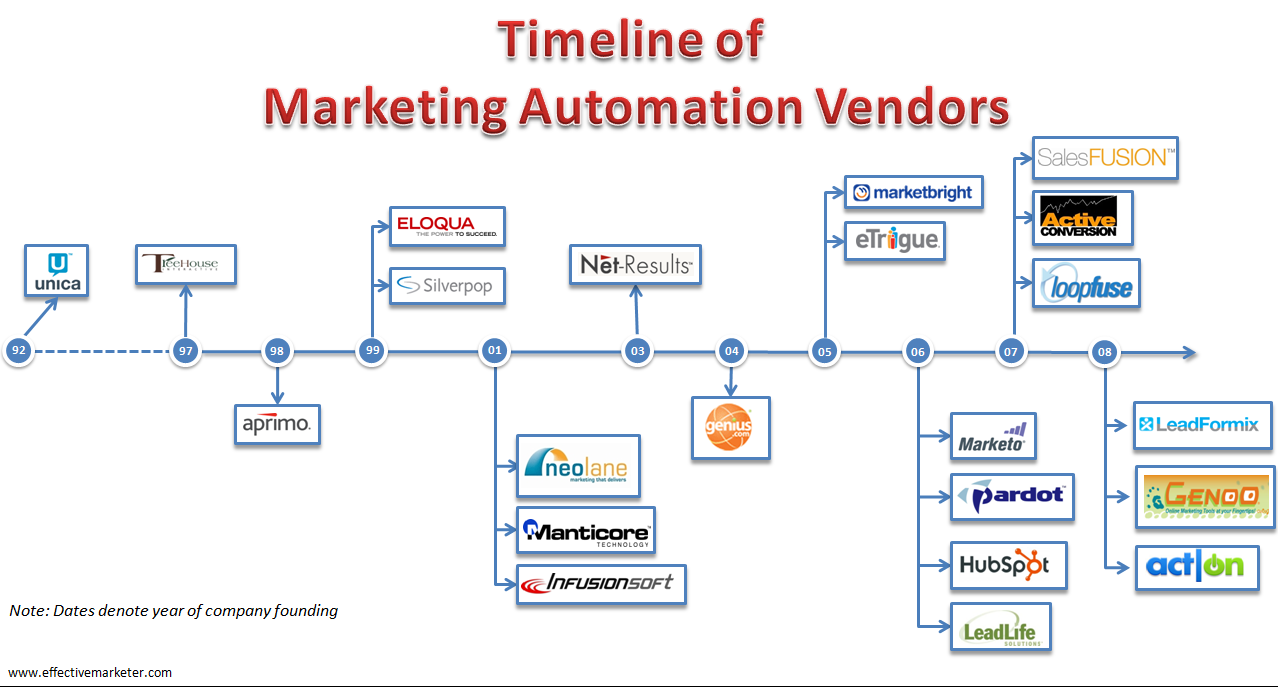
So let’s take a look at the marketing automation companies in play today (mostly US based in this case) and when they were founded. Interesting to note that the majority of the players only came to existence not even 5 years ago. This nascent industry still has lots of growth to do.

Timeline of Marketing Automation Vendors

You may spot some companies that were not considered to be “marketing automation” players just a year or so ago. That points to the evolving nature of the market, and the key functions of lead nurturing, scoring, and automated triggers becoming part of email marketing and other marketing solutions. Marketing Automation Software Guide published a B2B Marketing Automation market map that shows a few other players I ignored for the timeline above, like SAP and Oracle because although they do have marketing automation capabilities it is not their core business (and I don’t agree with tagging Salesforce.com as a marketing automation solution).

Investment in Marketing Automation

Another interesting factor to consider in the marketing automation industry and why it seems to be catching on fire is the money that is flowing towards some of the key players. Just a few marketing automation companies have already raised over $170 million dollars combined. Whether they will all be around a couple years from now is still to be seen, but it does make for a highly competitive environment. With cash to burn, these companies are focusing on growing the customer base first, with hopes that revenue will follow.

Total invested in Marketing Automation vendors

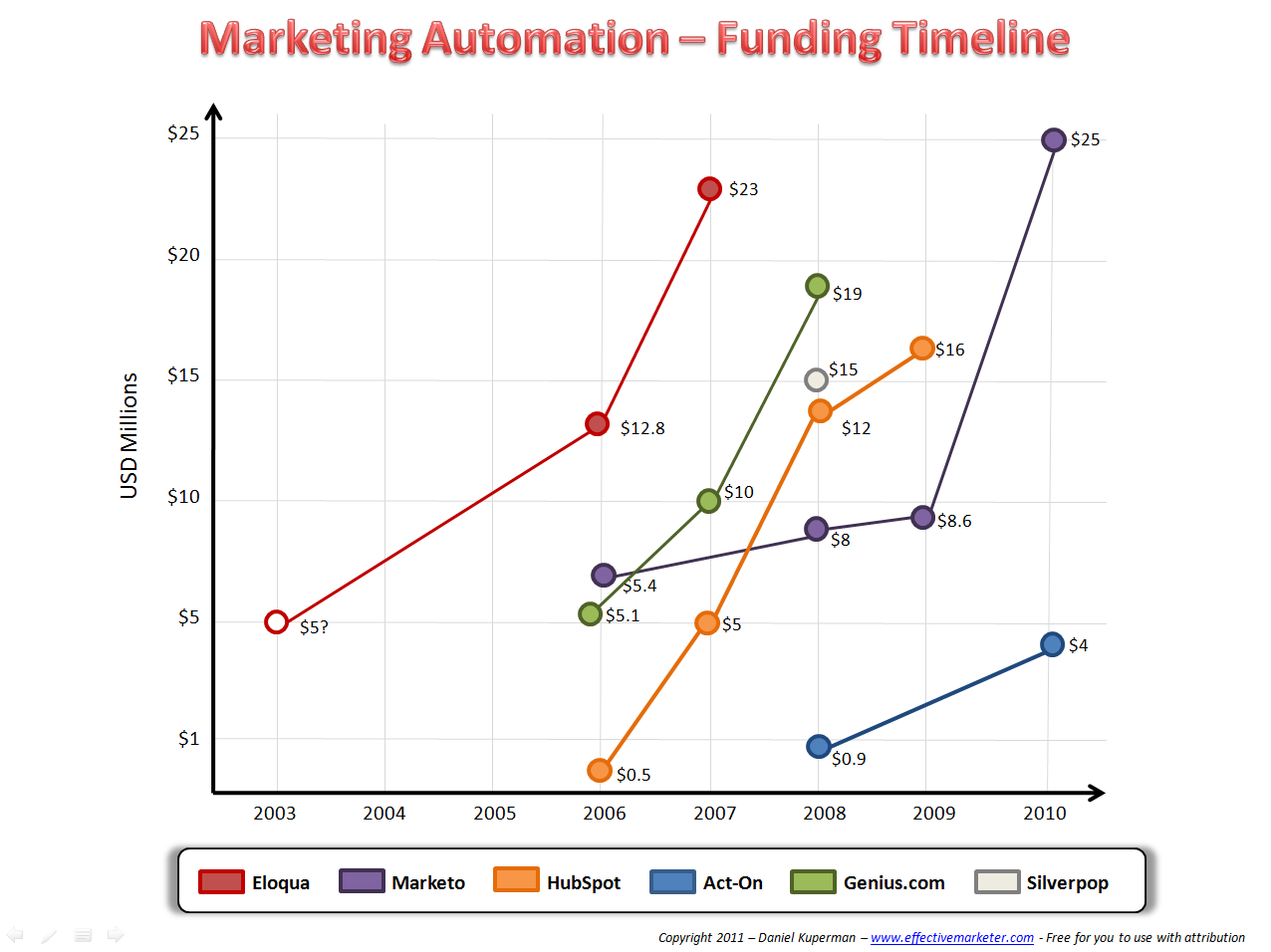
The marketing automation infographic above (click to enlarge) shows the top players in the MA space that have raised over $1 million dollars. Also interesting to note that if you break down the fundraising of each of the above vendors into a timeline (like I did below), most of the investment has been made in the past couple years.

Marketing automation funding timeline

You may have to click to enlarge the funding timeline infographic above.

Note: I used publicly available data and wasn’t able to find Eloqua’s Series A, so I deducted based on valuation of their second round.

The Marketing Automation Market

The Marketing Automation market is at an interesting stage. Companies are fighting for customers, trying to educate the market, and we may be seeing the beginnings of consolidation. Based on the investment figures above it seems is catching on fire, but at the same time there’s fierce rivalry and still a lot of room to improve… what will happen? I don’t know but it promises to be really interesting!

What do you think ?

P.S. Let me know if I missed any MA company in the graphics above or if I got incorrect data. I’d be happy to fix the infographics for benefit of everyone.


Marketing By Objectives

November 29, 2010

Objective-Action-Budget

In a recent article for the CMO Council’s Newsletter, Nicolas Watkis argues “Marketers won’t succeed if they don’t have objectives”. Right on, my friend!

As we have all heard before, marketers are now more than in any other time being measured and challenged to produce measurable results. Mr. Watkis then states “the most important activities for marketers are the establishment of marketing objectives, a plan for their achievement, a budget to support the plan, and the management of assets and resources to achieve the objectives”.

OK, I think we can all agree this makes sense, but then how do you go about coming up with a plan? His article argues that most marketers start with the budget and foolishly take that for a marketing plan while the right approach is actually quite different:

1. Set measurable objectives, both financial and marketing. The financial objectives are revenue, profits, return on assets (how much sales will the campaign generate? Is a valid question to answer in your objective) and although he doesn’t describe what the “marketing objectives” are, I would focus on lead generation numbers (how many qualified leads, for example) although other metrics such as “number of blog posts” or “twitter messages” could be valid objectives for social media campaigns.

2. List actions to be take for each objective, with completion dates, people responsible for each action and also think in terms of alternative actions (what to do in case the action is not successful). This last bit is important for factors outside your influence, maybe a contract that depends on another company has to be signed for the joint marketing campaign to start, or what to do if certain assumptions you’ve made when putting together the plan fail to materialize (i.e. what to do if mommy bloggers don’t pick up our story or offer right away as we hope they will do).

3. Profit and loss projection with a detailed marketing budget showing the allocation of resources. So here it is, the marketing budget, the final component of the marketing plan.

The methodology of OBJECTIVE -> ACTION -> BUDGET is logic, but why is it that so many marketers keep insisting on coming up with the budget before actually putting a plan in place? The “let’s copy last year’s budget” mentality is prevalent in many organizations because is the easy way out of a not so glamorous function. Maybe now is time for some change. So write “objective -> action -> budget”  down on paper, in big letters and stick it to your corkboard or use a post-it and glue it to your computer monitor. That’s what I just did 🙂


B2B Marketing Summit Shows Old Problems Persist

October 14, 2010

So it seems MarketingSherpa’s B2B Summit 2010 is over and from what I read in their wrap up post, the same old problems plaguing marketers for the last 5 years are still here today. First of all, what is this summit? According to their post:

“Last week in San Francisco, 211 business-to-business marketers spent two days sharing insights, case studies and advice on social media marketing, lead generation, Sales and Marketing alignment, and other hot-button issues on the West Coast swing of MarketingSherpa’s seventh annual B2B Marketing Summit.”

MarketingSherpa is known for quality content and I have attended a couple conferences (I was a speaker at the Email Marketing Summit 2008) and have always thought that the best you get from attending an event like this is more in the form of networking than in content itself. The other good thing about going to such a conference for me, is that I get dedicated time to really think through all the topics being discussed, without being interrupted for meetings, phone ringing and people walking in the office.

The many takeaways from this year’s B2B Marketing Summit (West Coast) according to MarketingSherpa, were:

  1. Begin with the end in mind
  2. Put yourself in your customers’ shoes
  3. Getting a lead is just the beginning…
  4. For successful lead generation and nurturing, you need quality content
  5. Use measurements that matter
  6. It all happens on the landing page
  7. Be strategic about presenting your campaigns and your vision to the C-level

None of the takeaways above strike me as particularly new or groundbreaking, but that’s how it always goes. Sometimes we just need to be reminded of the obvious so that we can focus on the essential.


How Success is Misunderstood

September 29, 2010

How do you define success? Number of leads generated? Amount of sales or deals closed? If you answered “it depends”, then you’re thinking smart. Success can be based on a number of different factors and it also varies based on who you talk to, after all, we all have different objectives (personal and professional).

Now let’s go one step further. If you see another company being successful (however you define success) and you try to apply the same method, can you guarantee you will also achieve success? If you said “it depends”, you just got yourself an extra point! As marketers we all know it’s not that simple. Questions about what the target market is, what industry are you talking about, and such are the first things that come to mind. A method of selling hot-dog on the street can be used to sell software, but I wouldn’t follow it by the letter.

That’s why it still amazes me that discussions about following a formula for success often get stuck in how you define “success” instead of discussing the differences between target markets. If you are a blogger and your readers are software entrepreneurs, you can’t really expect that the bag of tricks used to attract social media consultants will work the same way. A B2B company applying tactics used by B2C companies can be very successful but only after some necessary translation is done.

How do YOU define success and do you have a special formula?


The Opposite of Advertising

September 20, 2010

How can a company embark on an branding campaign without prominently displaying its logo? What seems to be the opposite thinking of the advertising school became the winning campaign of Banco Hipotecario, a financial services business based in Argentina.

After becoming the sponsor of Racing Club de Avellaneda, a big soccer team in Argentina, they decided to do something audacious, maybe even heretic in the minds of conservative brand strategists: they decided to NOT put the bank’s logo on the soccer jerseys. Crazy as it seems the whole strategy leveraged the ongoing “Creator of Owners” message Banco Hipotecario was already running (the message focused on showing how the bank was helping people become house owners through their mortgage lending business) and created the slogan “Racing: Duenos de su camistea” (Racing: Owners of their jersey), to show that the bank really cared for the sport and the team they were sponsoring. After being picked up by local media and sports commentators, fans raved about the new jersey.

Banco Hipotecario’s facebook page has over 14,000 fans and was the centerpiece of their second phase of the campaign. They asked fans to vote on a phrase to be printed on the shirt that would evoke how the fans feel about their beloved team. The winning phrase, “Duenos de una passion” (Owners of a passion) received 2,398 votes.

Voting on Racing's new slogan for their jersey

Although it was reported that some fans were against the printing of the phrase (and the choice of phrases themselves) on the shirt, it’s undeniable the level of participation the branding effort generated and how quickly they were able to engage the fans.

Sometimes going against established “best practices” may pay off.

Sources for more info on this story are:

Creativity Online article, F*ck Smaller. Make the Logo Disappear.

Marca del Gol post, Second Phase of Invisible Advertising (in spanish).

Communicate Good blog post, Invisible Branding.

Marketing News article, Marketing Across the Americas (requires login).


Taming Your Brand Mascot

May 10, 2010

From Tony The Tiger, Trix Rabbit and Energizer Bunny to Ronald McDonald and even John McCain (?!) brand mascots are a common tool to promote your product or service. More recently even Twitter mascots have been showing up as a company’s public face.

The good ones are those that you don’t even think about until you decide to wear your marketer hat. That’s what makes them memorable.

A recent article I read on Harvard Business Review, “ Aflac’s CEO Explains How He Fell For The Duck” made me think about brand messaging and the use of mascots. The article is great because it gives you an insider’s view of how the famous Aflac duck came to being and the challenges Aflac’s CEO had to overcome to get it adopted.

The first Aflac duck debuted in 2000. The company reported $9.7 billion (US and Japan combined) that year, up $1 billion from the previous year. In 2008, revenues were up to $16.6 billion. Amos credits this increase mostly due to the branding initiatives related to the duck, an amazing feat for any brand mascot. Here are some highlights of the Aflac duck’s impact:

  • First year after the duck’s introduction, sales were up by 29%.
  • Name recognition increased 67% after two years of running the commercials. Today the name recognition is 90%.
  • The duck has 165,000 facebook fans in the US.
  • In two months 100,000 people posted spoofs of the Japanese duck’s song online.

How do you create a successful brand mascot? I particularly like the tips a FastCompany article, “Brands with character”, gives:

  1. Give the brand human traits
  2. Create a life, backstory to your character/mascot
  3. Plan for the long run
  4. Don’t overcomplicate

What mascots do you consider memorable and why?


Why Social Media Needs to Die

April 14, 2010

OK, this may be a bit harsh, but all the talk about social media versus traditional marketing is driving me crazy. Sure, gurus, experts, and agencies alike want to tout they are the latest and greatest when it comes to the new marketing tools on the block and so it makes sense for them to brand themselves as “social media agencies” or “social media experts”. But what about the “traditional marketing” as they call it? It’s all the same thing, but with different adjectives.

Trends and the Obvious

Isn’t it funny how some numbers on a screen, a nice chart and statistically sounding papers can make you believe in anything at all? I found it amusing when reading about two new surveys about social media adoption were released that some of the highlights were:

  • Companies are spending more on social media and plan on increasing social media budget
  • Companies are switching more money from traditional marketing to digital marketing
  • Small and large companies alike are turning to social media
  • Social media is becoming a viable took in the marketing mix

Let’s say someone just came out with this new thing called the Television. And not only that, after a few years it is now in color and families are gathering around it for their favorite shows. Wow, you may say, let’s jump into that and get our own commercial there! Social media, like any other tool (or vehicle of communication to be exact) is the same thing. The new shinny object is obviously attracting people to it and the more you try it out, the better you’ll be at mastering the right message.

Another obvious trend being reported talks about how companies are integrating social media into their marketing efforts (a couple of reports discussed here and some discussion here too). Really?! Wow, these marketers must be really smart to be integrating social media… but how about the ones that say they haven’t integrated social media into their marketing mix? Are they losers? Maybe they are still trying out the waters, creating a twitter account to listen to the market before jumping right in. This “integration” talk is another useless discussion because it really doesn’t help you do anything better today. So what if most marketers are not integrating social media into their strategy? How can this data help you? Don’t tell me that you need that to “sell social media” internally into your organization because that’s a lame excuse. Agencies might like the data because it tells them how easy or how hard it will be to sell their new “social media” strategy service.

The Academic Debate No One Cares

I think I had enough of the whole social media versus marketing discussion when I listened to the Six Pixels of Separation Podcast talking about digital marketing agencies vs. traditional marketing agencies vs. social media agencies.

I wholeheartedly agree when Mitch Joel saysLet’s not make it bigger than it is.”

The discussion of where social media fits, and whether is part of marketing or not is purely academic and has no practical purpose.

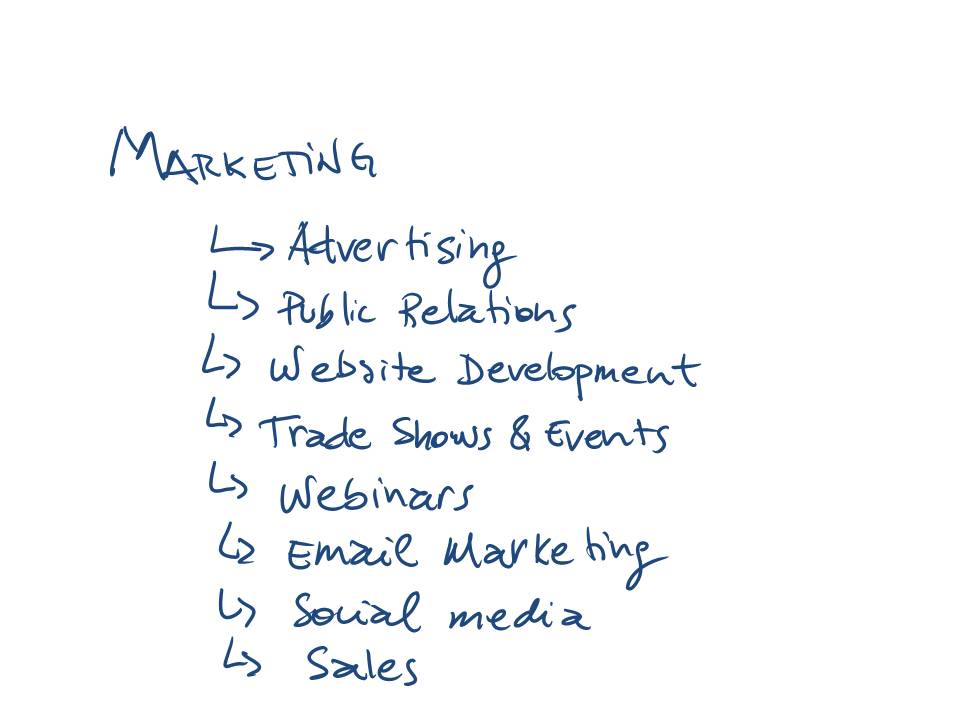
For those not in the marketing field, let me clarify this with the simple diagram below:

Marketing components

All of those items are under ‘marketing’. Yes, even ‘sales’ is part of marketing, that’s how we’re taught in school and how it is in the real world. In fact, books such as “Marketing Management” and “Principles of Marketing” by Philip Kotler widely used at marketing courses talk about the good and old “Four P Components” of the Marketing Mix and have as examples the following:

  • Product: product variety, quality, design, features, brand name, packaging, etc.
  • Price: list price, discounts, etc.
  • Promotion: sales promotion, advertising, sales force, public relations, etc.
  • Place: channels, coverage, assortments, locations, etc.

No, they don’t mention “webinars” or “email marketing” or “facebook” but you get the idea. Those are all tools of your marketing bag.

And Now For Something Completely Different

While many are using the term social media in everything they do, I propose something different:  just kill it from your vocabulary. You can argue about “push versus pull”, about how “inbound marketing” is the new thing and all that great stuff but keep in mind that it is all part of your marketing strategy and execution.

Talk about “integration”, about “traditional vs. new”, or “digital vs. virtual” doesn’t get you anywhere.

I know I’m not alone in trying to end the social media vs. marketing dichotomy and know that a lot of you marketers out there are getting tired of this whole thing, so let’s just try something completely different and stop talking about social media as if it were completely separate from what we do on a daily basis. It’s a tool, so let’s refer to it as one.


The Fun Theory: How to Change Behavior

November 30, 2009

How do you change people’s behavior? Corporate America usually relies on some form of compensation system which basically uses a reward/punishment method that tries to coerce people into doing what the company wants. You have to fill out forms, get approvals, and meet goals otherwise there’s no pay raise or bonus. In other cases you try to get website visitors to navigate a certain path by placing links in strategically important places or enticing them with an offer. Books and theories exist on how to get people to perform their best or to change the way they behave (“Bringing Out The Best In People” comes to mind) but rarely we see those in action.

Volkswagen launched what became quickly a viral campaign with emails being forwarded, youtube videos with over 1 million hits and comments from all corners of the web. They call it The Fun Theory (www.thefuntheory.com) and the goal is simple: using fun to change people’s behavior for the better. The videos on their website (embedded below) are some great examples of what they mean.

How are you changing your customers and your prospects behavior? Can you make something fun that will entertain and educate them? And how about your staff or your company’s employees? Some food for thought.