What’s Your Marketing Approach?

July 29, 2009

An interesting post by Steve Johnson talks about marketing not being a list, but rather an approach to solving customers problems and helping buyers to buy.

As marketers, we sometimes fall victims of the routine day-to-day tactical activities and forget why we are doing them. Create this email here, prepare a webinar there, and send the artwork for publication in that magazine. Do you ever stop at some point during the week to rethink your actions, rethink your role, rethink your strategy?

Being tuned to the market and being able to notice patterns is only possible if you do your job with eyes wide open. You don’t necessarily have to keep looking for this with everything you do at every minute (it would drive you crazy and slow you down considerably) but just recognizing the need for it does help.

Here are some actions you can take that might help:

  • After you create a presentation, review it thinking not only on who you will be presenting it to, but now thinking about whether more people in your market (customers and prospects) would find it interesting/educational
  • When you wrap up things for the day, think back at everything you created (collateral, presentations, copy, etc.) and make a note to revise it and expand it to become a piece you can repurpose for another audience
  • Make a point to touchbase with the sales reps every month and ask them what they are seeing in the market and what questions they are being asked
  • Schedule a couple hours per week (Friday afternoons are usually great) to review the week that passed and to plan for the week ahead, with the idea that what you will be working on, producing, and publishing should be solving a customer problem

How are YOU tackling the challenge of noticing patterns and solving customers problems?


Why Social Media Is Not For Everyone

July 21, 2009

While many are in love with the whole concept of Social Media as being the next big thing in marketing, the holy grail that will lift sales and enhance your brand, I have seen some detractors that insist in calling out the faults and dangers or adopting Social Media as part of your marketing strategy.

Taking the plunge into social media may not be the right thing for you

Taking the plunge into social media may not be the right thing for you

Social media is just another media

Experts, personalities and false prophets are all clamoring that social media is king. We’re told that if you have a good plan , if you follow a proven framework for rolling out your social media activities and integrate them with your sales efforts , then the ROI will be clear . That is, if you can translate all those additional site visits, downloads, and re-tweets into sales. Otherwise it’s just buzz.

Some blasphemous professionals on the other hand, caution us to be careful in our efforts, telling us we should really focus on those customers that love our product and not use social media targeting everyone. They caution us saying it could be dangerous to our business if incorrectly used and it’s only helpful to build relationships and goodwill .  Sales? Maybe not so much.

I don’t know about you, but so far it seems like Social Media is nothing more than just another media, another tool in the marketer’s arsenal. It’s like saying everyone should do email marketing, everyone should do podcasts, print ads and TV spots.

Choosing the right social media strategy

While some may say that since your employees are already using social media (facebook pages, tweeter accounts, linkedin posts, etc.) you should also jump on the bandwagon , I say there are several reasons for companies to be reluctant to embrace it wholeheartedly. The same questions you would ask before using any marketing tool available you should also ask of the Social Media tools. What is it for? Who is our target? What is our goal? What are our objectives? What resources will it require? Will we do it ourselves or will we outsource to someone with more experience?  Do we need to create rules or procedures for using it? How will we measure success?

At the company I work for we recently had an informal discussion about Facebook and Twitter, with people raising questions such as “why don’t we have a Tweeter page” or “let’s create a Facebook account and start inviting customers”. That is all nice and good, I said, but let’s first decide on why we are going to do it. Get people to buy our products! Tell them about a new release! And similar comments ensued. Yeah, but HOW do you do that? Just making sure you are Tweeting five times per day is not guarantee for success especially if you have nothing more to say that hasn’t been said already. As with any new tool or concept, it always seems easier said than done. Probably because it’s “free” (yes, you don’t have to pay for it but you do need to invest time), it is immediately implied that if you are not using it you are behind the times  and putting your company at risk.

Let’s put aside the fact that the press and the Internet in general are full of stories about how social media is transforming businesses and think in terms of marketing strategy. Why would you use a tool without first deciding how it will impact your brand, how it will impact your resources and how it will help you achieve your goals? I’m not saying that you shouldn’t use it but I am simply cautioning you to use it as part of your overall strategy. If you want to create a corporate blog that focuses only on your 10 most profitable customers and you have good reasons to do it, then don’t think for a minute that you are doing something wrong. If you need to Tweet about what you had for lunch because somehow this creates affinity with your prospects and will eventually translate into sales, then knock yourself out.  Nothing is purely good or bad

Social Media In Three Easy Steps

Step 1: Learn how to use it

Before judging whether something works and the best way to use it, first attend a course, read a book, talk to people that are using it. There are several free online courses and resources on the web you can use to learn more about it. Only then will you be able to really make a good decision.

Step 2: Learn how to NOT use it

Now that you know what the social media tools are all about and how they are supposed to be used, check out the myriad of examples of companies that are doing it correctly and getting returns and also check out how companies are screwing it up so badly it is becoming a public embarrassment (recent United Airlines fiasco , IBM’s IT failure debacle , and Habitat’s tweet spam come to mind). Learn from others mistakes and then you will be ready to commit your own.

Step 3: Teach and listen

With all that good info you now gathered at hands, bring this knowledge to your company and spread it around. Educate the CEO, the sales manager, your staff and everyone else that you think can help you shape your company’s strategy towards social media. Then listen to what they have to say, you may be surprised. And don’t forget to give them the option of doing nothing. Whatever works for your business is what you should do.

How did YOU approach social media at your company? Please share!


Don’t Forget Your Company History

July 16, 2009

The recent advent of the lost NASA tapes (they lost the original tapes from the Apollo 11 mission, the first Moon landing, then found out that they had all been erased) got me thinking. At my company we do our best to keep “old” stuff like pictures, awards, magazine ads, even show signage. Sure, call us pack rats but we like going back in time and talking about the old days and how things changed. Not only that, we feel a certain pride when we look back in time and realize how much we have accomplished.

A project that has been on my list for some time now, is to get all of those pictures and select a few that we can use on our website as part of our company history page. Adobe and General Electric are just two examples that come to mind that make good use of their history to talk about their origins and how it relates to what they do today.

How can a company’s history be used effectively? Here’s a few additional options:

  • Sales can talk about the company’s past to reinforce the message that the prospect is dealing with an established, solid player
  • Human Resources can show new employees and interviewees what the company culture feels like by sharing photos of past events
  • Volunteer organizations, once they see information, pictures and nominations from past activities can get in touch and partner with the company for a future joint community event or non-profit activity
  • Putting up a timeline with pictures at the company’s lobby can not only entertain visitors but give them a quick lesson on the company’s origins
  • Managers can refer back to historic events and milestones to reinforce the message of the company’s mission and goals during staff meetings
  • Marketing can use the company’s history not only on the website (photos and videos) but also on collateral, either as part of a campaign or simply to reinforce a point about the industry, the company’s reputation, or to give the company a more human face

So how are you using your company’s history in your marketing efforts?


Presenting Effective Charts

July 12, 2009
Are your impressive charts effective?

Are your impressive charts effective?

Stop doing charts in Excel. At least don’t use the default options that give you 3D bar charts with dull colors and gray background. The fix? Go to Juice Analytics website and download their free add-on to Excel that cleans up charts for a professional look.

Ok, now that we have a tool to fix those ugly Excel charts, let’s see what we can do about the main goal of your chart: The message.

How to Ensure Your Message is Clear

Before creating a chart showing the latest web analytics, or the trends in email clickthrough rates explaining the recent results in webinar registrations, think about what exactly you are trying to say. Sounds simple but often times I see charts presented just because they ‘look nice’ or because they show data. Yeah, you’ve seen them too, right? After you stared them for two minutes you are still wondering “What the heck is he trying to say with this chart?”.

Here’s five simple rules I use when presenting data on a chart format:

1. What is the summary?
As I do my analysis, I think about what all the data means. Are we losing customers? Was the last trade show really effective? Did we generate quality leads? Then, I think about what is the summary of all the analysis and the conclusion. This is often the most important piece of information of the whole presentation.
2. What is the story?
Saying “we didn’t reach our sales goals” is OK, but after the initial shock, people will wonder exactly what happened. So the next best thing is to think about the story. More specifically, what story are the numbers telling you? You will find that some data points when put next to other data points will give you a clear explanation of what happened. If you need a few different charts to present it, that’s OK. They will become your storyline.
3. What can I remove?
Less is more, especially when presenting data and charts. Think about what you can remove from the chart that might be distracting or that is not adding to the overall story. It could be a data point, could be labels, legend, or colors.
4.What needs explanation?
Some charts are clear and have all the information necessary, while others only glimpse into a certain question or answer. You may have to add supporting information either before or after the chart. Don’t assume everyone will ‘get it’ when looking at it. Always go back to step 3 and ask yourself if the additional info is really necessary.
5. What action needs to happen?
If you are presenting something, you need something to happen. Sure, you may just be sharing information but still you have a goal with this information sharing and why would you present something if nothing will happen as a result? The story your slides are telling and your charts are emphasizing should lead to a certain climax that will ask for action or actions to be taken. That’s the “so what” question people often ask themselves after a presentation. Don’t let anything up to imagination, add to the presentation what the audience needs to do or what needs to happen based on the information just presented.

1. What is the summary?

As I do my analysis, I think about what all the data means. Are we losing customers? Was the last trade show really effective? Did we generate quality leads? Then, I think about what is the summary of all the analysis and the conclusion. This is often the most important piece of information of the whole presentation.

2. What is the story?

Saying “we didn’t reach our sales goals” is OK, but after the initial shock, people will wonder exactly what happened. So the next best thing is to think about the story. More specifically, what story are the numbers telling you? You will find that some data points when put next to other data points will give you a clear explanation of what happened. If you need a few different charts to present it, that’s OK. They will become your storyline.

3. What can I remove?

Less is more, especially when presenting data and charts. Think about what you can remove from the chart that might be distracting or that is not adding to the overall story. It could be a data point, could be labels, legend, or colors.

4.What needs explanation?

Some charts are clear and have all the information necessary, while others only glimpse into a certain question or answer. You may have to add supporting information either before or after the chart. Don’t assume everyone will ‘get it’ when looking at it. Always go back to step 3 and ask yourself if the additional info is really necessary.

5. What action needs to happen?

If you are presenting something, you need something to happen. Sure, you may just be sharing information but still you have a goal with this information sharing and why would you present something if nothing will happen as a result? The story your slides are telling and your charts are emphasizing should lead to a certain climax that will ask for action or actions to be taken. That’s the “so what” question people often ask themselves after a presentation. Don’t let anything up to imagination, add to the presentation what the audience needs to do or what needs to happen based on the information just presented.

For some nice tips about how to prepare before you give a presentation, SlideMagnet has some pretty good advicethat drives home the key points while giving you some good laughs.

Charts That Tell a Story

Here is a compilation of great articles and sites I’ve read in the past that really helped me understand the importance of paying attention to data presentation and how to choose the right chart based on your data and message.

Images, Cliparts, and Stuff

Although another blog post should cover this in more detail, if you are using images (and you should) in your slides, make sure you get good ones. Cliff Atkinson has some great suggestions of places to get images from and the PresentationZen blog has a recent post that will help those trying to present technical information.

I hope the resources I listed will help you create better charts and presentations. If you know of other resources, please share!


Copywriting That Sells: Powerful Copy is Easier than You Think

July 5, 2009

Writing great copy is easy. Writing powerful, attention grabbing copy that will help you sell is another story. I usually

Copywriting that sells. This is your goal.

Copywriting that sells. This is your goal.

overcomplicate, think too much, duplicate sentences without realizing it and end up having to start from scratch. Now that I have attended a copywriting workshop I hope some of the lessons will stick long enough to help me improve.

Not all workshops are good, most of the ones I’ve been to are actually pretty bad but once in a while there’s one that stands out and this time was the copywriting workshop I attended a couple weeks ago. Far from exceptional (I am a very harsh critic) and very focused on basics, I nonetheless had some great insights and came out with great action-ready items I am putting to the test at work.

The Copywriting Wimp

The workshop instructor was Sandra Blum, a renowned copywriter, columnist for Dynamic Graphics magazine, and more recently one of the judges for DMA’s Echo Award. That in itself is a good indication that the material was above average. She not only customized the course the way she thought it should be delivered but was also able to get the group of 20 or so to interact and dictate the pace. Gotta love her for that.

Besides being a nice refresher of some basics, we all got some really good actionable items that we took back to our work and were able to put right into practice. Copywriting is easy, but writing powerful copy that sells is what separates the wimps from the champions. If you feel like a wimp sometimes, or need to get a good checklist of stuff that will help you during those difficult moments of “how do I make this sound more exciting?”, then read on.

10 Nuggets of Copywriting Wisdom

Here are some of the key insights I got from the workshop and I hope these few key lessons can help you improve your copywriting too.

1. “People don’t want more information, they want better information”. Before you start scribbling away, think about the two most important things about what you are writing, namely your objective and the action you want the reader to take.

Examples of objectives for your copy:

  • Sell
  • Lead generation
  • Public Relations
  • Generate Interest
  • Promote
  • Create anticipation
  • Arouse Curiosity
  • Provide information

Examples of actions you may want your readers to take:

  • Call
  • Return a response card
  • Visit a store
  • Place an order
  • Join up
  • Ask for an estimate
  • Give feedback / fill out a survey
  • Tweet or blog about it

2. “It’s not how long you make it, is how you make it long”. Sometimes you just have to write that extra paragraph and cutting more words won’t make your copy flow better. As long as your copy is engaging, your readers won’t mind. MarketingExperiments has an interesting test on short copy versus long copy that is worth checking out  and Sonia Simone from CopyBlogger has a great blog post on the same subject.

3. The goal is to write persuasive copy. It’s what Joe Sugarman calls the “Slippery Slide”, in his book “The Adweek Copywriting Handbook”, explaining that “The headline must be so powerful and compelling that you must read the subheadline, and the subheadline must be so powerful that you are compelled to read and so compelling that you must read the next sentence, and so on, straight through the entire copy to the end”. He also calls it “Reading Gravity” because it’s like a force pulling you through the copy. The ultimate test is whether the reader acted on your call to action.

4. Headlines and subheadlines are key to making your copy flow. Some people will only read those, while others will be compelled to keep reading. When used effectively, headlines will help you:

  • Grab the reader’s attention
  • Qualify the audience
  • Deliver a message
  • Draw the reader into the copy

5. Make working with copywriters work for you by using a creative brief. Sandra told us some interesting stories about having to use creative briefs to manage outsourced copywriters. Great idea! Why keep creative briefs a tool for only your marketing department to use? Make sure that copywriter you are hiring really gets it and ask him or her to fill out a creative brief, then use it to manage the project.

6. Decide on a style guide. Seems easy enough but if you are a freelance writer or if your company is using one, that is one of the first things you should do. Whatever the guide you use or that you created along the years based on your industry, product, or service make sure everyone is on the same page as to what are the standards. Avoid confusion later by spending some time deciding it now.

7. Work on your opening lines. Seriously. Opening lines can make or break your email, landing page, website, blog, or any other type of writing you do. Here’s a brief list of styles you can choose from:

  • Tell a story
  • Sell a benefit
  • Share news
  • Evoke curiosity
  • Present a problem
  • Present a solution
  • Flatter

8. Simplify your writing. Tailor your writing style towards your audience and be aware of how difficult your copy might be for someone to read and comprehend. There are several indexes out there for this kind of thing, like the Flesch-Kincaid, Gunning Fog, and one of my favorites (because of its name) the Simple Measure of Gobbledygook . The simplest way to use the readability test is by configuring it in your MS Word program.

9. Design and copy should be worked together. This is a key point for me because often times I write or edit copy then send it to the graphic designer who will insert it into some kind of layout he created. And often times the design needs to be changed because it doesn’t work with the copy. Make sure your designer understands the purpose of the piece you are writing, the benefits, and the desired outcome. Only then will you be able to have the design strengthen the copy.

10. Understand the benefit of your benefit. This was an aha! Moment for most people at the workshop. We all know about features and benefits but how about the benefits of the benefits? That means going a step further and really understanding the “so what” of what you are writing about. The lesson for me here is whenever I think I’m done with my copy, I go back and try to read it asking at every point “so what” and see if it still makes sense. For a nice article about features and benefits, check out Michael Fortin.

Copywriting Resources

Here are some great resources for those interested in learning more and fine tuning their copy making skills:

Books:

Websites:

Blogs:

The Gran Finale

Books, blogs and websites abound on copywriting and how to write killer copy, so I know a single post will not change your life. I do hope that some of the points I make above will help you in some way to get better or at least to try harder. Remember, copywriting is easy. The difficult part is to get people to read… and buy!

If you attended the workshop, what are some of the key lessons you learned? If you are an experienced copywriter, what resources do you use that you recommend others?


Free Stuff That Sells. Maybe.

June 13, 2009
Free Marketing Stuff Can Sell

Free Marketing Stuff Can Sell

As marketers our job is to generate brand awareness, educate our prospective customers on the benefits of our products and get them to purchase. Effective marketing is about generating sales. Sure, leads and nurturing and all of that are all good but the reality is that unless a sale is made, all that money was spent without any return. Part of the challenge is reaching enough people with your message so that at least a significant number of them decide to buy. And how do you reach even greater number of prospects? Give away free stuff.

Can free stuff sell?

There is a natural resistance among marketers to give whitepapers, webinars, even product spec sheets out for free, especially without requiring any kind of registration. We want names, titles, email addresses, phone numbers, company revenues, number of employees, and while we’re at it give us your annual budget too. What do we do with it? We send it along to the sales reps so tat they can chase these “leads” like eagles diving for their prey. Eagles rarely come back empty handed, though. But that’s another story.

Back to the free marketing stuff. I am enrolled in a free course called Inbound Marketing University, created by HubSpot. It is a free week long online training program featuring some great speakers on topic such as blogging, SEO, viral marketing, email marketing, lead nurturing… all the tools online marketers need to know.

So, why is it free? Because if they charged for it not as many people would register.  Also, the classes (delivered via online webinars, with the archives available afterwards) feature speakers from other respected companies that would love to be able to sell their products to the attendees. I’m not saying that it will be sales pitch university, but I am skeptical. Will it really have all the great insight you get from quality paid courses? Will I get sales calls from each company that is presenting a class? I sure hope yes for the first and no for the second.

As an attendee the question is whether the content will be good. As a marketer (HubSpot in this case) the question is whether sales will follow.

Free marketing that sells

Free marketing stuff can definitely help a company improve its brand and get new customers. People love free stuff, and if it is quality free stuff that you don’t have to regiser for they will tell more people to check it out and those people will tell even more people (viral marketing anyone?). Odds are that someone may eventually buy the product or service. David Meerman Scott is a master at this. His eBook “The New Rules of PR” was offered for free without requiring any registration from his website and was downloaded 250,000 times. When he came out with his hardcover book “The New Rules of Marketing & PR”, it reached number 1 in sales quickly. When people download his eBook and like it, they are more likely to purchase his new book. On top of that, by recognizing David as an expert on the subject and someone that is not emailing you every week with stuff you never asked for, he and his company (Pragmatic Marketing) may get some customers that otherwise would not have even thought about them.

And if you do a simple Google search, you’ll find tons of other free stuff that does not require registration. From free PPC tips, free guide on Facebook for business, free eBook on Twitter for Business, free email marketing guide, and other miscellaneous free stuff (some of which you wish you had never found).

Does it mean we should all offer free stuff without registration on our websites? And how about going a step further and forgo registration for everything else we have on the site, just let people take it? Of course not, but putting some thought into getting quality content available without too many hurdles for the users couldn’t hurt either. Going back to the Inbound Marketing University, what I liked about their registration process is that it was painless, they ask minimum information and so far only relevant emails about the course have been sent.

Whether Inbound Marketing University ends up delivering a great program or just more sales presentations, I will let you know throughout the week as I take their classes (probably more archive classes than live ones, for my free time during the day is fairly limited). The free offer has at least picked my interest so you could say that the strategy is working… for now.

Does free stuff appeal to you? Or you try to stay away from it? Do you offer free marketing materials without registration on your website? Please share your experiences! 🙂


Webinar Presentations That Suck

May 25, 2009

Webinar Presentations

You are not even 3 minutes into the webinar and you know it: The presentation will suck. You roll your eyes and switch to your email while you wait for the presenter to appear alive, for the next slide to have something meaningful, for the pain to end… and wonder if you’re the only one wasting your time watching this session. Yeah, we’ve all been victims of poorly delivered webinar presentations and hate when we sit through the whole thing waiting for that moment when something useful will come out of it only to find out we wasted a perfectly good hour!

How do you avoid the same mistakes you see people committing all the time when delivering web presentations? Here are five key rules to guide you when preparing your webinar:

1. Get in your head that this is NOT a live presentation: you can’t see people; you don’t know if they are paying attention or just checking their email, you don’t know if they have fallen asleep. All the great presentation techniques they teach when you have to deliver a presentation in person will most likely not work. So get over it and start thinking about connecting with your audience.

2. Your slides are more important than you: OK, this may be too harsh a statement, but if people can’t see you, then how do you keep them engaged? Yes, you should sound energetic, don’t speak in monotone and try to stand up while talking, but make sure your slides are top notch. All that public speaking help that is out there can’t help you if your slides suck. That means you really don’t know much about public speaking because your slides are supposed to help you deliver the message! This includes using animations to help make a point, graphics and diagrams to explain a complex idea, and easy-to-read font (think 18 pts or bigger). A good speaker with a great slide deck is something we don’t see every day, so show the audience that they are in for a treat!

3. Use strategically located polling questions: One way to engage the audience during a webinar is to use polling questions. If well crafted and placed, they can help get things going and keep the audience interested, but if used too much they can be a drag. I suggest using the first poll within the first 10 minutes of the presentation, the second poll in the middle, and the third poll can be used either 10 mins before the end or right after the end but before the Q&A part. Successful polls are the ones that make the audience think, that when the results are shown they are meaningful to the audience, and that the presenter can use to make a point or get ideas flowing.

4. Use a moderator when possible: unless you are a great speaker, the presence of a moderator can really help. Not only the moderator can help with instructions before the start of the presentation (how to maximize the screen, where to enter questions, etc.) but this person can also interject during the presentation to create a dialog. Some of the best webcasts I’ve watched were the ones where a moderator would interject at some points to feed a question that was relevant to the slide being presented or to make a comment that would help with a transition to the next section of the webinar.

5. Practice. Then practice some more: this is true with any type of presentation. Unless you practice, you won’t deliver a good presentation. For webinars, it is even more important since you don’t have your body language to help out; you have to keep people engaged with your voice, the slides, and the setup of the webinar. Prepare, rehearse, and train like you mean it!

Please do us all a favor and make sure your next webinar presentation doesn’t suck! 😉


Is Your Brand Trustworthy?

May 16, 2009

This week I attended an event put together by the American Marketing Association (AMA), Tampa Bay Chapter, in which Todd Taylor, Area Director for FranklinCovey, was giving a presentation on  “The Speed of Trust”. The presentation was based on the new book by the same name, authored by Stephen M. R. Covey, the son of famous author of “Seven Habits of Highly Effective People”, Stephen R. Covey.

I haven’t read the book, but the content of the presentation was interesting and provided some food for thought. The premise is that people do business with companies they trust. Employees are more productive if they work in an environment that feels trustworthy. Company’s costs go down when trust is rampant throughout the organization, and customers come back to do more business with you if they feel they can trust you.

Here are some of the main ideas behind The Speed of Trust:

Five Waves of Trust

Trust is like a drop in the water that creates waves reaching out, ever expanding. This is the core message from Covey’s trust theory, described as 5 waves of trust:

  1. Self: the confidence we have in ourselves, how we set and achieve our goals, our ability to inspire trust in others.
  2. Relationship: our behavior towards the people we interact with (spouse, co-workers, friends, etc.) and our ability to expand trust to the other people in our lives.
  3. Organization: this is how leaders can generate trust throughout the organization, how people interact during work and the impact trust has throughout the company. This is a key principle for managers, on how they lead their teams and inspiring them.
  4. Market: your organization’s reputation in the market as a trustworthy company to do business with.
  5. Societal: contributions you and your company make to the community and the world.

For a great overview, check out the video below.

Four Cores of Credibility

These are the four factors that create credibility:

  • Integrity: honesty, if you act according to your values
  • Intent: your motives, your agenda
  • Capabilities: the abilities we have that inspire confidence
  • Results: our track record, our history of accomplishments

It’s interesting to note these four “cores of credibility”, as Covey calls them, and look back at why people do business with you or your company. Better yet, think about the people YOU trust and why is that so. That mechanic you take your car to because he’s the only one that you feel will give you the correct diagnosis and pricing. The accountant you go to when you need to get your taxes done. Why do we trust people? The “four cores” above are the summary of what we go through as we think of trust.

Thirteen Behaviors

As if five waves and four cores weren’t enough, we’re given 13 behaviors. These are the behaviors that trustworthy people follow and that you should too if you want to increase your ‘trust index’.

1. Talk Straight
2. Demonstrate Respect
3. Create Transparency
4. Right Wrongs
5. Show Loyalty
6. Deliver Results
7. Get Better
8. Confront Reality
9. Clarify Expectations
10. Practice Accountability
11. Listen First
12. Keep Commitments
13. Extend Trust

Seems obvious, right? But are you really behaving in a trustworthy manner? And how can you influence your team, your department, your company to start practicing these behaviors? This is the question you should be asking yourself.

Marketing Trust

As marketers, we tell stories. Our stories are told via our website, our emails, our presentations, our product collateral, and with every other customer touchpoint. By understanding how trust is created, disseminated, and by practicing the thirteen behaviors in our campaigns (honoring opt-out requests, being upfront about product shortcomings, being honest in the description of product features, etc.) we can positively impact our company’s business.

Helpful links

Some helpful links for those interested in learning more about the “Speed of Trust” book and concepts:


Tools of the Trade: Webinars and Online Presentations

April 29, 2009

Webinars

Webinars or webcasts, as they are sometimes called, have increased in popularity and in effectiveness within the past 5 years or so. A common tool for today’s marketer they provide a great way to reach a large number of people with your message.

I believe in three simple rules for a successful webinar program:

  1. Understand and map your needs
  2. Choose the appropriate webinar platform
  3. Put in place a well documented webinar process

 1. Understand and map your needs

First and foremost, you should list out all the ways in which your company will be using webinars and the platform. For example, typical uses of webinar software often fall into one or more of these categories:

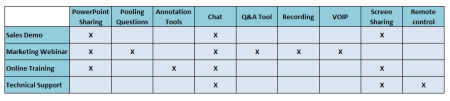
  • Online sales demos and presentations: a sales rep shares a PowerPoint presentation and his desktop screen while walking through a product demonstration.
  • Marketing presentations and educational sessions: usually involving a moderator and a speaker, sharing PowerPoint slides and often making use of polling questions and maybe annotations to engage the audience.
  • Online training: an instructor sharing PowerPoint slides, maybe sharing the desktop screen and using arrows, circles, and other annotation tools to illustrate a point.
  •  Technical support: a technical support representative with a customer on the phone where the customer shares control of his desktop and the rep troubleshoots.

OK, before you tell me that training and tech support are not part of the traditional definition of webinar, please bear with me for a moment and I’ll explain it in time.

Depending on the category, or type, of webinar usage you will be able to list out all the features you need. Each webinar platform has a set of features that can be useful or useless and why pay a premium if you don’t care whether circles can be drawn on the screen? An interesting way of looking at it is by making a grid on a sheet of paper or using a spreadsheet comparing your needs versus the features required.


Sample requirements grid for webinar platform selection

Sample requirements grid for webinar platform selection


Why list technical support and online training? Although often outside the marketing/sales spectrum, there are tools out there that may not only help with webinars but can also help with the needs of the tech support and professional services departments. Why not kill three birds with one stone? So don’t discard them completely until you have spoken to these departments and determined whether they should be included in the requirements grid or not.

2. Choose the appropriate webinar platform

Now that you have listed how you will be using webinars, you’re ready to investigate and fend off vendors. In your first conversation with a vendor, you should list all the uses (maybe even share the grid with them) for the tool you want to buy and ask for a demo showcasing the specific requirements you have. This way you make sure you control the sales process and don’t waste time with a tool that does not have a feature you consider critical.

Some of the most used webinar providers are:

          Microsoft LiveMeeting

          Adobe Connect

          WebEx

          GoToMeeting / GoToWebinar

          On24

          Lotus Sametime

If you do a quick Google search many others will show up, including free ones like:

          Yugma

          Dimdim

The Web Conferencing Council has some good information on webinars and has recently released a whitepaper comparing some of them.

One other thing to consider is the teleconference provider, especially for your marketing webinars that are likely to have dozens of attendees. Some webinar providers have their own conferencing service (GoToMeeting / GoToWebinar offers one for free and Adobe Connect users needs to use Premiere Global for an extra fee), so you should ask the question during your evaluation. The price for phone conferencing will increase the overall costs for your webinars.

3. Put together a well documented webinar process

Now that you have the tools in place, you should think carefully about the procedure to be followed for webinars, especially for the marketing webinars where multiple attendees are involved. Online lead generation events are more effective when there’s a formal procedure that is followed every time, preventing occasional glitches from happening. Thing of the following:

          When should a new session / room / webinar (the terminology varies according to the platform) be reserved?

          How will registrants get login information? Some webinar providers handle this process for you.

          Do polling questions need to be prepared in advance and uploaded?

          Do slides need to be prepared in advance and uploaded?

          Will registrants be contacted by email or phone prior to the webinar to ensure attendance?

          Will the online event be recorded? Should any special steps be taken in this case?

          Should a moderator make opening remarks and help with Questions and Answers?


These are only some of the questions that you should ask yourself as you are setting up your company’s webinar program.

Webinars, webcasts, online events, and whatever other name you have for this can be expertly handled once you know your requirements, have done vendor due diligence, and setup a process that can be followed and standardized.

I hope these simple tips will help you with your webinar initiative!


How Good A Boss Are You Really?

April 9, 2009

If you want to see how you (or your new boss) stack against top technology CEO’s, check out Glassdoor.com for an interesting ranking.

The site not only lists top executives based on approval ratings but also shows you reviews that give you some more specifics of the person, the company, and what it feels like working there. One of the more interesting features is the ability to search for salaries paid at a specific company. Insider information is always good when planning your next career move!