A Buyer Persona Template for the B2B Marketer

May 20, 2011

With the new hype of content creation now making the rounds of webinars, books, and whitepapers another term has regained the spotlight: the buyer persona.

I was reminded once again of the importance of creating buyer personas during Bulldog Solutions event on Marketing Benchmark in which Rob Solomon walked us through their five step process for organizing your marketing programs:

  1. Business Case
  2. Infrastructure
  3. Process Planning
  4. Program Execution
  5. Measurement

While going through each step should be another post entirely, there were a few really good key insights that defined their approach:

  • Establish a goal and structure all your efforts towards it
  • Map your content
  • Measure and share your results

I’m oversimplifying it but without these three key actions your efforts will prove fruitless. When talking about content mapping, the buyer persona discussion emerged and it became clear that what can come across a simple marketing exercise is actually the pillar of your content creation strategy. Afterall, as Stefannie Tilton best said, “You can’t make a connection with your audience unless you know who you’re trying to reach“.

Personas Drive Content Quality

David Meerman Scott argues that one of the benefits of creating buyer personas is that it will force you to create meaningful, easy to digest content that will actually make a difference in the buying process. In his words:

“Truly understanding the market problems that your products and services solve for your buyer personas, you transform your marketing from mere product-specific, ego-centric gobbledygook that only you understand and care about into valuable information people are eager to consume and that they use to make the choice to do business with your organization”

I couldn’t agree more.

Who’s Involved in Creating Personas

During the Bulldog Solutions event, we discuss this issue of how to create one and who should be involved. The agreement was that Sales should be the driver of the creation of the persona, with Marketing only helping the process. This won’t work in all companies, and aguably there might be some pushback to creating personas as a waste of time or it being “just a marketing thing”. Another common problem you might encounter when trying to create Buyer Persona profiles, is that it may be confused with User Persona – something totally different. We, marketers, are concerned with the buyer (we want to influence the purchase) while other departments like Development and Product Management will want to focus on the person actually using the product (a User Persona).

So, from a Buyer Persona standpoint, is only natural that Sales, who is most in touch with the person actually making the buying decision will be front and center in the creation of the profile and it will be a great exercise to align sales and marketing.

Buyer Personas for the B2B Marketer

While buyer personas have a long history (starting to be widely publicized in the early 90’s), what I’ve seen from all the templates that I could find is they are mostly focused on the B2C market adding strong emphasis to demographics, which in the B2B world are not as relevant as say, the person’s title or role in the purchasing process.

Another interesting development that is shaking the B2B space is the increase influence of social media in buying decisions. Buyer Persona Insights makes a good argument when it says that buyers in B2B marketplaces are becoming more social in their interactions.

“B2B buyers today are becoming more social and not just in technology usage but in terms of what the influence of the technology has done to make buyers behave more socially.” – Buyer Persona Insights

Buyer Persona Templates and guides can be easily found on the web, for example:

But don’t just stick with the standard templates, customize them based on your industry, and needs. When you are done, you can then proceed to map out your content to the multiple buyer personas you created. A good way to understand what type of content should be created for each buyer profile has benn outlined by Jeff Ogen on a post “Using Buyer Personas for B2B Marketing“. If you can use the persona you created to answer those questions, your content creation strategy will now have a good framework.

Want another good reason to start working on your buyer personas? According to a Frost&Sullivan Research Report, only 46% of marketers have developed buyer personas, so there are good chances your competition isn’t among them and you can start taking advantage of buyer persona development to improve your content creation. But more importantly, take alook at how Brand Regard improved 3x click-through for their website. They did it, you can too.


B2B Marketers Hold Off on Killing Traditional Media

October 22, 2010

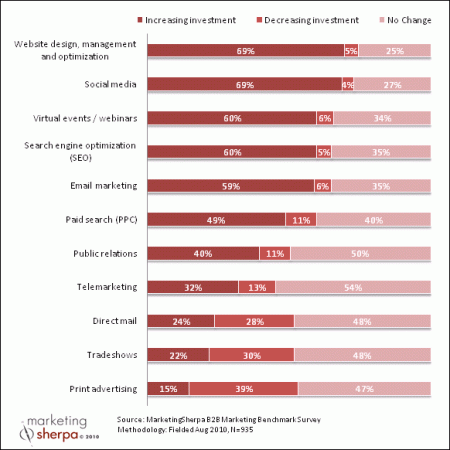
And so from the looks of it, according to the latest chart from MarketingSherpa, traditional marketing venues such as trade shows and advertising are still in play today and will be for the next year. Their latest study points out that “The majority of B2B organizations are increasing marketing budgets for inbound marketing tactics, including social media, virtual events and webinars, SEO and PPC”.

But, more interesting is that the majority of B2B Marketers are not planning on changing their marketing budget allocation for traditional marketing tactics. Also interesting to note that telemarketing as a budget item will also remain a key part of the budget, which shows outbound lead generation is still a strong component of most marketing plans.


B2B Marketing Summit Shows Old Problems Persist

October 14, 2010

So it seems MarketingSherpa’s B2B Summit 2010 is over and from what I read in their wrap up post, the same old problems plaguing marketers for the last 5 years are still here today. First of all, what is this summit? According to their post:

“Last week in San Francisco, 211 business-to-business marketers spent two days sharing insights, case studies and advice on social media marketing, lead generation, Sales and Marketing alignment, and other hot-button issues on the West Coast swing of MarketingSherpa’s seventh annual B2B Marketing Summit.”

MarketingSherpa is known for quality content and I have attended a couple conferences (I was a speaker at the Email Marketing Summit 2008) and have always thought that the best you get from attending an event like this is more in the form of networking than in content itself. The other good thing about going to such a conference for me, is that I get dedicated time to really think through all the topics being discussed, without being interrupted for meetings, phone ringing and people walking in the office.

The many takeaways from this year’s B2B Marketing Summit (West Coast) according to MarketingSherpa, were:

  1. Begin with the end in mind
  2. Put yourself in your customers’ shoes
  3. Getting a lead is just the beginning…
  4. For successful lead generation and nurturing, you need quality content
  5. Use measurements that matter
  6. It all happens on the landing page
  7. Be strategic about presenting your campaigns and your vision to the C-level

None of the takeaways above strike me as particularly new or groundbreaking, but that’s how it always goes. Sometimes we just need to be reminded of the obvious so that we can focus on the essential.


Flip the Funnel Book Review

October 13, 2010

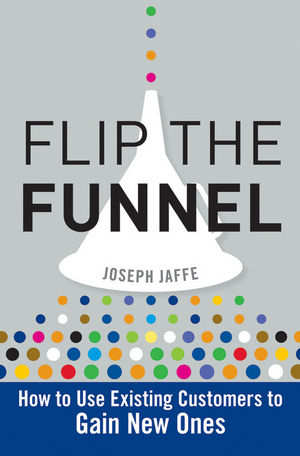
At the San Francisco Marketing Book Club meeting last week we discussed “Flip the Funnel: How to use existing customers to gain new ones“, by Joseph Jaffe. 

What’s the verdict?  Buy the book. OK, now the explanations and caveats.

First, the book talks about the essential function of customer service and how to leverage it with today’s current technologies, including (of course) social media. If you haven’t read much about customer service or if marketing isn’t your background, then the book will be a good starting point. For those that have some experience and background on the topic of excellence in customer service and have read one of the many classic books out there, then a lot of it will be just a review of what has already been said.

My biggest disappointed was that the author used mostly well known examples to illustrate his points. JetBlue, Domino’s, United Airlines, Zappos, and others are cases that we marketers already know. I would have liked to see other companies that he has worked with and are not so obvious and how they implemented his recommendations or how they have failed to recognize the importance of “flipping the funnel”. But then, maybe I’m not the target market for this book.

The other thing to be aware is that Mr. Jaffe is a bit verbose. If you have listened to his podcasts or seen his videos, then you know what I’m talking about. I felt like skipping a few pages just so I could get right to the point. Others may be ok with his style, but it just made it much harder for me to make progress. You should read an excerpt or check it out at the local bookstore to see if you like how he writes before buying the book.

But don’t be fooled, there are some really good ideas in the book:

Where is the money going?

Early in the book he makes the case that we’re spending money on the wrong side of the funnel. “Shouldn’t we be spending money against qualified prospective buyers versus shots in the dark at bagging a random stranger?”. He continues saying “The marketing funnel produces customers – but then does nothing with them.”

How right he is! Why is it we spend all that money and effort into getting people interested just to forget about them once we get the purchase order? There’s gold to be mined in existing customers and the book treats this as the new mantra for marketing. In Jaffe’s words “Keeping, cultivating, and nurturing existing customers and establishing unbreakable bonds with them”.

Segment and Treat Customers Differently

Although the methodology varies based on your industry and whether you are a B2B or B2C company, the big picture is clear. “The more opportunities we give our customers to engage us (as opposed to us engaging them), the more likely they’ll be able to do just that”, and I completely agree. According to Jaffe, we should segment customers into “walkers”, “talkers”, and “hybrid”, and deploy distinct approaches for each one. His new “flipped funnel” approach to doing that is called A.D.I.A (Acknowledgement, Dialogue, Incentivization, and Activation).

The Customer Experience

The whole point of the “new” flipped funnel approach is to create this unique “customer experience”, which means giving customers ways in which they can interact with the brand, and we can interact back with them. Sure, this is not new, but he suggests that “companies need to have an intensive, omnipresent approach to dealing with their customers”. Does this sound like your company? I know, everyone talks about how important the customer is, etc but very few companies really put the necessary resources behind that. The payback, he argues, is that “customers will pay a premium for higher perceived value”, and such value is likely to be how customers are treated. Customer service becomes your product, or better yet, the differentiator between your product and your competitor’s.

Social Media Still Not Treated Seriously

Where I think the book falls short is on the implementation side. It talks about companies having to deploy capabilities across every single customer touchpoint, connecting the dots between the physical and virtual world and giving customer service the strategic value it deserves, but there’s not much in terms of HOW companies are doing that. Although, if the research from MS&L mentioned in the book is correct (one third of companies are not incorporating social media in marketing efforts, and of 63% that were, a full two-thirds had not made changes to products or marketing based on customer feedback), then the problem is actually there aren’t many good examples to follow. Are we entering a new world, travelling a path very few have survived? We’ll see.


In sum, if you’ve already read a few books on the subject, you’re not going to gain anything new but for the novice or uninitiated this book may be just what you need to get your company on the right track to flipping the funnel and gaining new customers.


Making Website Reviews Easy

October 5, 2010

64/365 - mapping by Jenn Vargas @ Flickr

The website is a few years old, there are some inconsistencies in font and the colors don’t match all that well. On top of that, now you have videos you want to showcase and the home page was not designed with that in mind. In sum, the website needs a complete makeover. Sounds familiar?

When reviewing websites and discussing design elements, you invariably end up drawing all over the whiteboard, asking your designer to come up with some mockups and then annotating those and sending them back. How about using some technology to make things easier? I’ve already discussed the use of PowerPoint for website reviews and if you’re starting from scratch it not only provides you with a grate starting point but is a low cost solutions.

For reviewing existing websites, I have used my tablet PC to make screen annotations and save them as images to the team, but what if you have people remote or if you want them to review and add their own comments about the site on their own time?

Below are a few useful tools out there for this problem.

Website Review and Annotation Tools

ShiftSpace.org is an interesting app that gives you the ability to comment on any website using your browser, but others have to have ShiftSpace installed to see them.

Google Sidewiki is an extension for Google Chrome that lets you comment on any website, but falls short on the drawing options (arrows and circles and such).

Diigo allows you to add sticky notes and highlights to websites and share with other people, and they do not have to have diigo installed. Problem is, you can’t draw circles or squares on the site to illustrate changes in the design.

Sharedcopy.com takes a screenshot of a site, let’s you annotate, send to other people, where they can add their own comments to it. Requires users to have the sharecopy bookmark app on their browsers, but works nicely.

Notable is a paid app that gives you great tools for annotations and commenting on any site.

Bounce is my favorite so far, because not only is a free version of Notable, but is the easiest to use. No registrations, no downloads required. Simply go to the Bounce site, enter a URL and start annotating. Then save the comments and share the unique link with your team. If there’s one thing missing is the ability to draw on the page.

Any other tools I have missed?


How Success is Misunderstood

September 29, 2010

How do you define success? Number of leads generated? Amount of sales or deals closed? If you answered “it depends”, then you’re thinking smart. Success can be based on a number of different factors and it also varies based on who you talk to, after all, we all have different objectives (personal and professional).

Now let’s go one step further. If you see another company being successful (however you define success) and you try to apply the same method, can you guarantee you will also achieve success? If you said “it depends”, you just got yourself an extra point! As marketers we all know it’s not that simple. Questions about what the target market is, what industry are you talking about, and such are the first things that come to mind. A method of selling hot-dog on the street can be used to sell software, but I wouldn’t follow it by the letter.

That’s why it still amazes me that discussions about following a formula for success often get stuck in how you define “success” instead of discussing the differences between target markets. If you are a blogger and your readers are software entrepreneurs, you can’t really expect that the bag of tricks used to attract social media consultants will work the same way. A B2B company applying tactics used by B2C companies can be very successful but only after some necessary translation is done.

How do YOU define success and do you have a special formula?


Web Prototyping With PowerPoint

September 27, 2010

Prototyping with PowerpointWebsite re-designs are a common project on the hands of marketers at companies of all sizes. From quick home page makeovers to complete re-design and re-branding,there’s a lot of communication between the marketing team and web developers and designers, a process that involves lots of meetings, the developers spending hours on photoshop mockups that don’t look like what you asked, and a lot of scribbling on paper and on whiteboards.

How can we improve this process? The answer may lie in a tool most people already have… MS PowerPoint!

PowerPoint Prototypes

What I’ve successfully done in the past to help the communication between the marketing team and the designers is to use PowerPoint as a way to visually communicate with the how the new design and functionality will work. Instead of waiting for the designer to come up with a Photoshop or HTML mockup of something that doesn’t resemble what I asked for, the PowerPoint slide can serve as a guideline and visual discussion tool for everyone involved.

Marketers are good at visual communication, but not necessarily experts with the design tools. PowerPoint is something everyone knows how to use, though. So why not take advantage of this free (your company is likely using MS Office suite which comes with PowerPoint) tool and use it for some brainstorming? Mockups or prototypes created w/ PowerPoint are not supposed to replace professional wireframing tools such as Balsamiq, Justinmind, or Sketchflow, but should rather be used to help non-programmers and non-designers communicate their ideas. Plus, if you are discussing elements of the website design with other management team members or the CEO, the ability of quickly changing something on the slide will help you get approval faster.

Although you can make interactive prototypes using PowerPoint, my suggestion is to keep it simple and focus on key elements you’d like to communicate to the designers such as overall layout, placement of objects, and so on. You can get so deep into making sure your animations work if you’re going for a full interactive prototype that it will cost you many hours that will be just thrown away since it won’t be used again.

The key is to keep it nice and clean. A good starting point on how to do this is Travis Isaacs presentation “How to Wireframe Like a Ninja“. It talks about Keynote (a presentation tool for the Mac), but 99% is transferable to PowerPoint.

It also helps if you download something like this PowerPoint Prototyping Toolkit from Long Zheng, which gives you some nice tools you can start using right away.

So what are you waiting for? Start prototyping today! 🙂


The Opposite of Advertising

September 20, 2010

How can a company embark on an branding campaign without prominently displaying its logo? What seems to be the opposite thinking of the advertising school became the winning campaign of Banco Hipotecario, a financial services business based in Argentina.

After becoming the sponsor of Racing Club de Avellaneda, a big soccer team in Argentina, they decided to do something audacious, maybe even heretic in the minds of conservative brand strategists: they decided to NOT put the bank’s logo on the soccer jerseys. Crazy as it seems the whole strategy leveraged the ongoing “Creator of Owners” message Banco Hipotecario was already running (the message focused on showing how the bank was helping people become house owners through their mortgage lending business) and created the slogan “Racing: Duenos de su camistea” (Racing: Owners of their jersey), to show that the bank really cared for the sport and the team they were sponsoring. After being picked up by local media and sports commentators, fans raved about the new jersey.

Banco Hipotecario’s facebook page has over 14,000 fans and was the centerpiece of their second phase of the campaign. They asked fans to vote on a phrase to be printed on the shirt that would evoke how the fans feel about their beloved team. The winning phrase, “Duenos de una passion” (Owners of a passion) received 2,398 votes.

Voting on Racing's new slogan for their jersey

Although it was reported that some fans were against the printing of the phrase (and the choice of phrases themselves) on the shirt, it’s undeniable the level of participation the branding effort generated and how quickly they were able to engage the fans.

Sometimes going against established “best practices” may pay off.

Sources for more info on this story are:

Creativity Online article, F*ck Smaller. Make the Logo Disappear.

Marca del Gol post, Second Phase of Invisible Advertising (in spanish).

Communicate Good blog post, Invisible Branding.

Marketing News article, Marketing Across the Americas (requires login).


Marketing Content That Sells

August 30, 2010

When talking with lead nurturing and marketing automation vendors they all make it seem very easy.

You setup a campaign, define the nurturing stages, and even add some points to different interactions to score the lead and customize the nurturing experience. Then with all the triggers in place, sit back and watch the software do the job of sending the right message to the right prospect at the right time. Wow, it’s magical!

Yes, except for one little detail. Who’s going to write all that new content? Do you have the staff to do it? Will you have to outsource? Do you even know what kind of content you need for each nurturing stage? Yup, it is more complicated when you get to the implementation phase of the program, and that’s where most companies fail.

But why the focus on content? David Meerman Scott, in his book The New Rules of Marketing and PR points out that creating quality content is the new imperative:

“The tools of the marketing and PR trade have changed. The skills that worked offline to help you buy or beg or bug your way in are the skills of interruption and coercion. Online success comes from thinking like a journalist and a thought leader”.

You’d think that everyone would be doing it by now, but that’s not the case.

I recently finished reading Trust Agents, by @chrisbrogan and @julien, who approach this subject by saying:

“The difficulty in creating content that will get a recommendation, the one that most companies tend to get wrong, is that they don’t think creatively about how their content can be exciting to the average population”.

Ha! That reminds me of what I see when I visit most B2B companies’ websites.

We have all been there. You are researching a new product or service and Google points you to a website, one of the key vendors in that space, and you have to read the page twice to really get it what they are trying to say. How is it that your product or service will benefit me? What is that acronym you keep using? How do I get in touch with someone who can explain all of this? In the B2B marketing space this is notorious. Go to a trade show and the situation gets really bad. Trade show booths with slogans and taglines that don’t mean anything and sales brochures that are full of “features” and screenshots but lack detail of how they solve a problem.

While I still struggle to write good content, I did find some useful resources online that I hope will also help you out.

The resources above are a great start. The key ideas that seem to be present across them all are:

  • Buyer persona is key for content generation
  • Guest writers (employees, competitors, etc.) can help tremendously especially if you can’t dedicate a resource full time for the content writing job
  • Lists seem to be a favorite item on the web and a great way to get more viewers, just figure out what topic should your list cover
  • Content reuse, multiple formats for the content is a nice way of creating lots of content without having to come up with new ideas all the time (formats include webinar, recording, eBook, blog post, etc.)
  • Time the content for the right stage in the buying cycle / lead nurturing process – this is the most difficult, because it requires you to really know your customers and prospects

What has been your main challenge with content marketing?


The Ghost Blogging Debate Done Right

August 23, 2010

If there is a discussion that will never die is the Ghost Blogging debate. I recently listened to the best arguments both in favor and in opposition of ghost blogging via a Six Pixels of Separation podcast, expertly conducted by Mitch Joel who discussed the issue with Mark W. Schaefer, another excellent blogger and marketer.

Here’s the link to the podcast SPOS#214, it’s worth listening to. Then, check out Mitch’s blog Ghost Blogging And Last Rites for some additional insight and great comments by readers.